Gyeonggi Museum of Modern Art Explores Asian Colonialism and Labor in New Special Exhibition
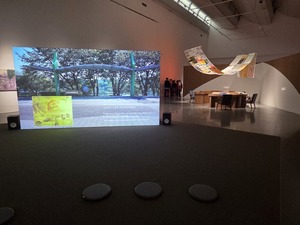
Thirty works by 14 artists and teams from eight Asian nations trace colonial legacies, state power, and human movement at the Gyeonggi Museum of Modern Art’s 20th-anniversary special exhibition, incheonilbo.com reported.
The exhibition features 30 works across diverse media along with four new works.
The exhibition, titled “Doing Love and Labor in Asia,” draws its conceptual framework from poet Kim Hye-soon’s work “Doing Female Beast Asia.” The collection spans video, installation, photography, painting, and sound across varied regional histories.
Colonial supply routes, shifting economic geographies, and erased historical records connect the works on display. The exhibition treats Asia as an intersecting site of distinct places and pasts.
“Reflecting on the histories left behind past empires and colonial periods evokes our common history in Asia,” the reporting said, pointing to human connection through love and labor.
Malaysian artist Marcos Cue links Borneo weaving traditions with industrial production in his installation.
“’Neglected’ is a shipwreck landscape made of giant masts and sails,” incheonilbo.com reported.
Cue connects the wreckage to his grandfather, who fled China during the Japanese occupation and never returned home. His pieces “Hope and Fear” and “Love, Labor, Loneliness” also examine the relationship between embroidery and labor while searching for hope amid generation and destruction.
Korean artist Jang Bo-yun explores the gap between memory and record through the life of her mother, a former nurse sent to Germany.
“Through the ‘Black Veil’ and ‘Maybe It Was a Scene’ series, she explores the lives of migrant laborers and the memories accumulated within them,” incheonilbo.com reported.
Her mother’s traces in Hamburg remained elusive, mirroring the unresolved mysteries of Nathaniel Hawthorne’s fiction.
Korean artist Noh Won-hee displays four paintings examining everyday life amid rapid urban development.
“’Don’t Cry’, ‘Time to Leave the Park’, ‘Do Your Best’, and ‘People Eating Ramen’ capture ordinary people against dim backgrounds, portraying the sorrows of reality and survival,” incheonilbo.com reported.
Indonesian artist Bagus Pandega turns his focus to industrial supply chains and environmental loss.
“Bagus Pandega presents sound using machinery, plants, and raw nickel in ‘L.O.O.P (Loss Lush Organic Oscillation)’ and ‘Swra Sirna’,” incheonilbo.com reported.
The nickel movement across a mechanical setup symbolizes resource exploitation in Indonesia and connects back to modern electric vehicle batteries.
Public artist talks are scheduled alongside the exhibition.
The first round of artist talks featuring Kim Young-eun, Jang Bo-yun, and Yagwang is scheduled for the 28th.
A second round of talks featuring Noh Won-hee and Ikkiwirikuru is scheduled for December 5.
“The exhibition continues until February 14 next year,” incheonilbo.com reported.