Gut Microbiome and Tryptophan Metabolism in Parkinson’s Disease
Parkinson’s disease affects almost 11 million people globally, a figure predicted to double, according to findings. While classical neurology has long defined the condition primarily as a motor disorder rooted in the degeneration of dopaminergic neurons in the substantia nigra pars compacta, recent clinical investigations point toward a broader systemic pathology originating in the gastrointestinal tract.
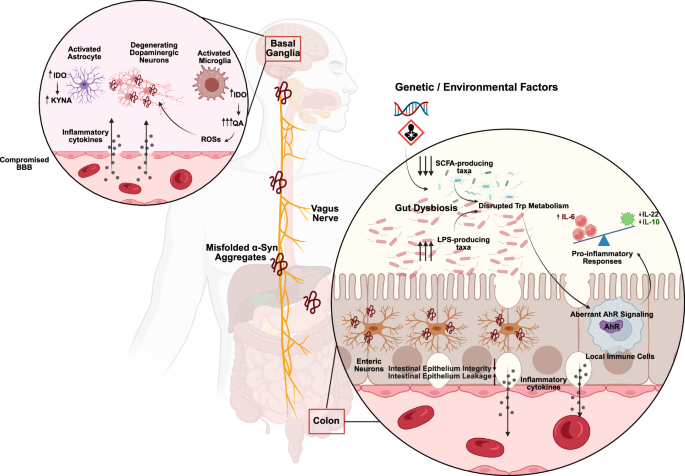
- Research identifies gut dysbiosis and disrupted tryptophan metabolism as drivers of Parkinson’s disease pathology through the gut-brain axis.
- A parallel regional study of South Indian patients in Kerala, published in npj Parkinson’s Disease, highlights elevated levels of pro-inflammatory microbes such as Akkermansia and Escherichia-Shigella.
- The aryl hydrocarbon receptor acts as a molecular bridge between microbial metabolites, intestinal barrier integrity, and immune signaling.
Microbial Shifts and Pro-Inflammatory Signatures in South Indian Cohorts
Expanding on regional microbiome variations, a separate study published in npj Parkinson’s Disease examined patients in Kerala, India, to map population-specific gut microbial compositions. Researchers utilized 16S rRNA gene amplicon sequencing to contrast the microbiome profiles of Parkinson’s disease patients against healthy controls. The investigation revealed distinct taxonomic differences, showing higher relative abundances of Akkermansia, Bifidobacterium, Escherichia-Shigella, Collinsella, an unclassified Eggerthellaceae genus, an unclassified Enterobacterales group, and Intestinimonas in the patient cohort.
The authors of the Kerala study noted that these taxa correlate with heightened inflammatory pathways and a concurrent reduction in anti-inflammatory microbial groups. Because gut microbial communities vary geographically, local evidence remains essential for evaluating proposed links between microbiota and neurodegeneration. However, the study identifies associations rather than establishing a direct causal mechanism, pointing to the necessity for larger investigations incorporating metabolomics and metagenomics.

Tryptophan Metabolism Disrupts Gut Barrier Integrity
At the center of this gut-brain communication lies the metabolism of the essential amino acid tryptophan. Tryptophan breaks down via three primary pathways: the serotonin, kynurenine, and indole routes. Microbial enzymes transform tryptophan into various indole derivatives that serve as ligands for the aryl hydrocarbon receptor.
These disruptions compromise gut barrier integrity, permitting local inflammation and the pathological misfolding of alpha-synuclein proteins within enteric dopaminergic neurons.
Aryl Hydrocarbon Receptor Modulates Target Gene Transcription
The aryl hydrocarbon receptor functions as a ligand-activated transcription factor belonging to the basic helix-loop-helix-PAS superfamily. In its inactive state, the receptor resides in a cytoplasmic chaperone complex containing heat shock protein 90. When bound by microbial or endogenous tryptophan metabolites, the receptor undergoes structural conformation changes, translocates to the nucleus, and heterodimerizes with the aryl hydrocarbon receptor nuclear translocator to modulate target gene transcription.
Misfolded alpha-synuclein aggregates can spread from the gastrointestinal tract to the central nervous system via the vagus nerve in a prion-like manner. This gut-first hypothesis helps explain why non-motor symptoms such as constipation, loss of sense of smell, and sleep disorders frequently precede classical motor impairments like resting tremors, bradykinesia, and muscle stiffness.
Disclaimer: The information provided in this article is for educational and scientific communication purposes only and does not constitute medical advice. Always consult with a qualified healthcare provider regarding any medical condition, diagnosis, or treatment plan.