
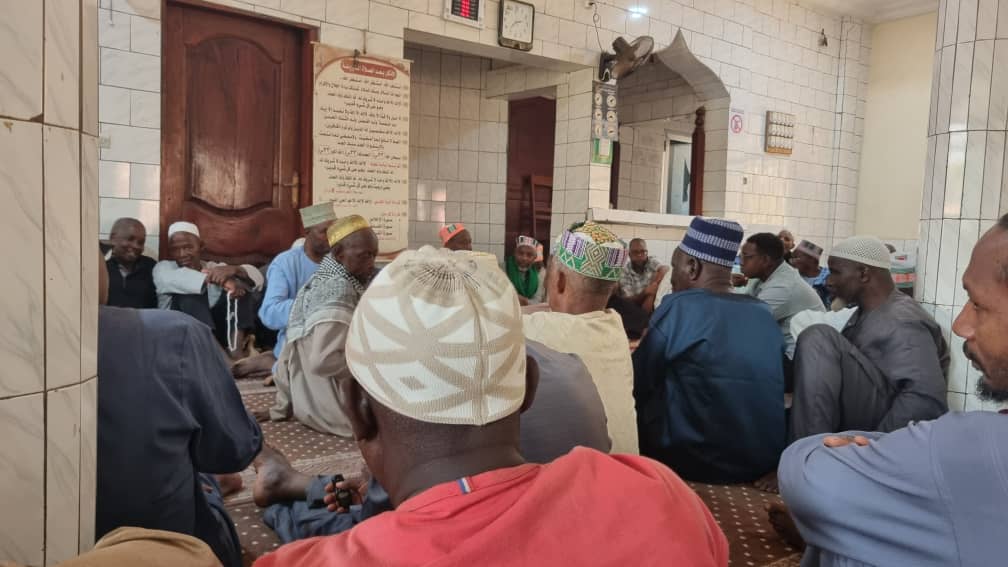
CONAKRY – A latest official document is now being issued to newly married couples alongside religious ceremonies in mosques across Guinea, including in the capital, Conakry. The form, which costs 100,000 Guinean francs, has sparked debate over its legal standing compared to a civil marriage certificate.
At the Kiroti mosque in the Lambanyi commune, Mamadou Saliou Baldé is responsible for distributing the document. “For several years, we have had this document available at our mosque,” Baldé explained. “With each celebration, we supply it to the couple for 100,000 GNF. The mosque retains this amount. The form comes from the Ministry of Territorial Administration and Decentralization, in collaboration with the Ministry of Religious Affairs. Those who fill it out can offer to pay for a pen, but it’s not required,” he said.
According to Baldé, the form includes sections for the groom, the bride, and witnesses, all of whom are required to sign. “The document is authenticated and can be used in certain specific cases,” he added.
Moussa Khan, who celebrated his marriage last Sunday, only learned of the document on his wedding day. “Personally, I was unaware of its existence. I was informed that I needed to obtain it, so I paid the 100,000 GNF. I haven’t filled it out yet, as I was advised to return with my wife to avoid any errors, given that it might be useful for future procedures,” he explained.
Boubacar Diallo, married since 2025, views the religious document as merely a preliminary step. “I received the document at the mosque, but that didn’t stop me from going to the town hall to obtain a civil marriage certificate. It’s the document issued by the commune that I use for all my official procedures,” he testified.
Legal expert Kalil Camara clarified the situation, referencing Law 0020/2023. While the law allows for marriages to be celebrated in places of worship by authorized religious authorities, Camara stated that this provision is not yet fully implemented. “The implementing regulations are still missing, as is the accreditation of places of worship and religious authorities. Currently, only the celebration performed by a civil registrar is legally recognized,” he explained.
Camara emphasized that Guinean law sets strict requirements for marriage: a minimum age of 18, free and informed consent, and the differing sexes of the couple. He also noted that prior publication of banns and adherence to legal deadlines are mandatory, and that opposition to the marriage can prevent its celebration.
According to Camara, even when the reforms are fully operational, religious authorities will only issue a declaratory certificate. “It’s based on this certificate that the civil registrar will establish the marriage certificate and family record book. According to the Civil Code, only the document drawn up by the civil registrar constitutes legal proof of marriage,” he insisted. A religious ceremony may eliminate the need for a separate civil ceremony, but does not negate the need for administrative registration.
A source within the General Secretariat of Religious Affairs confirmed the document’s origin as a collaborative effort with the Ministry of Territorial Administration. “The management of mayors and civil registrars falls under Territorial Administration. This document was developed jointly. As for the 100,000 GNF, we do not manage that financial aspect. If future spouses agree to pay, it does not pose a particular problem,” the source stated.
On February 19, 2026, the National Program for Administrative Census with a Civil Status Vocation (PN-RAVEC) announced a large-scale deployment of new civil status tools throughout the country. A key innovation is the “Declaration Booklet” for marriage, which is intended to become the new standard. Simple mosque documents will no longer suffice. This new booklet will serve as the essential declaratory act to establish the legal link, a mandatory prerequisite for obtaining an official marriage certificate. This reform aims to clarify the legal value of religious marriage in Guinea and end the ambiguity surrounding current delivery fees.
