
Nation Rushes Nutrition Hubs Amidst Delays
Government Aims for 1,542 New Service Units by Year-End
A nationwide push to expand nutritional access is underway, with the government targeting the completion of 1,542 new Nutrition Fulfillment Service Units (SPPGs) by December 2025. The initiative, spearheaded by the National Nutrition Agency (Badan Gizi Nasional), prioritizes underserved regions, including remote and underdeveloped areas.
Targeting Vulnerable Communities
The National Nutrition Agency, under the leadership of **Dadan Hindayana**, has already established 25,000 units through various partnerships and plans to deploy an additional 6,000 to the nation’s most remote territories (3T regions). Currently, 3,233 active units are serving 8.2 million beneficiaries.
“We initially aimed for completion by August, but legal and land procurement issues have caused delays,” stated **Dadan Hindayana**, Head of the National Nutrition Agency, highlighting the critical need for accelerated progress.
To achieve its goal, each regency is expected to host at least three new SPPGs. Areas where travel to existing facilities exceeds 30 minutes are automatically prioritized for new development, irrespective of the expected number of recipients.
Infrastructure Challenges and Solutions
The agency has earmarked Rp6 trillion (US$374 million) solely for infrastructure development, excluding equipment costs. However, construction has not yet commenced due to regulatory hurdles and outstanding land use agreements.
Dadan Hindayana is requesting assistance from the Ministry of Public Works to expedite land processing and fund implementation. The revised target is to complete construction by October and serve all 8.2 million beneficiaries by December.
Collaborative Construction Models
The expansion will employ two primary models: partner-built facilities, where non-government entities cover construction costs and receive government incentives for operations, and state-funded units, financed by the state budget (APBN). The latter will involve fixed management fees for local implementing partners, including community groups.
“This is a continuation of our current system. We will provide formal mandates to community groups to manage the state-built facilities with support from 47 trained volunteers,” **Dadan Hindayana** explained.
Ministry of Public Works Pledges Support
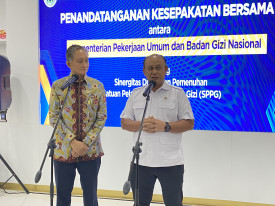
Minister of Public Works, **Dody Hanggodo**, expressed confidence in his ministry’s capacity, referencing past experience in constructing public learning centers. “Compared to Sekolah Rakyat, these buildings are smaller, just 800 to 1,000 square meters which makes them easier and faster to build,” **Dody Hanggodo** noted.
The primary obstacle identified is land availability, which remains under the purview of regional governments. The Ministry of Public Works plans to collaborate with the Ministry of Home Affairs to initiate high-level discussions with provincial and local officials to surmount these challenges.
A joint task force is being established to assess the suitability of proposed sites, examining factors such as land quality, water access, sanitation, and existing infrastructure. “Insya Allah (God willing), construction will begin soon,” **Dody Hanggodo** added.
These efforts are part of a broader government strategy to combat malnutrition and bolster food security, particularly in vulnerable communities. Globally, food insecurity remains a significant challenge, with the World Food Programme reporting that over 783 million people faced chronic hunger in 2023 (World Food Programme 2023).
