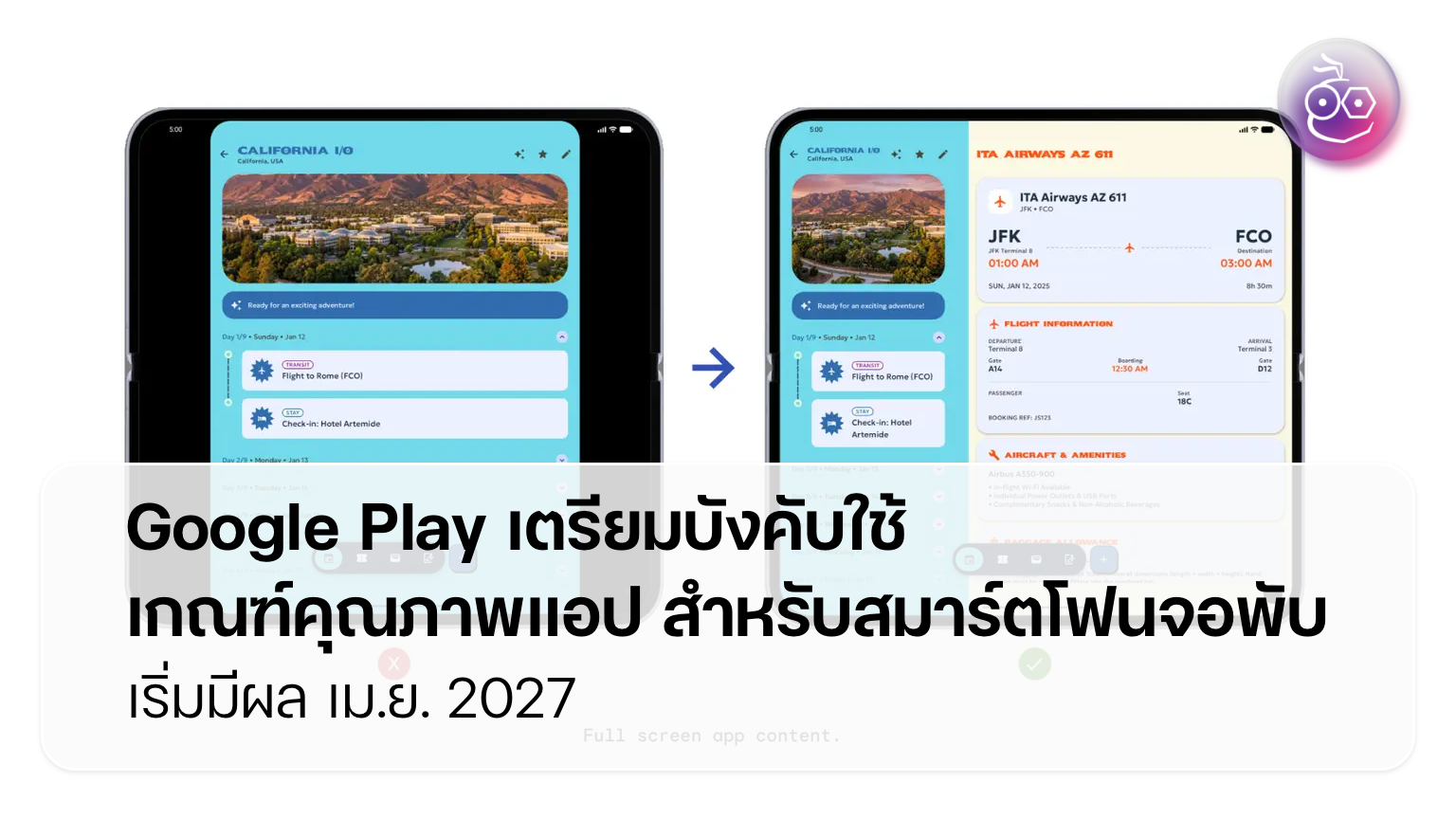
Google Play to Mandate Adaptive App Quality Standards for Foldables by April 2027
Google Play is tightening the rules for foldable Android apps: from April 2027, any app that ships on the store must meet Tier 3 of Android’s adaptive app quality guidelines for foldable screens, and apps that miss the bar could lose the right to publish updates and drop down the store’s rankings, iMoD reported.
Google confirmed the deadline and its consequences in developer guidance. Non-compliant apps will “no longer be able to publish or update on Google Play, and may have reduced visibility on the store.”
The requirement targets the most visible failure of foldable software: apps that letterbox, or refuse to fill the wider inner display when a phone is opened. Tier 3, which Google calls the “Adaptive ready” baseline, requires apps to fill the entire screen without compatibility modes, to preserve scroll position, text input and media playback through rotation, resizing and folding or unfolding, and to work in multi-window environments, 9to5Google reported.
Developers who clear the floor get something to aim at above it. Apps meeting Tier 2 or Tier 1 will be eligible for “premier store badging, editorial spotlighting, and enhanced merchandising across Google Play,” 9to5Google reported. Games follow a separate clock: their Tier 3 large-screen quality bar takes effect in August 2027, two months after apps, though game listings must carry foldable screenshots by April 2027 alongside everything else, iMoD reported.

Screenshots become a submission requirement
From April 2027, any new app or store-listing update must include three foldable screenshots on top of the two standard phone screenshots, iMoD reported. The technical specifics are precise, and fonearena laid them out: devices such as the Samsung Galaxy Z Fold8 Ultra and Google Pixel 11 Pro Fold have 1:1 inner displays, so at least one screenshot must show the unfolded screen at that ratio.
Devices with 4:3 inner displays, like the Galaxy Z Fold8, need an unfolded shot at 4:3 plus a portrait shot of the folded outer display at 10:16.
| Device type | Required screenshots | Examples |
|---|---|---|
| Standard phone (landscape optional) | 9:16 portrait; 16:9 landscape optional | Galaxy S26, Pixel 11 Pro |
| 1:1 inner display | At least one unfolded screenshot at 1:1 | Galaxy Z Fold8 Ultra, Pixel 11 Pro Fold |
| 4:3 inner display | One unfolded 4:3; one folded 10:16 portrait | Galaxy Z Fold8 |
Existing apps that never get updated will keep working as before and remain downloadable after the deadline, iMoD reported. The screenshots can be captured on physical devices or in the Android Emulator, which fonearena noted Google has confirmed satisfies the Play Console requirements.
Where the tiers go next
Three tiers now define Android’s adaptive quality framework. Tier 2, “Adaptive optimized,” evaluates responsive multi-pane layouts, unstretched interface elements, and basic external keyboard, mouse, trackpad and stylus support across large screens. Tier 1, “Adaptive differentiated,” covers tabletop and book postures, camera continuity, interactive picture-in-picture and multi-instance support for media and reading apps, fonearena reported.
For games, the top tier sets performance targets: sustained 60 FPS playback, 120 FPS on supported displays, thermal and battery stability across long unfolded sessions, and dynamic resolution scaling between the inner and cover screens, according to 9to5Google.
The framework will not stop at foldables. Google says the quality bar will “progressively expand to incorporate Tier 2 and Tier 1 standards across foldables, tablets, Googlebooks, and Android XR,” fonearena reported. The Android ecosystem already counts more than 580 million large-screen devices, a category that spans Amazon’s Alexa tablets, Googlebook laptops and Android XR hardware such as the XREAL Aura.
Google recommends developers build adaptive layouts with modern toolkits such as Jetpack Compose, use design guidelines and Figma templates, and test on physical devices, emulators, or devices hosted through Android’s remote services, according to fonearena.
What remains unstated is the pace. Google has set a date for Tier 3 but no timetable for when Tier 2 or Tier 1 will stop being optional, and the developer guidance making that timeline public does not say. Apps that clear the April 2027 bar get a badge; the ones that don’t have until April 2027 to find out what visibility on the store actually costs.
- QualSynth Uses Deterministic Validation for LLM Minority-Class Oversampling
- iCloud Photos Is a Synchronised Repository, Not a Backup: Security Boundaries and Deletion Risks
- Christian de Looper Argues Sony XM4C Delivers Refined Sound Quality (newsdirectory3.com)
- Google Reportedly Rejects UK Government Request to Remove Brand Video (newsy-today.com)