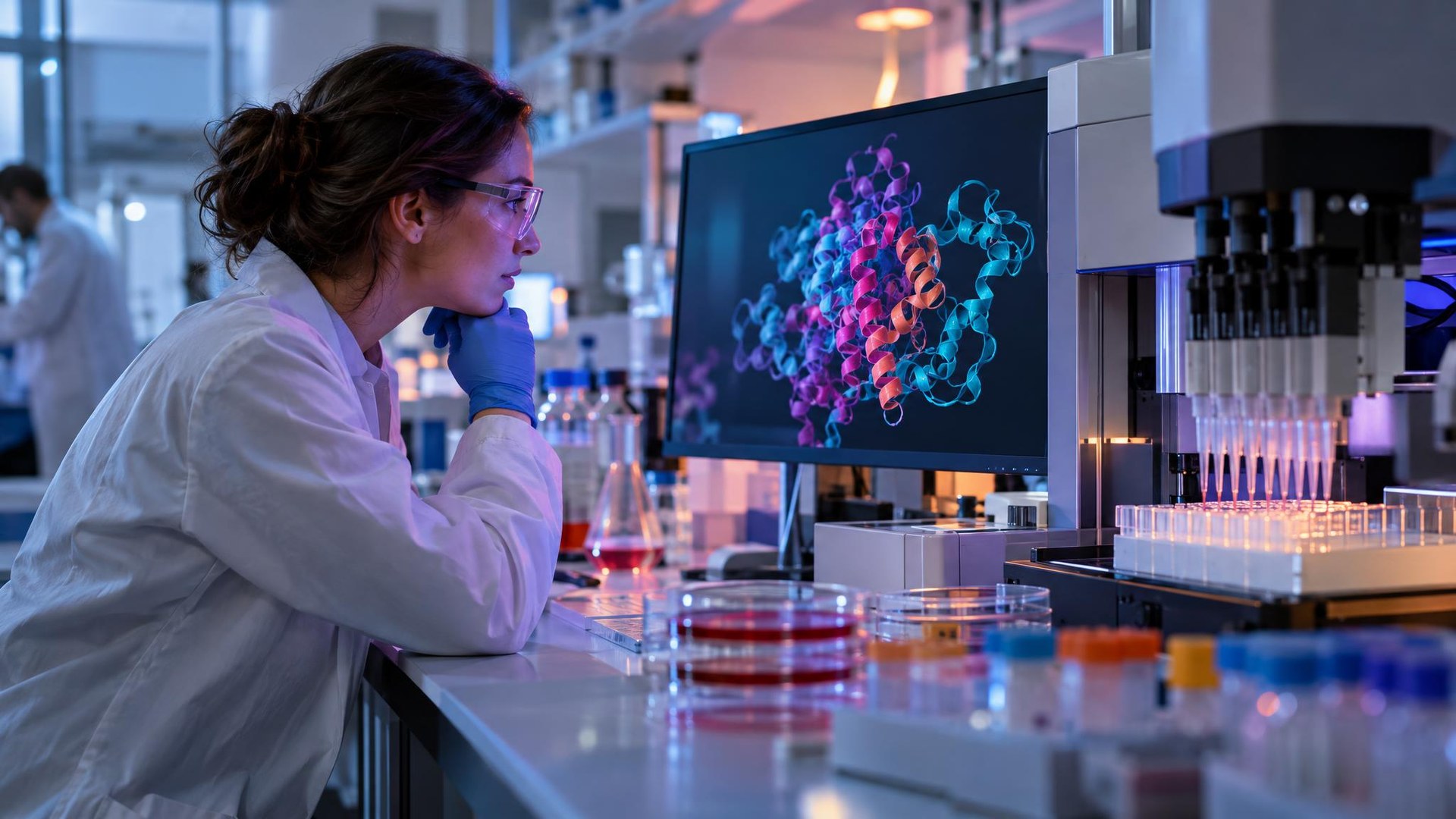
Google DeepMind Uses Antigravity Agent Platform to Discover Novel Antimicrobial Peptide
Google DeepMind Uses Antigravity Agent to Target Antimicrobial Resistance
Rising antimicrobial resistance could result in an estimated 10 million annual deaths globally by 2050, according to Google DeepMind. To address this crisis, researchers on October 15, 2026, published a technical walkthrough detailing how they used Google Antigravity, an agentic development platform, to identify a novel antimicrobial peptide candidate in Streptococcus pseudopneumoniae.
The Tech TL;DR:
- Google DeepMind demonstrated an agentic science workflow on October 15, 2026, using the Antigravity platform and the Gemini 3.8 Flash model to discover a potential bacteriocin.
- The computational pipeline identified a 97-amino-acid peptide from Streptococcus pseudopneumoniae (UniProt ID A0A0U0D591) using ProtNLM and structural verification tools.
- While structural and genomic analyses indicate a biologically plausible defense mechanism, experimental wet-lab validation remains required to confirm actual antimicrobial activity.
Agent Identifies Novel Antimicrobial Peptide in UniProt
The discovery pipeline began when researchers and the Antigravity agent addressed a specific biological objective: locating novel antimicrobial peptides within Streptococcus pseudopneumoniae. According to the technical post authored by Pengfei Tian, Maxwell L. Bileschi, Zoi Tsangalidou, Sukhdeep Singh, and Lucy J. Colwell, the agent queried UniProt databases and narrowed millions of entries down to a focused shortlist. This process surfaced a bacteriocin designated as UniProt ID A0A0U0D591, which measures 97 amino acids in length and belongs to the Lactococcin 972 family.
To establish novelty, the agent ran a BLAST search against manually reviewed Swiss-Prot sequences. According to DeepMind’s documentation, this check confirmed the absence of any meaningful sequence homolog among manually reviewed proteins.
AlphaFold and Foldseek Validate Candidate Structural Model
Following the initial sequence filtering, the agent retrieved the candidate’s predicted 3D structural model from the AlphaFold Protein Structure Database. It then executed a Foldseek search to identify remote structural relatives and superimposed the models to evaluate geometric similarity. The resulting structural alignment showed that the candidate’s fold closely matched an experimentally determined bacteriocin, reinforcing the functional predictions generated by ProtNLM, a deep learning model trained to predict biological function directly from raw amino acid sequences.
Genomic inspection provided further contextual evidence. The agent located the candidate sequence sitting six base pairs upstream of an operon containing an ABC transporter permease and its partner ATP-binding protein, alongside an annotated bacteriocin and an XRE transcriptional regulator. DeepMind characterized this arrangement as a strong indicator of a working bacteriocin system. Antigravity also introduced an embedded Biomolecular Structure Viewer, enabling scientists and the agent to share a unified 3D workspace where notes can be pinned directly to binding pockets.
Transitioning to Bench Protocols and Open Access
Having synthesized the genomic and structural data, the agent proposed a mechanism of action targeting bacterial division alongside a predicted potency spectrum against drug-resistant pathogens. The agent subsequently translated these computational findings into a structured bench protocol covering protein expression, antimicrobial susceptibility testing, target engagement, and in vitro toxicity testing. DeepMind emphasized that despite the comprehensive in silico evidence, the candidate requires empirical wet-lab validation.
The platform integrates plugins for over 30 life-science databases, including the 1PB AlphaGenome Atlas, PubChem, and ChEMBL. Developers and researchers can access open-source customizations via GitHub while deploying the workbench across macOS, Windows, Linux, and Googlebook environments.
# Example cURL request pattern for querying life-science database APIs
curl -X POST "https://api.deepmind-antigravity.internal/v1/science/query"
  -H "Authorization: Bearer $ANTIGRAVITY_API_KEY"
  -H "Content-Type: application/json"
  -d '{
    "target_organism": "Streptococcus pseudopneumoniae",
    "model": "gemini-3.8-flash",
    "databases": ["UniProt", "AlphaFold", "ChEMBL"]
  }'
Disclaimer: The technical analyses and security protocols detailed in this article are for informational purposes only. Always consult with certified IT and cybersecurity professionals before altering enterprise networks or handling sensitive data.