
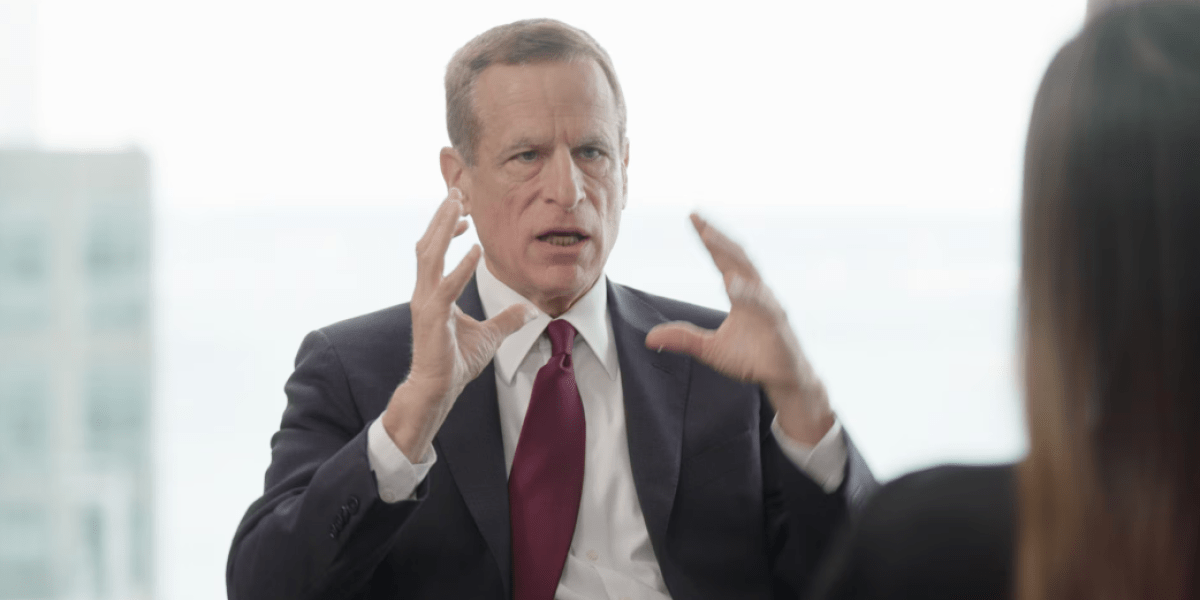
Goldman Sachs Vice Chairman Rob Kaplan is warning ambitious professionals that reaching the highest levels of corporate leadership can trigger a surprising and often debilitating challenge: a sudden absence of critical oversight. The phenomenon, Kaplan explains, can lead to previously high-performing executives hitting a wall after years of success.
“When you’re junior, you’ve got senior people watching everything you do,” Kaplan said during a recent masterclass conversation with Meena Flynn, Goldman’s chair of Global Private Wealth Management. He elaborated that this dynamic fundamentally shifts as executives ascend the corporate ladder. “As you obtain more senior and you get promoted, pretty soon the bosses are no longer watching you. The only people watching you are your subordinates.”
This lack of upward feedback, Kaplan argues, creates a breeding ground for failure. He stated he has spent the last two decades observing a pattern of successful individuals faltering after reaching senior management positions. Kaplan, who has held leadership roles at Goldman Sachs, Harvard Business School, and the Federal Reserve Bank of Dallas, identifies a combination of factors contributing to this decline: isolation, blind spots, an inability to learn from mistakes, and a weakening of professional relationships.
Kaplan’s return to Goldman Sachs in 2024 was highlighted by CEO David Solomon, who emphasized Kaplan’s “wealth of knowledge, deep relationships and significant global leadership expertise,” according to a company statement. His current role focuses on mentoring, leadership development, and shaping the firm’s culture, reflecting a proactive approach to addressing the challenges facing senior leaders.
A core issue, Kaplan stresses, is the prevalence of unrecognized “blind spots.” He explained to Flynn that everyone possesses areas where their self-awareness is lacking, and these are often invisible to the individuals themselves. If left unaddressed, these blind spots can lead to leaders becoming increasingly isolated and creating an environment where subordinates are hesitant to offer constructive criticism.
Kaplan advocates for a counterintuitive solution: actively cultivating subordinates as coaches. He acknowledges that some executives may fear this approach will project weakness, but argues that strong leaders should actively seek advice from those who observe their behavior most closely. “You seek to encourage an atmosphere of debate, disagreement. You want to encourage people to tell you when you’ve done something that they don’t agree with,” he said.
He cautions against leaders who merely solicit feedback but then dismiss or rebut it immediately. Kaplan recommends a practical step for senior leaders: conducting three to four “skip level” meetings each week. These 30-minute one-on-one sessions should be used to gather information, assess employee morale, and solicit advice on areas where the company is falling short. “You don’t have to always act on it, but the fact you listened makes people feel included and empowers them,” he explained, fostering a sense of shared ownership.
Another common pitfall for newly promoted senior leaders is an overreliance on past successes. Kaplan warns against the assumption that “whatever got me here is what I’m going to keep doing.” Instead, he emphasizes the need for leaders to continually assess their situation and adapt their leadership style accordingly.
Leaders must also be mindful of the behaviors they model, as subordinates increasingly base their actions on observed behavior rather than explicit instructions. Kaplan illustrates this point with an example: “If you say you want teamwork but you keep promoting producers who have sharp elbows and are not teamwork oriented, [your team will respond] ‘Okay, I get it. You don’t really believe in teamwork; you believe in production.’”
Kaplan also points to the internal “failure narrative” that can undermine senior leaders—a self-defeating internal monologue that whispers doubts and insecurities during challenging times. He suggests processing these insecurities with a trusted confidant. He also stresses the importance of defining clear priorities, but doing so in collaboration with the team to ensure buy-in and minimize disruptive course corrections.
Kaplan rejects the notion that leadership is an innate quality based on charisma or charm. “My best advice is leadership is something you have to work at,” he said, emphasizing the need for continuous learning, curiosity, and resilience. He suggests that when facing overwhelming pressure, leaders should focus on helping others—colleagues, clients, or members of the community—as a way to regain perspective.
