
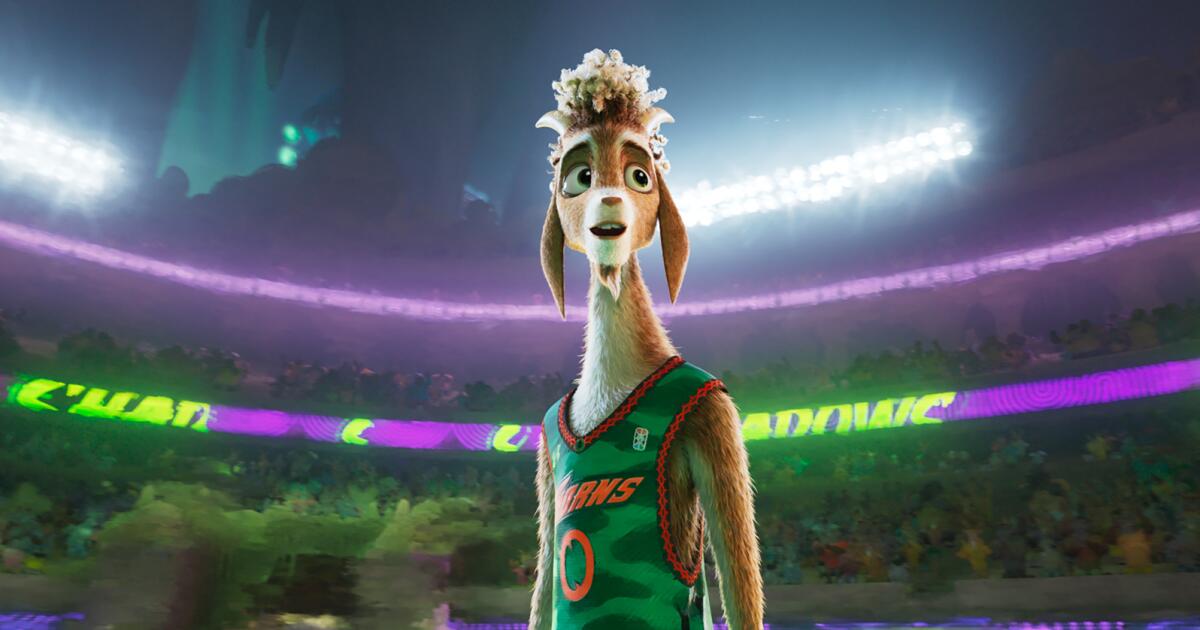
“Goat,” a new animated sports comedy from Sony Pictures Releasing, debuted in theaters Friday, February 13, 2026, following an early access screening on February 7th. The film, directed by TV animation veteran Tyree Dillihay and starring Caleb McLaughlin, Gabrielle Union, and Aaron Pierre, centers on an underdog story within the world of “roarball,” a basketball-like sport populated by anthropomorphic animals.
The film follows Will Harris, a young goat voiced by McLaughlin, who dreams of playing for his hometown team, the Vineland Thorns. His idol is Jett Fillmore, the Thorns’ star player, voiced by Union. According to a review in the Los Angeles Times, the film’s narrative follows a “by-the-numbers sports movie” formula. Will, considered “tiny” by professional roarball standards despite his passion for the game, gains attention after challenging Mane Attraction (Aaron Pierre), a significantly larger star player.
“Goat” boasts an extensive voice cast, including Nicola Coughlan, David Harbour, Nick Kroll, Jenifer Lewis, Patton Oswalt, Jelly Roll, Jennifer Hudson, Sherry Cola, Eduardo Franco, Andrew Santino, Bobby Lee, and, notably, Stephen Curry, who produced the film and voices a giraffe character. Curry’s involvement stems from his position as a Golden State Warriors prodigy, bringing a personal connection to the sports theme. The film’s budget reportedly fell between $80 and $90 million, according to Wikipedia.
The world of “roarball” depicted in “Goat” distinguishes itself from other animated animal universes, such as “Zootopia,” by avoiding divisions based on predator and prey. Instead, the film focuses on a distinction between “smalls” and “bigs,” with Will’s journey challenging preconceived notions about size and ability. The Los Angeles Times review notes that the sport itself is inclusive, lacking gendered teams or species-based discrimination, with any prejudice stemming from public perception rather than formal rules.
Visually, “Goat” aims for a vibrant aesthetic, building on Sony Pictures Animation’s previous successes with “Spider-Man: Into the Spider-Verse,” which combined 3D CGI with traditional hand-drawn animation. The film’s environments blend natural elements with urban settings, creating unique backdrops for the roarball games, including a volcanic landscape for the finale. But, the Los Angeles Times review suggests that although visually appealing, this aesthetic doesn’t fully compensate for the film’s predictable storyline.
The film incorporates contemporary cultural references, including internet memes and crypto, in an attempt to appeal to a wider audience. The review also points to allusions to sports culture, such as press conferences and kiss cams. Despite these efforts, the review characterizes the film as a “sugar rush without much substance,” lacking the nuance found in other animated projects like “Zootopia” or the pure entertainment value of the “Sing” movies.
As of Friday, February 13th, box office numbers reported by Wikipedia demonstrate a modest $30,210 in earnings.
