
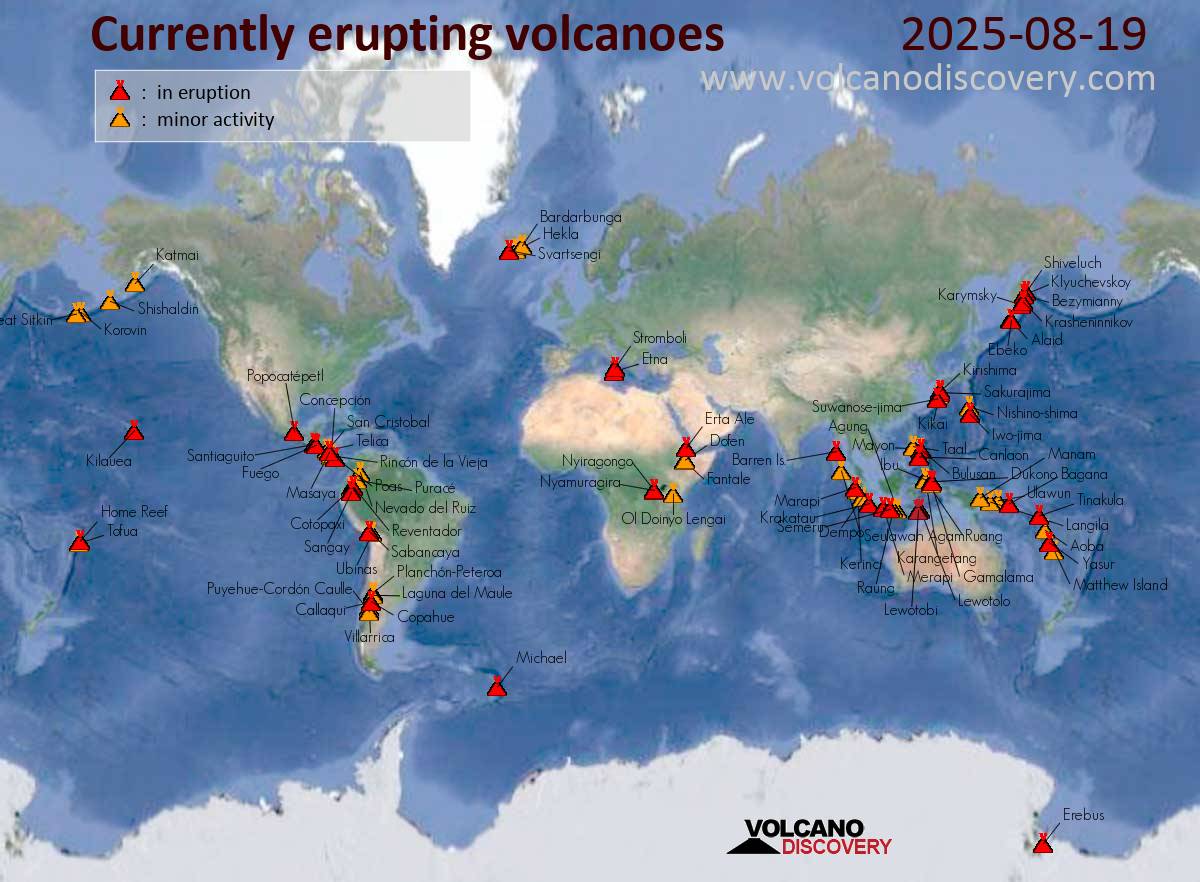
Global Volcanic Activity Report: Multiple Eruptions Continue Worldwide
Table of Contents
August 19, 2025 – A surge in volcanic activity is being observed across the globe, with ongoing eruptions and heightened alert levels at several key volcanoes. From Italy to Indonesia, monitoring agencies are tracking ash plumes, lava flows, and potential hazards. This report provides a comprehensive overview of the current situation, as of today, August 19, 2025.
Active Volcanoes in europe and Asia
Etna (Sicily, Italy)
Recent satellite imagery from August 19th reveals continued effusive activity at Mount Etna. new vents have opened on the volcano’s southern flank, feeding a lava flow extending southward. The ongoing eruption is being closely monitored for any changes in intensity or direction.
Klyuchevskoy (Kamchatka, Russia)
The eruption at klyuchevskoy volcano persists, with a notable ash plume reaching an estimated 8 kilometers in altitude on august 14th.Ashfall was reported in the nearby village of Klyuchi. Currently, two summit vents are ejecting incandescent material to heights of approximately 500 meters.
Did You Know? Volcanic ash can disrupt air travel, damage infrastructure, and pose health risks. Monitoring volcanic activity is crucial for mitigating these hazards.
Increased Activity in Indonesia and the Pacific Ring of Fire
Several volcanoes in Indonesia are exhibiting increased activity,prompting alerts from the Volcanic Ash Advisory Center (VAAC) in Darwin,Australia. The Pacific Ring of Fire, a region known for its frequent seismic and volcanic activity, is experiencing a period of heightened unrest.
Ibu (Halmahera, Indonesia)
Explosive activity continues at Ibu volcano. VAAC Darwin has issued warnings regarding a volcanic ash plume reaching an altitude of 7,000 feet (2,100 meters).
lewotobi (Flores, Indonesia)
Lewotobi volcano is also exhibiting ongoing explosive activity, with an ash plume extending to 8,000 feet (2,400 meters). The plume is moving northeast.
Lewotolo (lesser Sunda Islands,Indonesia)
On August 19th,Lewotolo volcano continued to display explosive behavior,generating an ash plume reaching 7,000 feet (2,100 meters). The plume is drifting north.
Semeru (East java, Indonesia)
Semeru volcano remains active, with an ash plume rising to 15,000 feet (4,600 meters) and moving southwest at 5 knots. This poses a potential hazard to aviation.
Dempo (Sumatra, Indonesia)
Dempo volcano is experiencing ongoing explosive activity, with an ash plume reaching 15,000 feet (4,600 meters) and drifting southeast.
Dukono (Halmahera, Indonesia)
Ground reports confirm continued eruption activity at Dukono volcano, with an ash plume reaching flight level 060.
Volcanic Activity in the Americas
Popocatépetl (Central Mexico)
Volcanic Ash Advisory Center Washington (VAAC) is monitoring Popocatépetl for emissions.
Santiaguito (Guatemala)
Explosive activity continues at Santiaguito volcano, with an ash plume reaching 14,000 feet (4,300 meters).
Fuego (Guatemala)
Fuego volcano is also exhibiting ongoing explosive activity, with an ash plume reaching 14,000 feet (4,300 meters).
Nevado del Ruiz (Colombia)
VAAC Washington has issued reports regarding potential emissions from Nevado del Ruiz.
Sangay (Ecuador)
VAAC Washington reports ongoing emissions observed on webcam at Sangay volcano.
Reventador (Ecuador)
Reventador volcano continues to exhibit explosive activity, with an ash plume reaching 14,000 feet (4,300 meters).
Pro Tip: Stay informed about volcanic activity in your area by following official sources like the USGS, VAACs, and local emergency management agencies.
Understanding volcanic activity is crucial for public safety and disaster preparedness.The ongoing eruptions highlight the dynamic nature of our planet and the importance of continuous monitoring and research. What steps do you think are most crucial for communities living near active volcanoes? How can technology improve our ability to predict and mitigate volcanic hazards?
| Volcano | Location | Current Activity | Plume Height (approx.) |
|---|---|---|---|
| Etna | Sicily, Italy | Effusive Eruption | N/A |
| Klyuchevskoy | Kamchatka, Russia | Eruption | 8 km |
| Ibu | Halmahera, Indonesia | Explosive | 7,000 ft (2,100 m) |
| Semeru | East Java, Indonesia | Explosive | 15,000 ft (4,600 m) |
Volcanic eruptions are a natural part of Earth’s geological processes, driven by the movement of tectonic plates and the accumulation of magma beneath the surface. The frequency and intensity of eruptions vary significantly depending on the volcano’s type,location,and magma composition. Monitoring volcanic activity has advanced significantly in recent decades,utilizing satellite imagery,ground-based sensors,and elegant modeling techniques. However,predicting the exact timing and magnitude of an eruption remains a significant challenge. The study of volcanology continues to refine our understanding of these powerful forces of nature and improve our ability to protect communities at risk.
Frequently Asked Questions about Volcanic Activity
- What is a volcanic eruption? A volcanic eruption is the release of lava, ash, and gases from a volcano.
- What are the dangers of volcanic ash? Volcanic ash can disrupt air travel, damage machinery, and cause respiratory problems.
- how are volcanoes monitored? Volcanoes are monitored using a variety of techniques, including seismographs, gas sensors, and satellite imagery.
- What is the Pacific Ring of Fire? The Pacific Ring of Fire is a region around the pacific Ocean known for its frequent earthquakes and volcanic eruptions.
- Can volcanic eruptions be predicted? While predicting the exact timing of an eruption is difficult, scientists can identify signs of increasing activity and issue warnings.
