
Glenn Flores Receives 2026 Pediatric Research Award for Health Equity Work
Miller School Pediatrician Receives Prestigious National Award
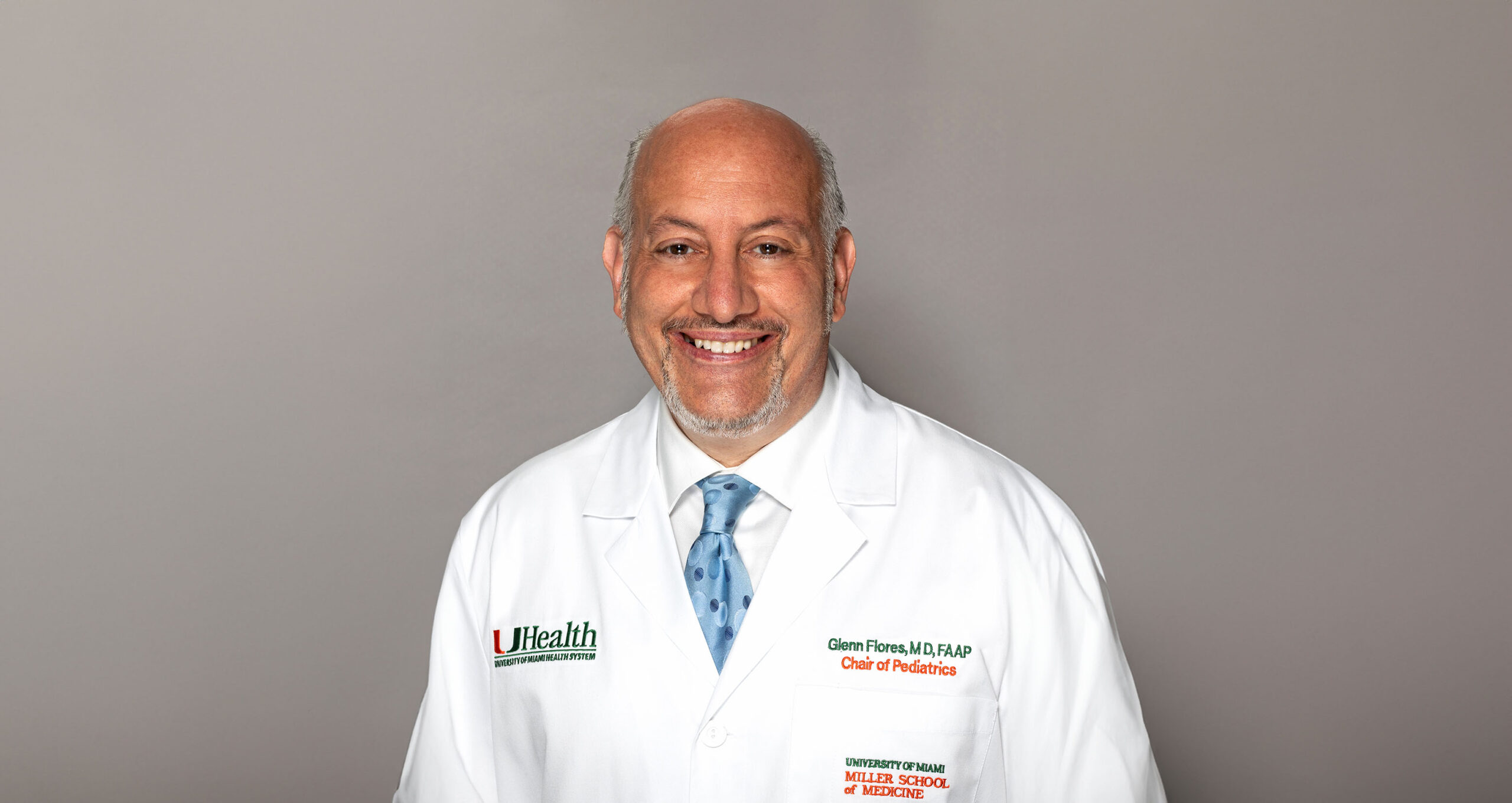
Dr. Glenn Flores, chair of the Department of Pediatrics at the University of Miami Miller School of Medicine, has been named the 2026 recipient of the Society for Pediatric Research’s Douglas K. Richardson Award for Perinatal and Pediatric Health Care Research. The award recognizes investigators with a career dedicated to advancing health services research and improving care for children and families.
“I am deeply honored and humbled,” said Dr. Flores. “The Richardson Award is a tremendously prestigious honor from the Society for Pediatric Research, recognizing an investigator’s lifetime achievements and significant contributions to child health. It is particularly meaningful because prior Richardson Award recipients include some of the most accomplished and illustrious researchers in the field of pediatrics.”
A Career Dedicated to Better Health for Children
Dr. Flores’s work spans more than 260 peer-reviewed publications and has significantly shaped national understanding of children’s access to and experience with healthcare. His early research focused on language access in medical settings, leading to impactful changes in national policy.
A landmark 2003 study published in Pediatrics meticulously documented errors stemming from inadequate interpreter services and their clinical consequences. The findings directly influenced federal standards and prompted the widespread adoption of professional medical interpreters in healthcare facilities.
Dr. Flores also led influential studies demonstrating persistent racial and ethnic disparities in childhood health outcomes, even when accounting for socioeconomic factors. His 2002 paper in JAMA on Latino child health remains a foundational resource in the field.
Beyond identifying problems, Dr. Flores has focused on developing solutions. His National Institutes of Health-funded Kids’ HELP randomized controlled trial demonstrated the effectiveness of parent mentors in securing health insurance for uninsured children, surpassing traditional Medicaid/CHIP outreach efforts. The results informed federal legislation authored by Dr. Flores, leading to a $120 million CMS program that established parent-mentor initiatives in 11 states and the Cherokee Nation.
Dr. Flores was previously honored with the David P. Rall Award for Advocacy in Public Health by the American Public Health Association. He has served as an expert and advisory committee member for Sesame Workshop and participated in a JAMA Network Open listening session addressing structural racism in healthcare.
Impact on Clinical Care and National Policy
Studies led by Dr. Flores have consistently shown the negative consequences of childhood uninsurance, including increased unmet healthcare needs, poorer health status, financial strain on families, and job loss among caregivers. Subsequent longitudinal research demonstrated that obtaining insurance reverses these trends, improving health outcomes, increasing access to primary care, and reducing financial burdens on families.
“Getting kids health insurance coverage not only improves their outcomes,” Dr. Flores said, “but it will save our nation billions, based on our projections. I consider that would be the biggest single step we could take.”
Dr. Josh Sharfstein, vice dean for public health practice and community engagement at Johns Hopkins Bloomberg School of Public Health, and a former mentee of Dr. Flores, stated, “He taught me to hold myself to the highest possible standards. I still hear his supportive but firm voice pushing me to do my very best.”
Dr. Flores’s work has driven evidence-based policy changes at multiple levels, influencing Medicaid/CHIP outreach strategies, clinical communication standards, and national approaches to childhood obesity and mental health. The U.S. Department of Health and Human Services Office of Minority Health commissioned a review by Dr. Flores on the efficacy of medical interpreter services. Published in Medical Care Research and Review, the study has been cited over 1,600 times and is considered the most-cited article on language barriers in healthcare.
A Legacy of Mentorship
In addition to his research, Dr. Flores is recognized as a highly influential mentor in academic pediatrics. He has mentored countless trainees, including faculty members, fellows, residents, and medical students, many of whom now hold leadership positions in divisions, residency programs, research institutes, and national health equity efforts.
Dr. Elena Fuentes‑Afflick, chief scientific officer of the Association of American Medical Colleges, noted, “Dr. Flores’s research has transformed national understanding of pediatric health care utilization, particularly for underserved children.”
Dr. Flores directs the NIH-supported Research in Academic Pediatric Investigator Development (RAPID) Program, which has supported over 120 early-career investigators from diverse backgrounds.
Dr. Mark Schuster, a previous recipient of the Richardson Award in 2014, wrote, “imagine a better qualified candidate for the 2026 SPR Douglas K. Richardson Award. Dr. Flores has made substantive research contributions in all four areas encompassed by the Richardson Award, and his contributions to pediatric health services research have been both significant and enduring.”