
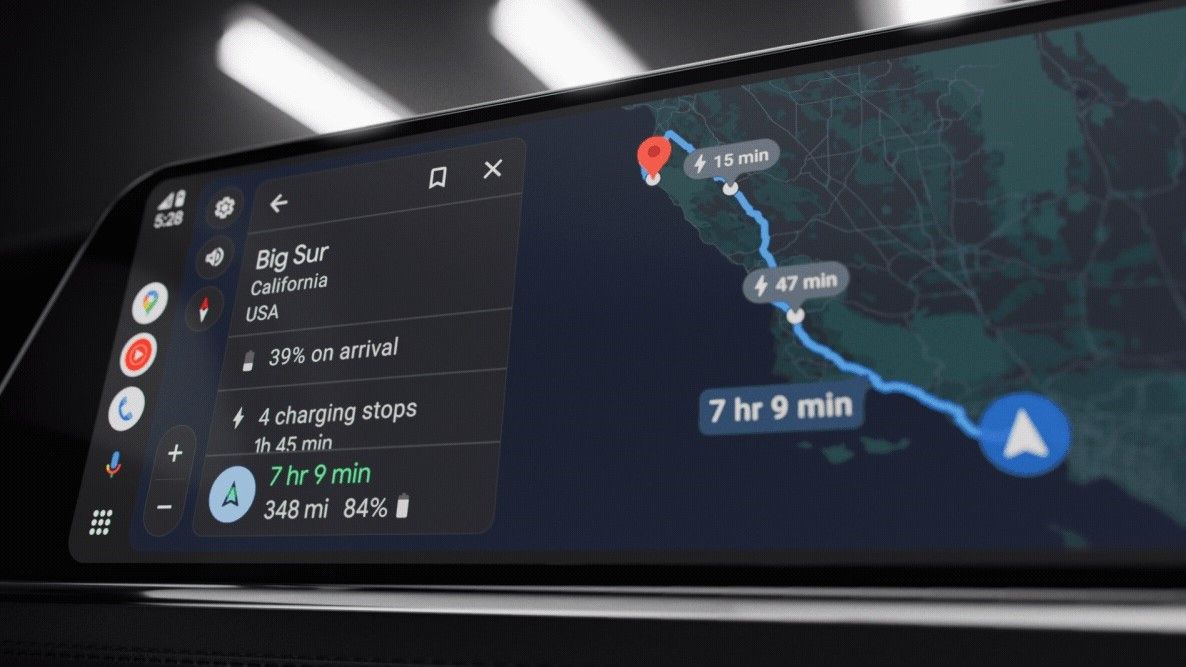
Get in: Android Auto EVs see AI battery predictions in Google Maps for stress-free plans
Google Maps is pushing another “AI-enhanced” update to Android Auto this week, promising to solve range anxiety with battery predictions for over 350 EV models. As a Principal Engineer, I’ve seen enough “smart” routing algorithms fail when real-world variables hit the pavement. The press release talks about “stress-free plans,” but from an architectural standpoint, this is a latency and data integrity challenge. We are moving from static range estimation to dynamic, telemetry-driven predictive modeling. The question isn’t whether the feature exists, but whether the inference engine can process traffic, elevation, and thermal battery degradation data rapid enough to be useful before the driver passes the charger.
- The Tech TL;DR:
- Core Function: Google Maps now ingests real-time traffic and elevation data to predict battery percentage at arrival, requiring user input of “starting percentage.”
- Deployment Scope: Rolling out immediately to 350+ EV models across 15 brands in the U.S., leveraging on-device and cloud-based inference.
- Enterprise Implication: Fleet managers must audit data privacy policies regarding vehicle telemetry sharing with third-party mapping APIs.
The fundamental bottleneck in EV navigation has always been the “garbage in, garbage out” problem. Legacy systems relied on EPA-rated range, a static number that disintegrates the moment you hit a headwind or drop below freezing. Google’s new approach attempts to solve this by treating the vehicle not just as a coordinate, but as a sensor node in a larger network. By asking the driver to input the starting battery percentage, the system initializes a state vector. It then layers this against historical traffic patterns and real-time congestion data. This isn’t just a UI tweak; it’s a shift toward edge-computing logic where the map application acts as a localized Energy Management System (EMS).
However, for the CTOs and senior developers watching this rollout, the implementation details matter more than the marketing copy. The latency introduced by querying external charging station availability APIs while simultaneously calculating energy consumption curves can be significant. If the round-trip time (RTT) for these data packets spikes during peak travel times, the “prediction” becomes a lagging indicator rather than a proactive tool. This is where enterprise-grade infrastructure becomes relevant. Organizations managing mixed fleets of EVs cannot rely solely on consumer-grade apps for logistics. They necessitate robust managed IT services capable of integrating vehicle telemetry directly into their own ERP systems, bypassing the latency of consumer app layers.
The Architecture of Prediction: Cloud vs. Edge
To understand the efficiency of this update, we have to look at where the computation is happening. Is Google running these models on the vehicle’s head unit (likely an ARM-based SoC) or offloading to the cloud? Given the complexity of factoring in “real-time information about traffic” and charging station load, a hybrid approach is most probable. The heavy lifting of training the model happens in the cloud, but the inference—the actual prediction of “you will arrive with 14% battery”—likely occurs on the edge to minimize data usage and latency.
For developers looking to replicate this logic or integrate similar telemetry into custom fleet dashboards, the data structure would resemble a complex JSON payload containing state-of-charge (SoC) deltas. Below is a conceptual representation of how a backend service might structure a request to calculate energy consumption based on route segments:
curl -X POST https://api.maps.googleapis.com/v1/ev:computeEnergy -H "Authorization: Bearer $ACCESS_TOKEN" -H "Content-Type: application/json" -d '{ "vehicleProfile": { "model": "EV_MODEL_X", "batteryCapacityKwh": 75.0, "currentSocPercent": 82.0 }, "routeSegments": [ { "distanceMeters": 15000, "elevationGainMeters": 120, "trafficSpeedKmph": 45, "ambientTempCelsius": 18 } ], "chargingStops": { "required": true, "connectorType": "CCS2" } }' This level of granular data exchange introduces significant surface area for potential vulnerabilities. When a vehicle transmits its precise location, battery health, and driving habits to a third-party cloud provider, the attack surface expands. It is no longer just about navigation; it is about protecting the digital twin of a physical asset. Security teams should be treating these integrations with the same rigor as any other IoT endpoint. This is precisely the kind of scenario where cybersecurity auditors and penetration testers are essential to validate that the data pipelines between the vehicle’s OBD-II port (or equivalent digital interface) and Google’s servers are encrypted end-to-end and compliant with SOC 2 standards.
Comparative Analysis: Legacy vs. AI-Driven Estimation
The shift from static EPA estimates to AI-driven predictions represents a fundamental change in how we calculate efficiency. The table below breaks down the technical differences in how these systems process data:
| Metric | Legacy Estimation (Static) | AI-Driven Prediction (Dynamic) |
|---|---|---|
| Data Inputs | Distance, Average MPG/MPGe | Distance, Elevation, Traffic Density, Ambient Temp, Battery Health |
| Compute Location | Local Head Unit (Basic Logic) | Hybrid (Cloud Training / Edge Inference) |
| Latency Sensitivity | Low (Static Calculation) | High (Requires Real-Time API Calls) |
| Accuracy Variance | High (+/- 20% in extreme weather) | Medium/Low (+/- 5% with calibrated input) |
While the consumer benefit is clear—reducing the cognitive load of planning a road trip—the backend implications are massive. Google claims this covers “more than 15 brands,” which implies a significant normalization layer is required to ingest data from disparate OEM APIs (Tesla, Rivian, Ford, etc.). Each manufacturer exposes telemetry differently. Standardizing this into a unified prediction model requires a robust middleware layer. For enterprise fleets operating heterogeneous vehicles, relying on a single consumer app is a single point of failure. Instead, forward-thinking logistics companies are turning to custom software development agencies to build aggregator platforms that normalize this data across their specific fleet mix, ensuring that a Ford E-Transit and a Tesla Semi can be managed on the same dashboard with equal fidelity.
this update is less about “magic” and more about better math. By forcing the user to input the starting percentage, Google is manually closing the loop on state estimation, effectively crowdsourcing the calibration of their model. It’s a pragmatic solution to a hard engineering problem. However, as we integrate our vehicles deeper into the cloud ecosystem, the line between a navigation app and a critical infrastructure component blurs. The reliability of these predictions will depend entirely on the integrity of the data pipeline. If the API returns stale traffic data or the elevation model is off by a few meters, the “stress-free plan” becomes a stranded vehicle. In the world of autonomous and semi-autonomous logistics, there is no room for approximation—only precision.
Disclaimer: The technical analyses and security protocols detailed in this article are for informational purposes only. Always consult with certified IT and cybersecurity professionals before altering enterprise networks or handling sensitive data.