
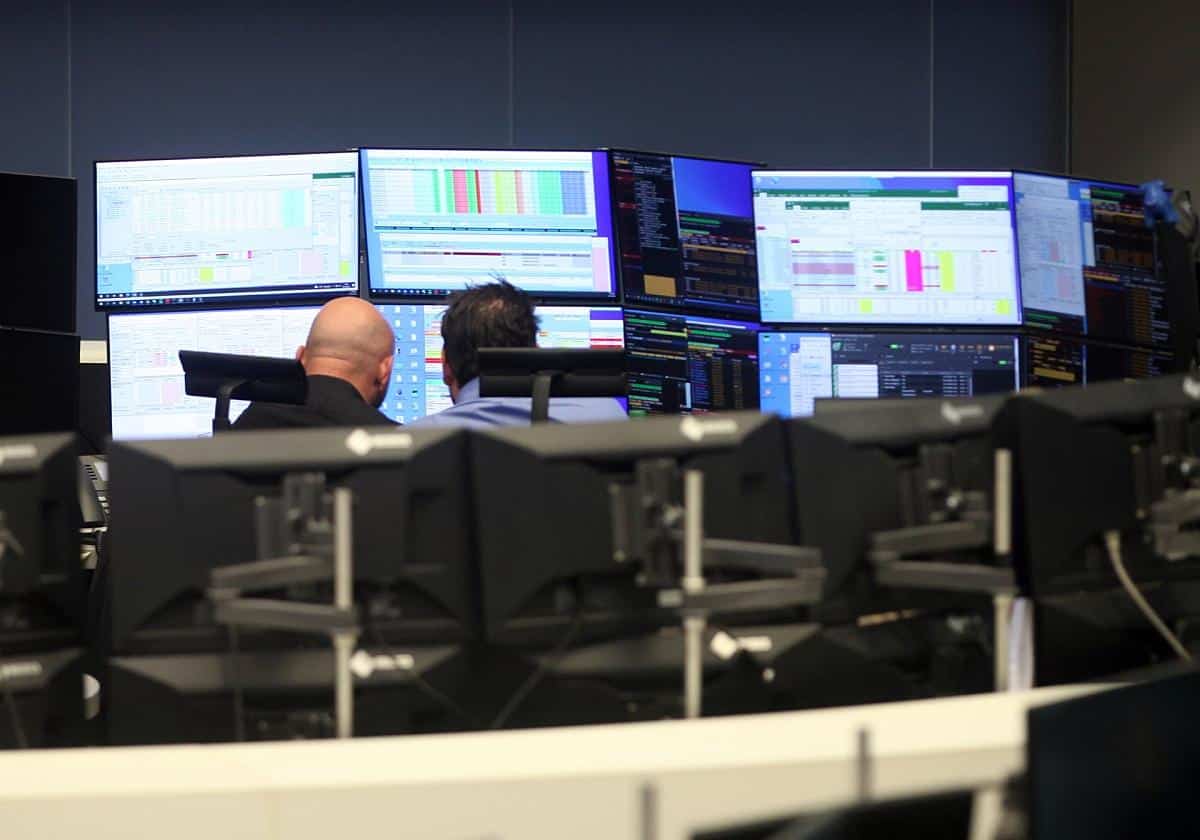
The German stock market began the new trading week with significant losses. The DAX index fell sharply Monday morning, though some sector values and the price of oil moved against the trend. Escalating tensions in the Middle East weighed on investor sentiment, but did not trigger widespread panic, according to market observers.
At the start of trading Monday morning, the DAX experienced substantial declines. Around 9:30 AM local time, the benchmark index was calculated at approximately 17,715 points, 2.3 percent below Friday’s closing level. Shares of Rheinmetall and RWE were the only companies in the index to reveal gains, bucking the overall market trend. Deutsche Bank, Zalando, and Siemens were among the worst performers.
Investors reacted primarily to the conflict in the Middle East at the start of the trading week. “Despite an unprecedented geopolitical escalation in one of the world’s most important oil-producing regions, the DAX is starting the new week without panic,” said Jochen Stanzl, Chief Market Analyst at Consorsbank. He noted that the situation in Iran offered a pretext for a sharp correction, but the sell-off was proceeding in an orderly manner. “This is perhaps the most important takeaway this Monday. We are seeing an orderly decline: it is going down, but there is no panic. The markets seem to be assuming a limited-duration conflict,” Stanzl added.
The oil market is a key focus for investors. Stanzl indicated that the worst-case scenario for the global oil market – Iran using oil as a weapon and closing the Strait of Hormuz – had materialized. “However, the feared explosion in oil prices has not yet occurred,” he said. “The oil price remains well below the $100 mark and is falling from its daily high. Full oil inventories and a potential increase in production by OPEC+ are helping to alleviate fears of an oil shortage.”
Despite this, the price of oil rose sharply Monday morning. A barrel of North Sea Brent crude cost around $80.00 around 9:00 AM German time, 9.8 percent more than at the close of the previous trading day.
The European currency too weakened at the start of the week. On Monday morning, one euro cost $1.1704, meaning one dollar was worth 0.8544 euros.
