German Army Deploys Loitering Munitions in Force-on-Force Exercise for First Time in Lithuania
Germany’s Army deployed loitering munitions in a force-on-force exercise for the first time during the multinational “Freedom Shield 26-2” drill at the Rūdninkai training area in Lithuania, the Bundeswehr confirmed.
The exercise involved the newly formed Panzerbrigade 45 “Litauen” and marked a capability step toward closing a gap in indirect fire effect until longer-range artillery systems arrive.
Army Inspector Lieutenant General Christian Freuding observed the test and said: “I am convinced that this will quickly get us to closing the gap, to the interim solution, for the area of indirect effect.” The brigade, which completed its final subunits in Munster only days earlier, is slated to be permanently stationed in Lithuania by 2027.
Freuding added: “I am convinced that with this we will make an important capability step into the future, that these systems, as they were employed, reinforce us in the land forces operations concept.”
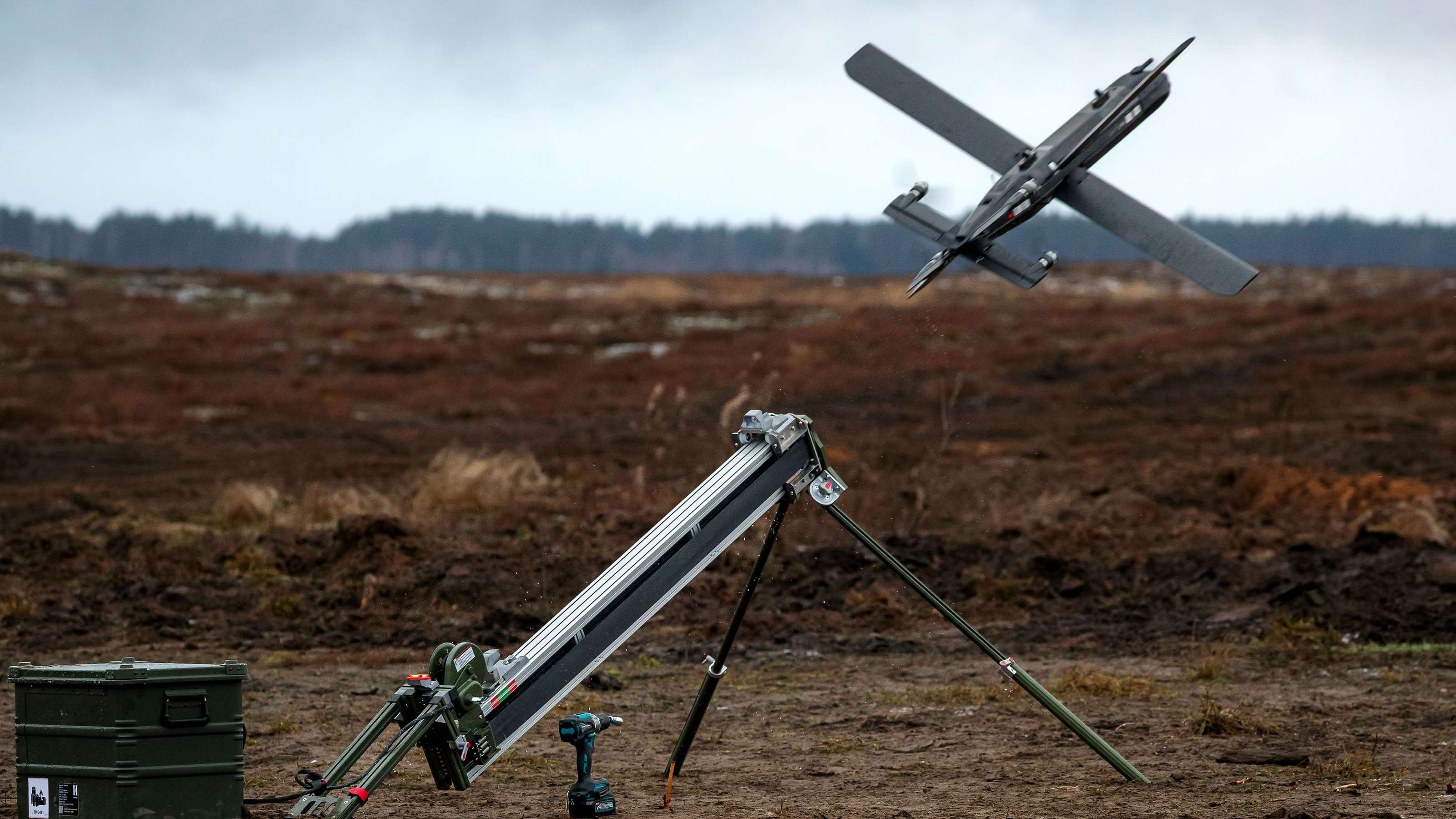
Two different systems were tested, both developed by German defense firms Helsing and Stark Defence, Euronews reported. One is a white aircraft that takes off vertically; the other is a dark, X-winged munition launched from a catapult.
Operators used the drones against simulated armored targets, carrying exercise warheads without explosive charges to evaluate performance without live ordnance. Lieutenant General Freuding stated: “For the first time, Loitering Munition systems were successfully employed in a two-sided exercise.”
Master Sergeant Steffen A., who leads the Loitering Munition Systems group in Lithuania, described his role: “What is my mission here? I operate the LM, the Loitering Munition, and then engage the armored enemy in the terrain.” The systems combine reconnaissance and strike: they fly into the operational area, loiter, and use sensors and software to detect targets such as enemy tanks or command posts, presenting them to the human operator who decides on engagement.
The drill took place roughly twelve kilometers from the Belarusian border within NATO’s largest exercise in Lithuania to date, involving around 3,800 soldiers from eight alliance nations. Experience from the war in Ukraine, where both sides have employed attack drones en masse against armor, artillery and logistics, is feeding directly into the brigade’s tactical procedures.
Parallel to the munitions test, the Bundeswehr evaluated “Clarity,” an AI-supported platform from Helsing for battlefield reconnaissance and target selection, according to Euronews. The software is designed to fuse data from multiple sensors — potentially including drones and surveillance systems — to flag potential targets and give commanders a more complete picture faster than traditional multi-step targeting cycles allow.
Lithuania’s position bordering both Belarus and the heavily militarized Russian exclave of Kaliningrad makes it one of the most sensitive areas in the alliance. Germany’s commitment to station a full combat brigade there permanently represents a fundamental shift in its military posture.