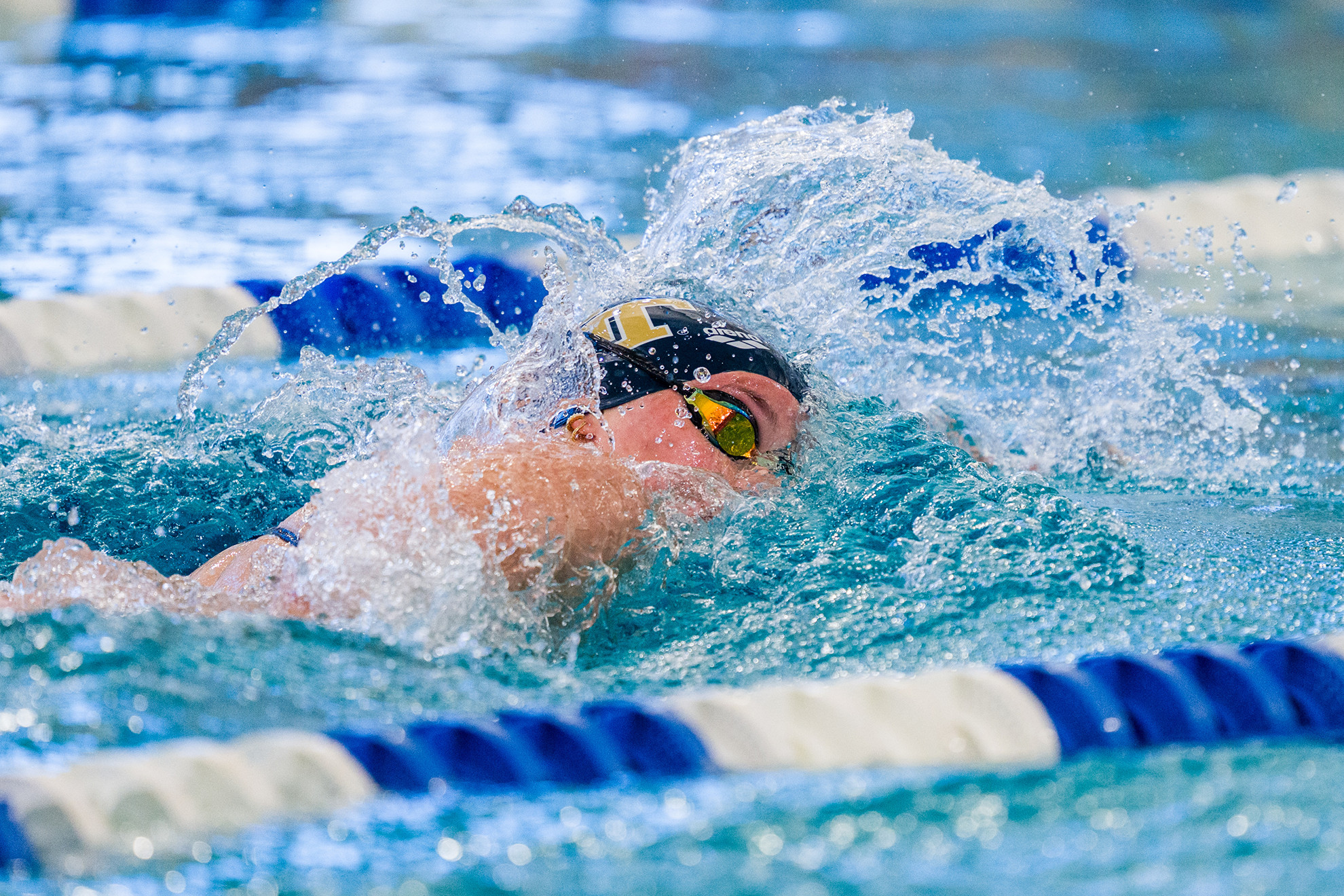
Georgia Tech Women’s 200 Medley Relay Clocks Third-Fastest Program Time at Georgia Fall Invitational
Three seconds separated a standard dual-meet appearance from program history on Wednesday at the Georgia Fall Invitational, where the Georgia Tech swimming and diving teams secured a top-three relay mark.
The women’s 200 medley relay squad clocked a time of 1:38.01, finishing 0.76 seconds faster than their previous best effort at the Dual Meet Tournament, Georgia Tech Yellow Jackets reported.
Vivien Rothwell opened that relay with a 24.50 back split, followed by Annabel Smith with a 27.85 50-breast split.
Zara Masud swam a 23.27 50-fly time before Jillian Ferrari anchored the 50-free leg in 22.39.
Rothwell has now served as the leadoff swimmer in all four of the fastest program times in school history.
The men’s squad recorded a 1:24.95 time in the 200 medley relay, placing eighth overall and ninth in the Tech record book.
Ricky Balduccini posted the third-fastest 50-back split among all lead squads at 21.40.
Leo Verschooten added a 20.44 50-fly time during the opening day events at Gabrielsen Natatorium.
The invitational began with the 1650 free event, featuring Hailey Dopson and Lukas Vetkoetter.
Dopson finished 11th with a time of 16:47.78 in her first competitive mile race, marking the ninth-fastest time in program history.
Vetkoetter finished 13th on the men’s side with a time of 15:19.08.
The men’s A-squad placed 10th overall in the 800 free relay at 6:23.26, while the B-squad finished 12th at 6:26.01 after the women’s 800 free relay was disqualified.
Competition resumes on Thursday at 9:30 a.m. with swimming prelims at Gabrielsen Natatorium.
Women’s 1-meter and men’s 3-meter diving events are scheduled to begin at 11:30 a.m.
Finals sessions will commence at 5:30 p.m. with the 200 backstroke, 100 freestyle, 200 breaststroke, 200 butterfly, and 400 freestyle relay.
Georgia Tech, founded in 1885 as the Georgia School of Technology, opened in 1888 with two buildings symbolizing equal emphasis on teaching and hands-on production. The institute adopted its current name in 1948 to reflect its evolution into a research university. Today, it operates satellite campuses in Savannah and Metz, France, and reported a $5.8 billion economic impact for fiscal year 2024, leading all public institutions in the state.
Supporters can review renovation projects and operational support details through the Full Steam Ahead $500 million fundraising initiative.