
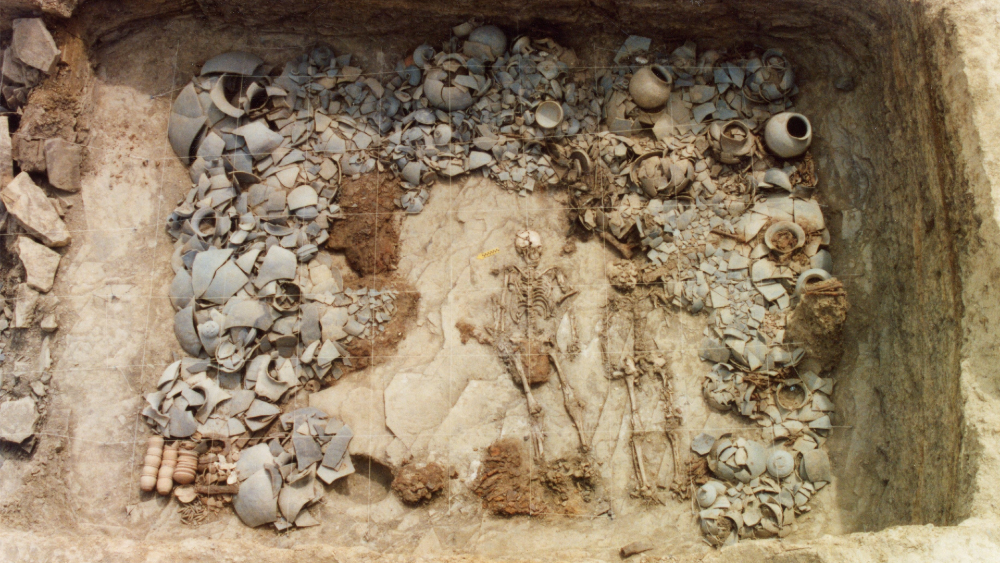
Genomic Analysis Reveals Ancient Korean Sacrificial Caste
A genomic analysis of ancient remains from the Korean Peninsula has uncovered the existence of a specialized sacrificial caste, where entire families were systematically killed to honor local royalty. This research, focusing on the Imdang-Joyeong burial complex, provides a stark biological record of the social stratification and kinship practices prevalent during the Three Kingdoms period.
Key Clinical Takeaways:
- Genomic sequencing of 78 skeletons reveals the practice of “sunjang,” where servants and their entire households were sacrificed alongside the elite.
- The data indicates a high prevalence of consanguineous marriage (close-kin mating), particularly within the ruling classes of the Silla kingdom.
- Analysis of the Imdang-Joyeong complex confirms a dense kinship system focused on women and their descendants between the fourth and sixth centuries.
The intersection of paleogenomics and archaeology has opened a window into the biological costs of ancient social hierarchies. By sequencing the DNA of 78 individuals from 44 tombs at the Imdang-Joyeong burial complex in Gyeongsan, researchers have transitioned historical anecdotes of human sacrifice into verifiable genetic data. This site, located in the southeast region of the Korean Peninsula, served as a burial ground for local ruling families descended from Abdok, a polity that was incorporated into the Silla kingdom around the fourth century.
The Biological Signature of the Sacrificial Caste
The study, published in the journal Science Advances, identifies a specific burial practice known as “sunjang.” While historical records had previously suggested that retainers or servants were killed to accompany the deceased elite, the genomic evidence reveals a more expansive and systemic tragedy. The data suggests that this practice was not limited to isolated individuals but frequently claimed entire households.

Researchers identified at least 20 two-chambered tombs that provide clear evidence of this sacrificial pattern. The genomic sequencing allows for the identification of kinship ties among those interred, proving that the “sacrificial caste” consisted of related individuals who were eliminated as a unit. This level of social control indicates a rigid caste system where the biological survival of a servant’s family was entirely contingent upon the status of the ruling elite.
Analyzing such complex skeletal data requires precision in identifying kinship and cause of death. For modern medical professionals dealing with complex hereditary markers or forensic reconstructions, the methodology used in this study mirrors the rigor found in contemporary diagnostics. Those seeking to understand the intersection of genetics and physical evidence often rely on the expertise of board-certified forensic pathologists to differentiate between natural pathology and external trauma in skeletal remains.
The genomic data suggests that the practice of sunjang was not limited to individual servants but may have claimed entire households, revealing a dense and oppressive social structure.
Consanguinity and the Risks of Close-Kin Marriage
Beyond the evidence of sacrifice, the genomic analysis highlights a pervasive pattern of consanguineous marriage—unions between closely related individuals. The Silla kingdom’s social structure favored these marriages to consolidate power and maintain the purity of royal lineages. The research specifically identified 11 first-degree kinship relationships among the analyzed samples, pointing to a society where inbreeding was a calculated political tool.
From a clinical perspective, high rates of consanguinity significantly increase the probability of autosomal recessive disorders. When two related individuals procreate, there is a higher likelihood that offspring will inherit two copies of a deleterious recessive allele, leading to increased morbidity and a higher incidence of congenital anomalies. While the ancient Silla elite viewed these unions as a means of preserving status, the biological reality was a heightened risk of genetic instability within the ruling bloodlines.
This historical precedent underscores the critical importance of modern genetic screening. Families with a history of consanguinity or those identifying high-risk markers in their lineage are encouraged to consult with licensed genetic counselors to assess the risk of hereditary conditions and implement informed reproductive strategies.
Kinship Dynamics and the Role of Matrilineal Descent
The analysis of the Imdang-Joyeong complex similarly reveals a kinship system with a heavy focus on women and their descendants. This suggests that while the overarching political structure of the Silla kingdom was hierarchical, the internal biological and social organization of these local polities may have placed significant emphasis on maternal lines to track descent and inheritance.
The dense kinship networks identified through DNA sequencing demonstrate that these families operated as tightly knit biological units. This cohesion served a dual purpose: it reinforced the power of the ruling families through concentrated lineage and ensured that the sacrificial caste remained a distinct, manageable group. The biological markers left in the skeletons of Gyeongsan serve as a permanent record of this social engineering.
The study’s reliance on high-throughput sequencing of ancient DNA (aDNA) highlights the evolving standard of care in paleogenomics. By extracting genomic data from degraded skeletal material, researchers can now map the pathogenesis of ancient populations and their social evolution with a level of accuracy previously reserved for living patients.
The Future of Paleogenomic Research
The findings from the Imdang-Joyeong complex shift our understanding of the Three Kingdoms period from a purely historical narrative to a biological one. The evidence of a sacrificial caste and the prevalence of inbreeding provide a window into the extreme social pressures and genetic risks of the Silla kingdom. As genomic technology advances, the ability to sequence larger sample sizes will likely reveal whether these practices were isolated to the Gyeongsan region or were systemic across the entire peninsula.
This research demonstrates that the biological record rarely lies, even when historical texts are sparse. The mapping of ancient kinship and the identification of “sunjang” provide a cautionary tale regarding the intersection of absolute power and biological viability. For those interested in the intersection of genetics, history, and pathology, maintaining access to a network of vetted advanced diagnostic centers is essential for applying these genomic insights to modern health challenges.
Disclaimer: The information provided in this article is for educational and scientific communication purposes only and does not constitute medical advice. Always consult with a qualified healthcare provider regarding any medical condition, diagnosis, or treatment plan.