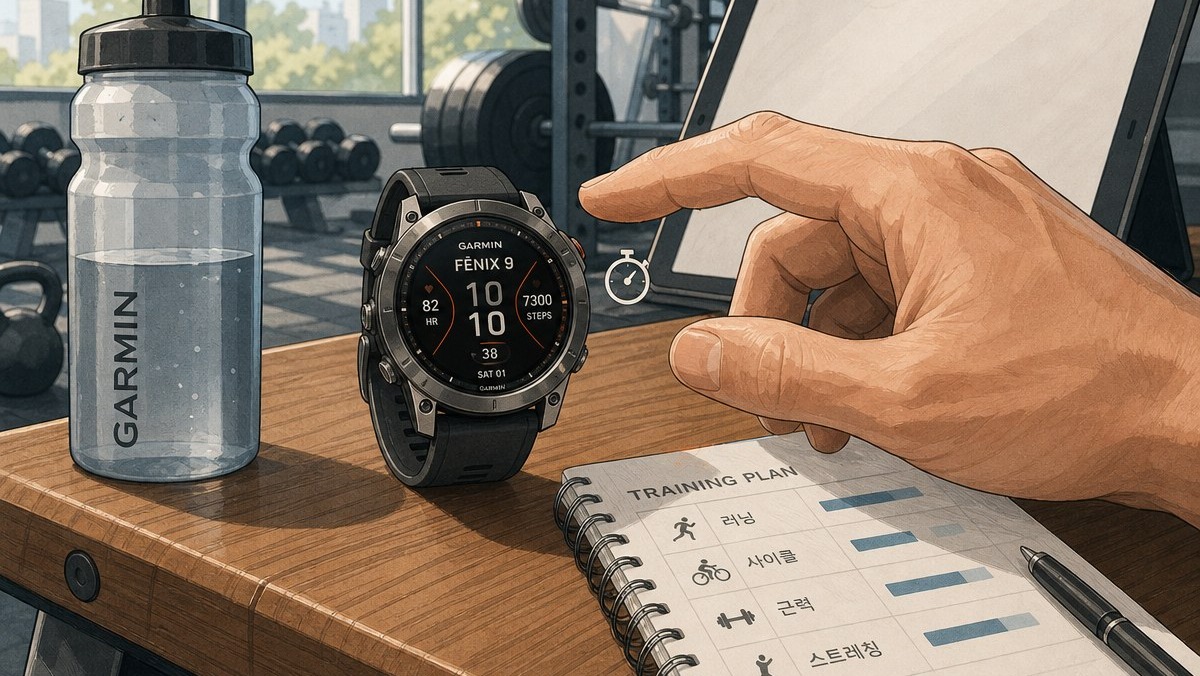
Garmin Fenix 9 Button Lag Persists After 7.22 Update Despite New Chip
Garmin released software version 7.22 addressing map loading speed, Connect IQ watch face menu delays, and general app responsiveness.
Garmin Fenix 9 owners are reporting slower button response times than on the previous Fenix 8 model, despite the new watch carrying a faster chip and more RAM, 위키트리 reported.
Users on Garmin’s forum describe delays of two to three seconds to start an activity, roughly one second to record a lap, and up to six seconds to open the training menu, according to coverage by Samsung Magazine.
By comparison, the Forerunner 265 — priced at about one-third of the Fenix 9 — responds noticeably faster. One user posted a side-by-side video showing the Epix Gen 2 and Fenix 9 Pro performing the same start, save, and cancel actions; the older Epix completed each step first.
The lag appears primarily during workouts. Menu navigation outside of activities feels normal, but pressing buttons mid-run or mid-ride produces no immediate feedback, leaving athletes uncertain whether the input registered. Samsung Magazine characterized even the simple act of timing a run as “unnecessarily frustrating.”
Update 7.22 does not fully resolve the issue
Garmin released software version 7.22 late last week, addressing map loading speed, Connect IQ watch face menu delays, and general app responsiveness. Forum members say the start, stop, and back buttons remain slow for some users, and reports persist of widget scrolling freezes and sluggish post-activity saves.
A Garmin representative wrote on the forum that the company has been unable to reproduce the button delay internally. The representative asked affected users to submit additional details to help engineers diagnose the cause. Samsung Magazine described the outlook as “light at the end of the tunnel, but a long, dark tunnel.”
A workaround has emerged: several users report that disabling sounds during activities sharply improves responsiveness. However, Samsung Magazine’s tester did not encounter the issue on a Fenix 9 Pro InReach unit, leaving the scope of affected models unclear.
Ecosystem pressure mounts as Big Tech enters health
Cycling publication Velo argued that the bike-computer market has shifted from hardware to ecosystems and data, and that Garmin’s lead — built through acquisitions of MetriGear (2010), Tacx (2019), and Firstbeat Analytics (2020) — is now contested by Apple, Google, and Samsung, according to 위키트리.
Rivals also show gaps. Velo noted SRAM’s Hammerhead lacks a biometric ecosystem; Wahoo dominates indoor trainers but lacks a 24-hour multi-sport data engine and its watch effort “failed badly”; Coros replicates Garmin’s ecosystem at lower cost but relies on a Wahoo partnership to fill missing pieces.
Garmin recently acquired TrainingPeaks and TrainHeroic to strengthen its coaching platform. Velo concluded Garmin stands at a crossroads: either match Big Tech head-on or risk stumbling at the critical moment. Retaining users once they enter an ecosystem depends as much on basic device responsiveness as on data depth. Garmin says it is gathering more information from affected users; no fix timeline has been announced.