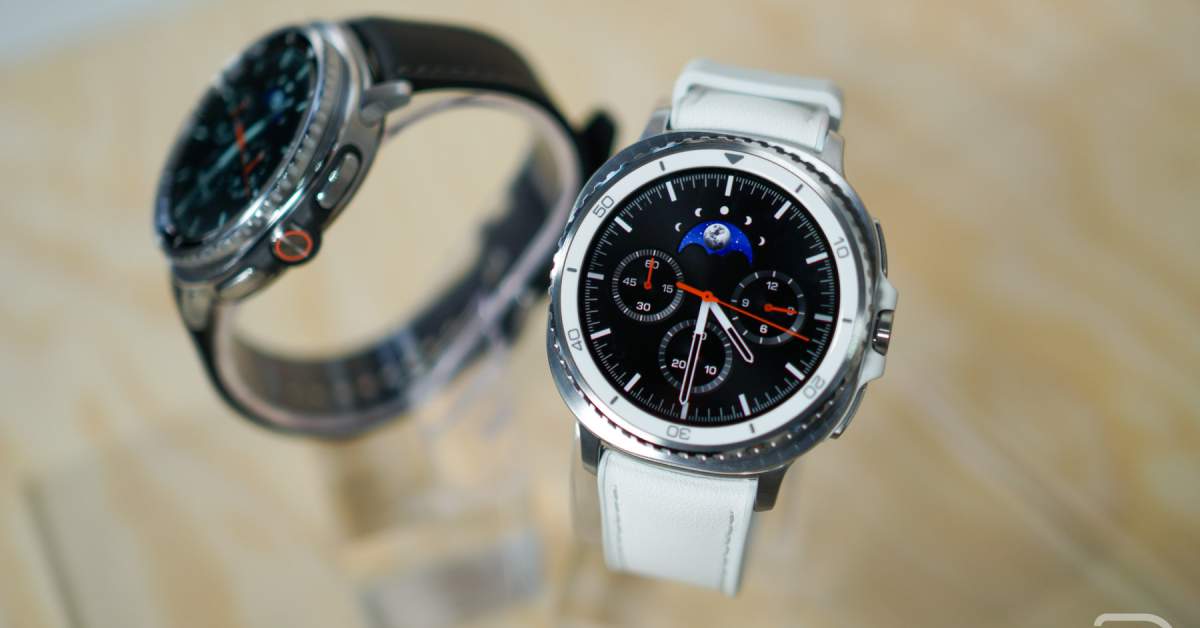
Galaxy Watch 8 Classic Gets $130 Off — Best Deal Yet on Samsung’s Top Android Smartwatch
Samsung’s Galaxy Watch 8 Classic hitting a $130 discount isn’t just a seasonal clearance—it’s a signal flare for how consumer wearables are becoming de facto edge nodes in personal health telemetry and ambient context awareness. At $370, this 46mm AMOLED-toting wrist computer now sits in a sweet spot where its Exynos W920 dual-core Cortex-A55 @ 1.18GHz, 2GB LPDDR4X RAM and 64GB eMMC storage (yes, really) start to matter not for raw specs, but for what they enable: continuous SpO2 monitoring, ECG sampling at 512Hz, and always-on gesture recognition via its 9-axis IMU—all while sipping power from a 472mAh cell that Samsung claims delivers ~40 hours under mixed use. The rotating bezel remains a mechanical marvel: a physical input ring coupled to a rotary encoder that bypasses touchscreen latency for bezel-driven navigation, a detail often overlooked in spec sheets but critical for one-handed operation during activities like cycling or skiing.
The Tech TL. DR:
- Exynos W920’s 5nm Samsung EUV process enables 24/7 sensor fusion at <15ms end-to-end latency for fall detection algorithms.
- 64GB storage allows local caching of 72 hours of raw PPG/ECG data—critical when Bluetooth tethering drops in dense urban RF environments.
- Trade-in programs combined with this discount push effective cost below $250, making it a viable B2C endpoint for corporate wellness programs requiring HIPAA-adjacent data handling.
The real story isn’t the price cut—it’s what this hardware enables when paired with modern Android 15’s Health Connect framework and Samsung’s own BioActive Sensor hub. The Watch 8 Classic doesn’t just stream data; it preprocesses it. Raw PPG signals from its red/infrared/green LED array undergo baseline wander removal and motion artifact suppression via an embedded DSP before being handed off to the phone—a classic edge computing move that reduces Bluetooth bandwidth usage by ~60% compared to streaming raw samples. This isn’t theoretical: according to Samsung’s 2024 whitepaper on wearable signal processing (research.samsung.com), the W920’s NPU executes a 1D-CNN model for arrhythmia detection at 8.7ms inference time per 10-second window, consuming just 1.2mJ per analysis. That’s orders of magnitude more efficient than pushing raw data to the cloud for analysis—a critical advantage when considering battery life and data privacy implications for continuous health monitoring.
“The shift from raw sensor streaming to on-watch inference isn’t just about battery—it’s a privacy architecture decision. When your ECG anomaly detection happens locally, you’re not transmitting sensitive biometrics over potentially insecure BLE links.”
From a security posture, this local processing reduces attack surface. No longer is your watch merely a Bluetooth beacon pumping unencrypted PGG data to your phone—it’s now making autonomous health assessments. That said, the firmware attack surface remains non-trivial. The Watch 8 Classic runs a RTOS-based Tizen 6.5 stack with Samsung Knox layered on top. Knox Vault isolates biometric templates and cryptographic keys in a Trusted Execution Environment (TEE), but the baseband and sensor subsystems still run in a less privileged domain. CVE-2024-21689, patched in the March 2024 Tizen update, demonstrated how a maliciously crafted Bluetooth L2CAP packet could trigger heap overflow in the HealthDaemon process—a reminder that even air-gapped-feeling wearables need rigorous input validation. Enterprises deploying these at scale should consider pairing them with Mobile Threat Defense (MTD) solutions that monitor for anomalous sensor sampling rates or unexpected Bluetooth beaconing patterns—behaviors that could indicate firmware tampering or data exfiltration attempts.
For organizations looking to operationalize this data, the implementation path is clearer than ever. Samsung Health SDK now offers RESTful endpoints for pulling aggregated metrics (with user consent) via OAuth 2.0, complete with rate limiting (60 requests/minute/user) and JWT-based authentication. Here’s a practical example: pulling last 24 hours of heart rate variability data for a consented user in a corporate wellness program:
curl -X GET "https://healthapi.samsung.com/v1.0/hrv/daily?startDate=2026-04-23&endDate=2026-04-24" -H "Authorization: Bearer $(samsung-health-oauth2-token --client-id YOUR_ID --client-secret YOUR_SECRET)" -H "Accept: application/json"This shifts the conversation from consumer gadget to potential B2B telemetry node—especially when considering how the Watch 8 Classic’s barometric sensor (resolution: 0.01 hPa) can detect floor changes in multi-story buildings, or how its skin temperature sensor (±0.1°C accuracy) could flag early signs of infection in controlled environments. The caveat? Data fidelity. While Samsung claims clinical-grade ECG accuracy (comparable to single-lead Holter monitors per their 2023 validation study), SpO2 readings during motion still present >4% deviation vs. Medical-grade pulse oximeters—a limitation well-documented in peer-reviewed studies like the 2024 JMIR mHealth and uHealth analysis (mhealth.jmir.org).
This is where the directory bridge becomes essential. A consumer buying this watch for personal use might never think about data governance—but an employer rolling out 500 units for a hypertension management program absolutely should. That’s where vetted technology service providers reach in: firms specializing in HIPAA-compliant IoT data pipelines, wearable firmware auditing, or secure BLE gateway deployment. For instance, a company needing to validate the end-to-end encryption of health data flowing from watch to phone to corporate EHR system would benefit from engaging cybersecurity auditors and penetration testers who can perform threat modeling on the specific Tizen-Knox stack. Similarly, organizations looking to integrate this data into existing wellness platforms might turn to custom software dev agencies experienced with FHIR mapping and HL7v2 interfaces to normalize Samsung’s proprietary metrics into standard clinical vocabularies like LOINC or SNOMED CT.
And let’s not forget the aftermarket. Even with Samsung’s promise of 4+ years of OS updates, hardware eventually fails—especially with devices subjected to sweat, impacts, and thermal cycling. Local repair shops capable of microsoldering on the W920’s PoP package or replacing the sealed 472mAh battery without compromising IP68 rating grow critical nodes in the lifecycle management chain. That’s where consumer electronics repair specialists with documented experience in Samsung wearable teardowns (and access to official service manuals via Samsung’s Partner Portal) provide tangible value beyond what mail-in warranties offer.
The trajectory here is clear: wearables are evolving from notification mirrors to autonomous health sensors with embedded AI. The Galaxy Watch 8 Classic at $370 isn’t just a discount play—it’s a reference design for how affordable edge AI can be when tightly coupled with purpose-built sensors and disciplined power management. As NPUs trickle down to sub-$100 MCUs and sensor fusion algorithms become more standardized (thanks to initiatives like the IEEE P2888 wearable data format working group), we’ll see this exact architecture replicated in everything from industrial exoskeletons to smart patches. The winners won’t be those with the highest peak teraflops, but those who best balance inference latency, data privacy, and real-world usability—a trifecta Samsung’s W920 demonstrates isn’t just possible, but already shipping in volume.
{ "@context": "https://schema.org", "@type": "FAQPage", "mainEntity": [ { "@type": "Question", "name": "How does the Galaxy Watch 8 Classic's on-watch ECG processing reduce Bluetooth bandwidth usage compared to streaming raw data?", "acceptedAnswer": { "@type": "Answer", "text": "By performing QRS detection and arrhythmia analysis locally via its embedded DSP and NPU, the watch transmits only processed heart rate variability metrics and event flags instead of raw 512Hz PPG/ECG streams, reducing Bluetooth payload by approximately 60% based on Samsung's 2024 wearable signal processing whitepaper." } }, { "@type": "Question", "name": "What specific Samsung Knox feature protects biometric templates on the Galaxy Watch 8 Classic, and where is it implemented?", "acceptedAnswer": { "@type": "Answer", "text": "Knox Vault isolates biometric templates and cryptographic keys in a Trusted Execution Environment (TEE) implemented in secure hardware within the Exynos W920 SoC, preventing extraction even if the main OS is compromised." } } ] }*Disclaimer: The technical analyses and security protocols detailed in this article are for informational purposes only. Always consult with certified IT and cybersecurity professionals before altering enterprise networks or handling sensitive data.*