Futian District Showcases Robotics, AI, and Biotech at China Hi-Tech Fair
The 28th China Hi-Tech Fair opened in Shenzhen on November 26 with Futian District showcasing an ecosystem where robots from different makers collaborate on a shared operating system and biotech firms close drug-discovery loops with shared data, Sohu reported.
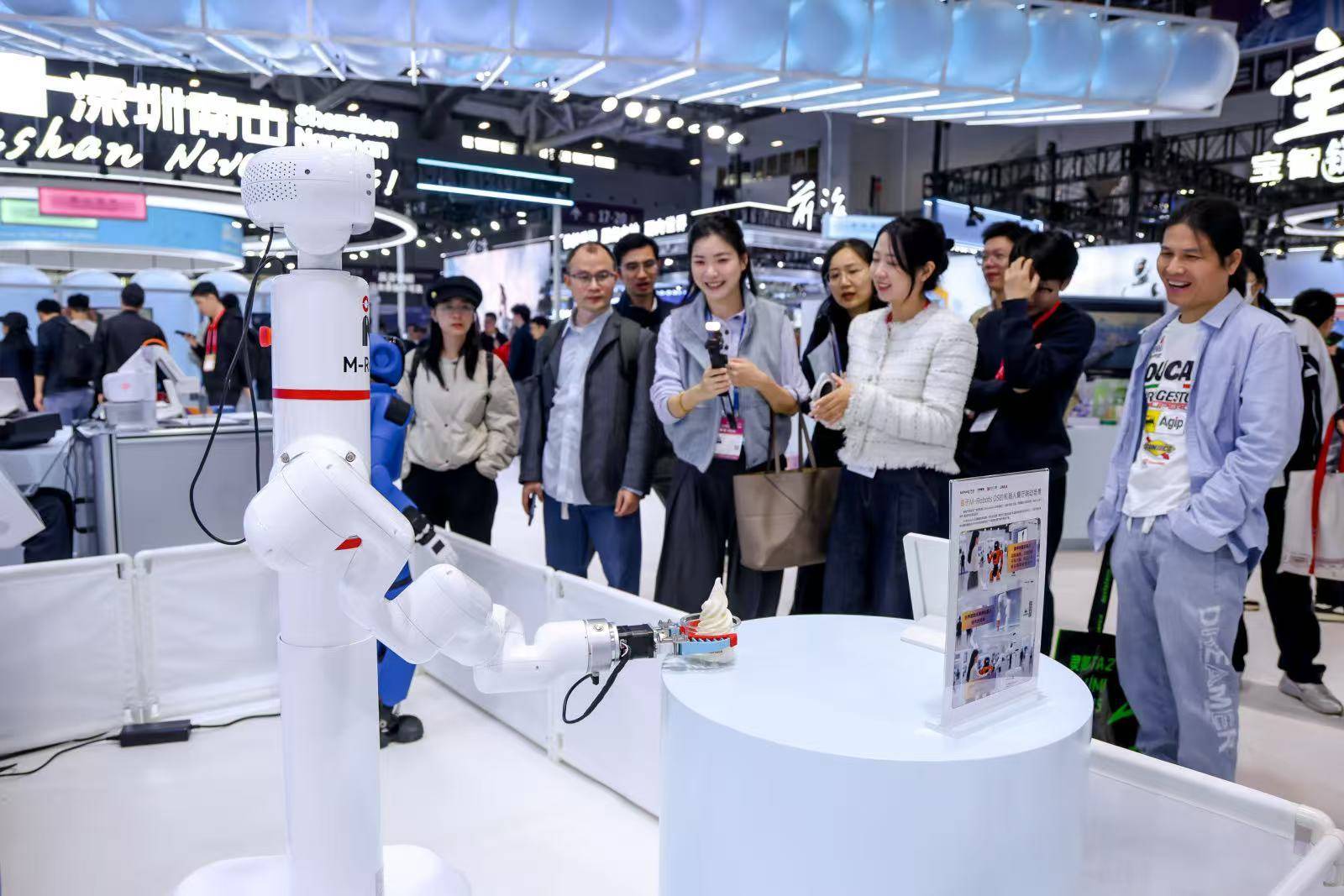
- Kaihong OS links greeting, ice-cream and delivery robots from separate vendors in a single demo.
- XtalPi and CieGene iterate AI-designed molecules against organoid test data in a closed loop.
- Futian aims to support unicorn-tier companies by 2030, backed by local and schedulable computing power.
Unified OS turns robot crowd into crew
At the Futian pavilion in Hall 15, a greeting robot, an ice-cream robot and a delivery robot — each from a different manufacturer — worked the same floor without collision.
The platform combines a unified connectivity layer with on-device intelligent agents and large models to allocate tasks and coordinate hardware. Kaihong has already partnered with Shenzhen Smart City Group to extend the same stack into urban governance and public services via digital twins and AIGC, Sohu reported.
AI designs, organoids validate, data returns
In drug discovery, XtalPi and CieGene have built a feedback loop: XtalPi’s algorithms design and screen candidate molecules; CieGene tests them on cardiac and renal organoids for efficacy and safety, then feeds the experimental data back to retrain the models. “AI can increase the breadth of drug molecules; organoids can increase their precision,” said Zhang Haisheng, founder and CEO of CieGene, told Sohu.
“Only by combining AI design with real experimental data and continuously iterating can R&D become more precise.” Dai Changgui, CieGene’s COO, said the cluster of early-stage R&D service providers in Futian lets companies cut timelines and raise success rates.
A similar loop runs between XtalPi and Yaosu Technology. Yaosu uses organ-on-chip systems to validate candidates in environments closer to human physiology. The pair also co-develop customized automated lab platforms so data flows continuously.
Precision parts power humanoid victory
When Honor’s “Lightning” humanoid won the Beijing E-Town half-marathon in April, 159 core metal structural parts — covering hip, leg, foot and trunk assemblies — came from Futian’s Lens Technology. The company joined Honor’s development early and has moved to volume delivery. Deep co-development lets Lens translate its materials, process and precision-manufacturing strengths into product competitiveness while giving the whole-machine maker earlier manufacturability input, Sohu reported.
Shenzhen, as a premier global technology hub, hosts the Shenzhen Stock Exchange, one of the world’s largest by market capitalization, and is home to tech giants like Huawei, Tencent, and DJI.
By 2025, the city ranked as the eighth-most competitive and largest financial center globally, with a GDP surpassing Hong Kong and Singapore. Additionally, Shenzhen is the largest automobile manufacturing city in China, led by BYD Company, which underscores its dominance in both tech and industrial innovation.
Policy, capital and compute stack the deck
Futian’s “Smart Futian · AI Reality” launch event on November 27 added ten product debuts, according to 粤港澳都市网. The district disclosed infrastructure figures to back the pipeline: locally deployed compute and schedulable compute; 11 “new-quality industrial communities” adding premium space since 2026; and the “Moli Fudi” AI community in He’tao hosting AI firms, research institutes and live scenarios, 粤港澳都市网 reported. Futian aims to grow its unicorn-tier pipeline to more than 100 companies by 2030 through a five-“one” mechanism — one implementation plan, one cultivation list, one professional agency, one space carrier, one service platform — targeting fintech, AI, biopharma, new energy, semiconductors and digital economy, 粤港澳都市网 reported.
As of 2025 the district counted national high-tech enterprises, specialized “little giants,” national-level “little giants,” and unicorns including two “super unicorns” — Honor and GoGoX — tying the national district-level lead, 粤港澳都市网 reported. First-half 2026 industrial output above designated size rose year-on-year; value-added grew, topping the city, 粤港澳都市网 reported. International buyers are writing their own lists.
A British father-son team sought robot parts, chips and R&D partners for agricultural robots; Portuguese founders wanted open SDKs on Chinese industrial hardware to build European solutions; a Brazilian sleep-tech founder hunted investors in the Bay Area, according to 凤凰网.
“China’s open innovation speed is very fast, and new technology applications are also very fast,” the Brazilian founder, Bonaldi, told 凤凰网. “Therefore, China is a very suitable place for high-tech enterprises to develop, especially the Guangdong-Hong Kong-Macao Greater Bay Area.”