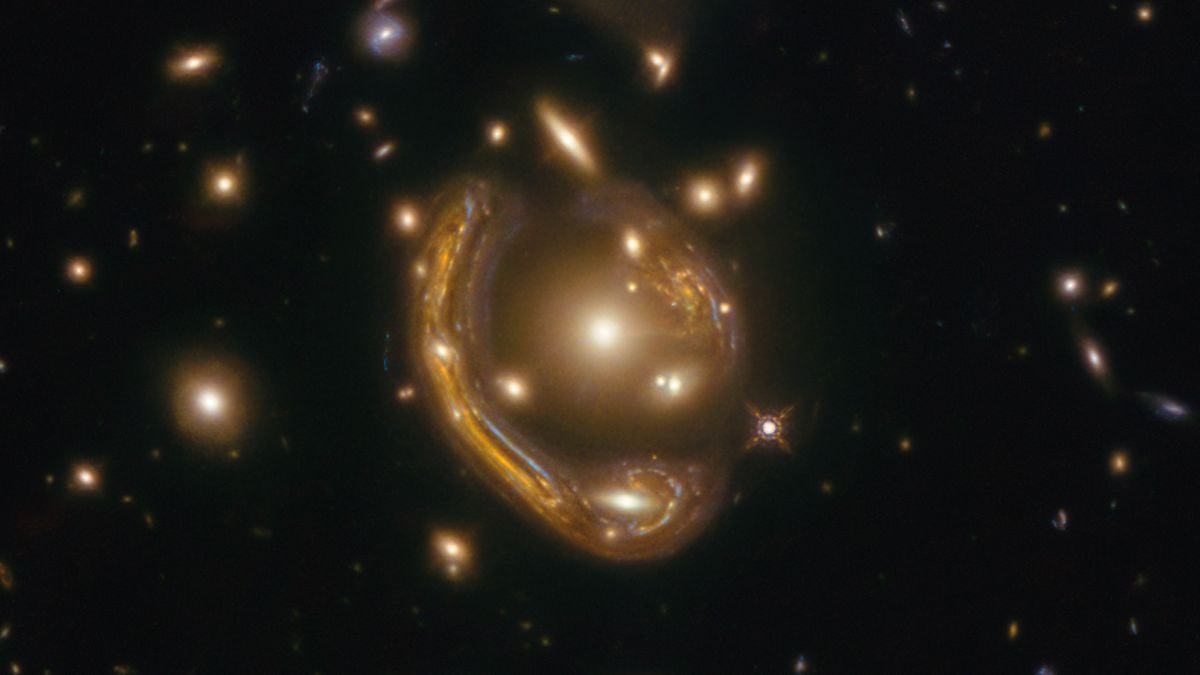
Fundamental Laws of Gravity Pass Major Cosmic Tests
The universe is essentially the ultimate legacy system, running on a codebase written in the 17th century with a few major patches deployed during the early 20th. For years, astrophysicists have suspected a critical bug in the gravitational runtime—a discrepancy between visible mass and observed orbital velocities that suggested the fundamental equations were failing at scale. However, recent telemetry from the furthest reaches of the observable universe suggests that the “legacy” code is, in fact, performing exactly as specified.
The Tech TL;DR:
- The Benchmark: Observations of distant galaxy clusters confirm Newton’s inverse square law remains stable across hundreds of millions of light-years.
- The Bug Report: The “cosmic ledger” discrepancy (where galaxies move too fast for their visible mass) is not a failure of gravity’s “API,” but evidence of an invisible data layer: dark matter.
- The Verdict: Alternative gravity theories (Modified Gravity) are losing architectural viability as the standard model holds firm under extreme stress tests.
In the world of systems architecture, we talk about “scaling issues”—where a solution that works for ten users crashes when you hit ten million. Gravity has faced a similar scaling crisis. On a planetary level, Newton’s laws are essentially O(1) in their reliability. But when you scale the environment to galaxy clusters separated by hundreds of millions of light-years, the math starts to look shaky. University of Pennsylvania cosmologist Patricio Gallardo and his collaborators recently stress-tested this system by analyzing the motion of galaxy clusters, including MACS J1149.6+2223, to see if the fundamental equations for gravity need a rewrite.
The core of the problem is what Gallardo describes as a “massive discrepancy in the cosmic ledger.” When observing how stars orbit within galaxies or how galaxies move within clusters, the velocity is too high relative to the visible matter. In developer terms, the output doesn’t match the input. This creates a binary choice for the architectural roadmap: either the “fundamental equations for gravity need to be modified,” or there is a massive amount of “dark matter” providing additional gravitational pull that we simply cannot detect with current sensors.
The Gravity Tech Stack: Incumbents vs. Disruptors
To understand why this test matters, we have to look at the competing “frameworks” attempting to explain the universe’s behavior. The current production environment relies on a hybrid of Newtonian gravity and Einstein’s General Relativity. The “disruptors” are the Modified Gravity theories, which suggest that gravity doesn’t follow a strict inverse square law at extreme distances.
| Framework | Core Logic | Scaling Performance | Current Status |
|---|---|---|---|
| Newtonian Gravity | Inverse square of distance | Excellent (Planetary/Local) | Legacy Baseline |
| General Relativity | Spacetime curvature | Excellent (Cosmic/High Mass) | Enterprise Standard |
| Modified Gravity (MOND) | Variable acceleration | Theoretical (Galaxy Scale) | Experimental Fork |
The recent data analysis utilized the cosmic microwave background—the faint afterglow of the Big Bang—as a diagnostic tool. As this light passes through the hot gas surrounding galaxy clusters, it picks up tiny distortions. By treating these distortions as telemetry, researchers can infer the velocity of the clusters. The result was a clean pass: gravity behaves exactly as Newton and Einstein predicted, even across the largest distances in the universe. This effectively kills the “bug” theory and reinforces the “dark matter” hypothesis.
Processing this level of data isn’t a trivial task. Analyzing cosmic microwave background distortions requires massive computational overhead, often involving distributed clusters and complex data pipelines. For enterprise organizations dealing with similarly massive datasets, the bottleneck is rarely the algorithm but the infrastructure. This represents why firms are increasingly relying on cloud infrastructure consultants to optimize their HPC (High-Performance Computing) environments and ensure that data ingestion doesn’t hit a latency wall.
The Implementation Mandate: Simulating the Inverse Square Law
For the developers in the room, the “inverse square” logic is a simple calculation, but it’s the foundation of the entire cosmic architecture. If the law were modified—say, to an inverse cube or a logarithmic decay—the entire universe would either collapse or fly apart. Below is a Python implementation of the gravitational force calculation used to verify these scales.
import math def calculate_gravitational_force(m1, m2, distance): """ Simulates Newton's Law of Universal Gravitation. Formula: F = G * (m1 * m2) / r^2 """ G = 6.67430e-11 # Gravitational constant if distance <= 0: raise ValueError("Distance must be greater than zero to avoid singularity.") force = G * (m1 * m2) / math.pow(distance, 2) return force # Example: Force between two galaxy clusters (simplified masses) mass_cluster_a = 1e45 # kg mass_cluster_b = 1e45 # kg dist_light_years = 100_000_000 dist_meters = dist_light_years * 9.461e15 print(f"Gravitational Force: {calculate_gravitational_force(mass_cluster_a, mass_cluster_b, dist_meters)} Newtons") While the math is straightforward, deploying this at scale across a galactic dataset requires rigorous containerization and orchestration. To manage the resulting data sprawl, many research institutions are adopting managed IT services to handle the Kubernetes clusters required for these simulations, ensuring that the compute nodes are balanced and the storage I/O is optimized for petabyte-scale reads.
Architectural Implications and the Dark Matter "Patch"
The fact that Newton's law "holds its ground in the 21st century" is a testament to the robustness of the original design. However, it leaves us with a haunting reality: the "missing mass" is real. Dark matter is essentially the "hidden dependency" of the universe. We can't see it in the source code (the visible spectrum), but the system won't run without it.
From a security and integrity perspective, this is the ultimate "black box" problem. We are observing the effects of an entity we cannot directly measure. This mirrors the challenges faced by modern CISOs managing shadow IT; you can see the traffic hitting the network, but you can't find the device generating it. To solve this, organizations are deploying cybersecurity auditors and penetration testers to map out their invisible attack surfaces, much like astronomers are mapping the invisible scaffolding of dark matter.
For those interested in the underlying data science, the methodologies for these tests are often documented in open-source repositories and pre-print servers. You can find similar astrophysical modeling frameworks on GitHub or explore the latest theoretical papers on arXiv. For a more accessible breakdown of how these cosmic measurements are translated into physics, Ars Technica often provides the best technical deep-dives.
The trajectory of this research suggests that we aren't looking for a new law of gravity, but a new understanding of matter. We've confirmed the API is working; now we just need to find the hidden library that's actually doing the heavy lifting. As we continue to probe the edges of the observable universe, the focus shifts from questioning the rules to identifying the players.
*Disclaimer: The technical analyses and security protocols detailed in this article are for informational purposes only. Always consult with certified IT and cybersecurity professionals before altering enterprise networks or handling sensitive data.*