FSC: 2026 Policy Finance Targets Exceeded; Growth Fund to Expand to 40 Trillion Won in 2026
The Financial Services Commission confirmed Tuesday it exceeded 2026 policy finance targets and will expand the National Growth Fund to 40 trillion won in 2027.
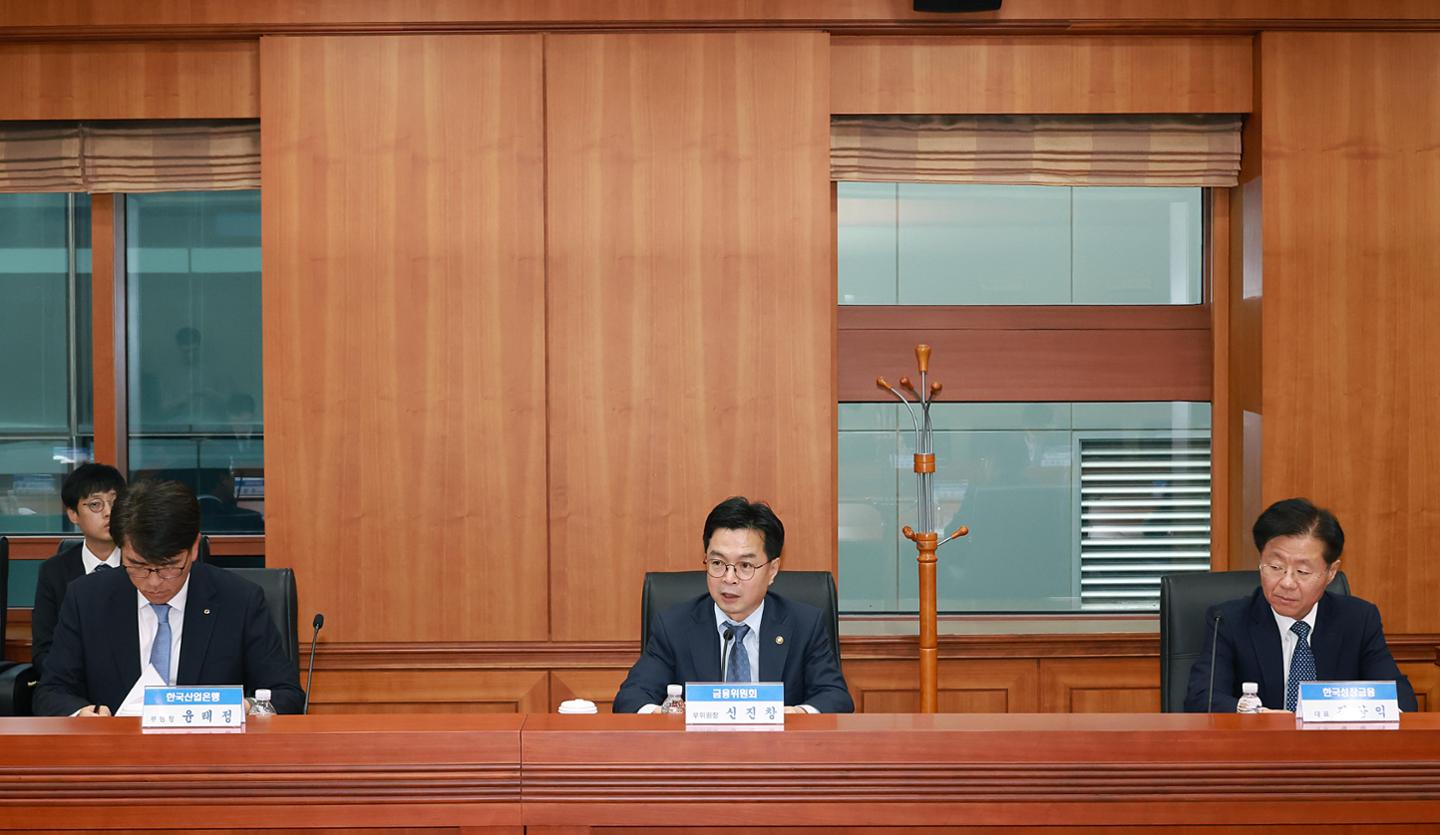
The Financial Services Commission (FSC) held a working-level meeting on Tuesday to finalize policy finance plans for 2027, confirming that the government exceeded its 2026 support targets for strategic industrial sectors.
Government officials, local authorities, and policy finance institutions gathered at the Government Complex Seoul to review current performance and coordinate funding demands for the upcoming year, the FSC reported. By the end of October, four major policy finance institutions—the Korea Development Bank, the Industrial Bank of Korea, the Korea Credit Guarantee Fund, and the Korea Technology Finance Corporation—supplied a total of 245.2 trillion won in policy finance, according to the FSC.
At the 13th Policy Finance Support Council meeting held on Dec. 24 last year, the four institutions had planned to supply a total of 252 trillion won for 2026, with 150 trillion won earmarked for five priority strategic areas, according to Go.
- Strategic sectors received 170.9 trillion won through October, surpassing the annual goal of 150 trillion won.
- The National Growth Fund is on track to meet its 30 trillion won approval target for 2026.
- Policy finance support for local regional businesses reached 95.8 trillion won by October.
The FSC attributed the early achievement of these goals to the rapid deployment of funds into high-tech sectors such as semiconductors and artificial intelligence. “This year’s excellent policy finance performance is expected to continue next year,” said Jeon Yo-seop, Director General for Financial Policy at the FSC, urging departments to share specific funding needs based on regional economic expertise.

Growth Fund Expansion for 2027
Starting next year, the government plans to increase the annual supply of the National Growth Fund to 40 trillion won, up from this year’s 30 trillion won target. The fund also intends to broaden its scope beyond the existing 12 strategic industries to include aerospace and quantum technology.
The 12 current industries are AI, semiconductors, displays, bio, vaccines, robots, future mobility, defense, secondary batteries, hydrogen, core minerals, and content. An amendment to the Enforcement Decree of the Korea Development Bank Act to reflect the expansion is under legislative notice from Oct. 22 to Dec. 1.
According to 한국일보, opposition lawmakers recently questioned the distribution of low-interest loans, noting that most approved funds went to large enterprises rather than small and medium-sized firms. The FSC has countered that such figures should be viewed in the context of all support methods, including direct investments, rather than focusing solely on specific loan categories. As of September, 179 companies applied for low-interest loans and 23 were approved for 5.8405 trillion won.
Large enterprises accounted for 5.03 trillion won, or 86.1%, of the approved amount. Sixty-six SMEs applied and three were approved for 136.5 billion won, or 3.7% of their requested amount. The average execution rate for approved loans in August was 3.93% for large enterprises and 3.89% for SMEs, a difference of 0.04 percentage points. The FSC said that the large enterprise share across all support methods, including direct investment, was 34.0% as of October.
The Financial Services Commission (FSC) directs policy finance through the Policy Finance Support Council, a consultative body launched at the end of 2022 to align supply with national industrial strategies, where the FSC Vice Chairman presides over coordination with the Korea Development Bank (KDB), Industrial Bank of Korea, and Korea Credit Guarantee Fund.

2026 Policy Finance Supply by Sector
Financial authorities are currently preparing the 2027 operational plan based on input from various government ministries and local governments.
“Next year, with a larger scale and support for more diverse high-tech industries, we ask that each ministry and local government actively submit their funding needs for promising companies,” said Son Young-chae, head of the National Growth Fund Promotion Group, as cited by Yonhap News. The FSC plans to finalize these measures and announce them at upcoming strategic committee meetings.