France and Germany propose EU market-blocking tool against unfair trade
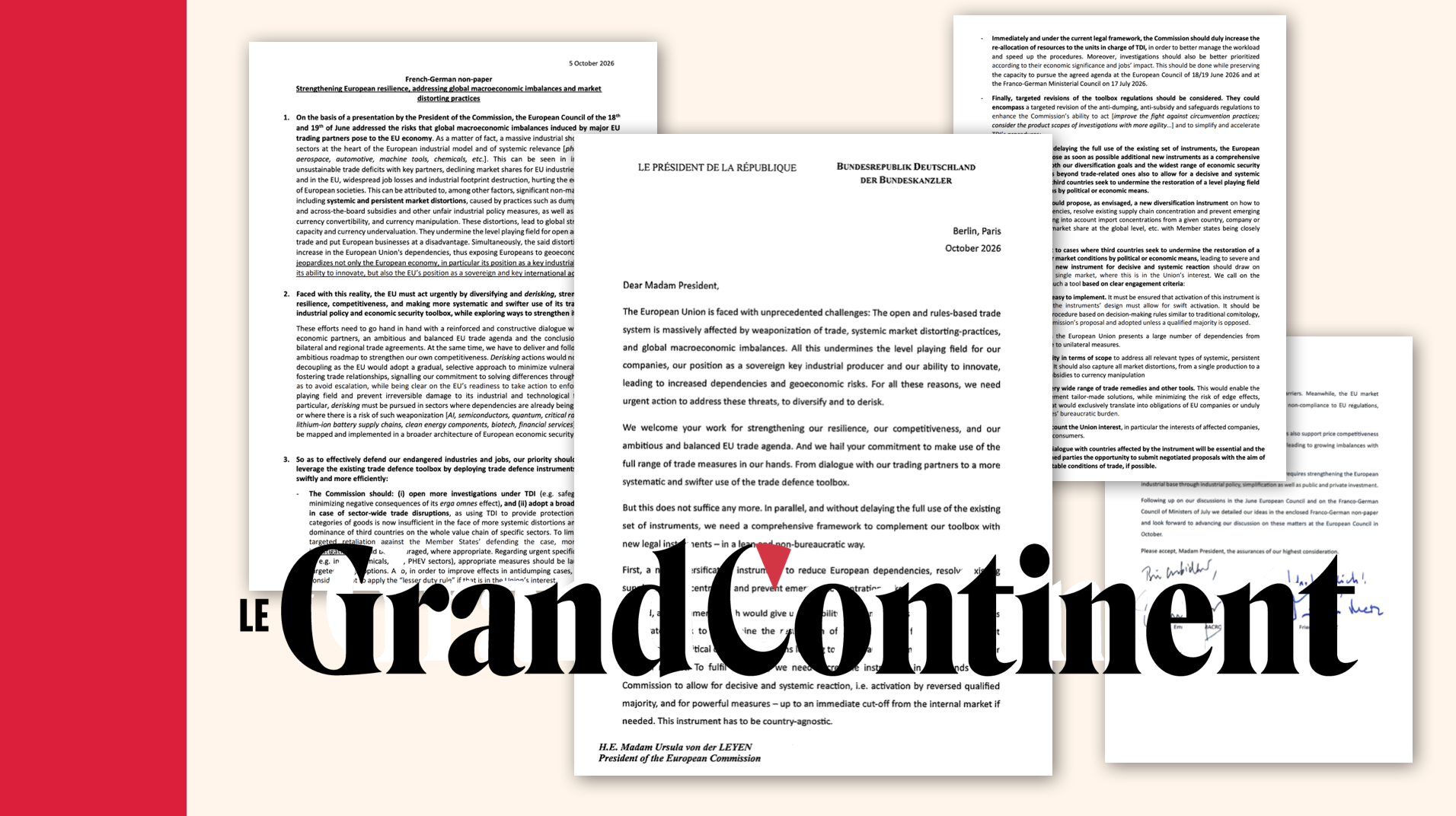
France and Germany jointly sent a one-page letter and a three-page non-paper to the president of the Commission on October 5, 2026, proposing an immediate market-blocking mechanism and systemic response tools against unfair trade practices from third countries.
The joint push follows discussions at the European Council on June 18 and 19, and the Franco-German Council of Ministers on July 17, setting the stage for the upcoming European Council meeting in October. Paris and Berlin warned of a massive industrial shock threatening foundational European sectors, including pharmaceuticals, automotive, aerospace, machine tools, and chemicals.
EU Faces Massive Trade Deficits and Chinese Subsidies
The Franco-German proposal targets structural global overcapacities, widespread and excessive subsidies, currency manipulation, and massive flows of non-compliant small parcels. Pascal Lamy noted that the European Union recorded a trade deficit of one billion euros per day with China in 2025. Chinese enterprises receive three to eight times more public support than their OECD counterparts.
Compounding this competitive imbalance, the Chinese yuan remains undervalued by 16 to 30 percent. Domestic demand in China remains depressed, with private consumption accounting for only 40 percent of GDP, compared to 53 percent in the European Union and 68 percent in the United States. Neither the letter nor the non-paper explicitly names China, but the diagnostic criteria apply directly to its economic model.
EU Proposes Mechanism to Block Unfair Market Access
The two capitals want the European Union to establish a systemic response mechanism to regulate access to the single market. This instrument would allow for the immediate blocking of any third country attempting to hinder the restoration of fair competitive conditions. Designed to be explicitly country-agnostic, the mechanism targets distortions ranging from isolated products to entire sectors, covering both direct subsidies and currency manipulation.
Activation of this tool would bypass traditional member-state deadlocks by relying on a reversed qualified majority. Under this system, a Commission proposal would automatically pass unless an explicit qualified majority of member states votes against it, ensuring that institutional inertia favors swift action rather than delay.
Proactive Enforcement and Upcoming Trade Talks in Beijing
Ahead of formal legislative changes, Paris and Berlin urged the European Commission to utilize existing tools more proactively. They want the Commission to launch investigations on its own initiative to spare individual member states the burden of filing complaints and facing potential retaliation. They also called for examinations of entire sectors rather than narrow product categories, alongside derogations from the lowest legal standard rule when European interests demand it.
The proposals also mandate stricter restrictions on the single market entry of non-compliant goods driven by massive flows of small packages, while aiming for an industrial acceleration law and targeted European preference in strategic sectors by the end of 2026. Both governments want the Eurogroup, the European Central Bank, and the Commission to restart dialogue on exchange rates with competent authorities after years of stagnation.
On October 8, European Commissioner for Trade and Economic Security Maroš Šefčovič will travel to Beijing to co-chair the Trade and Investment working group with counterpart Wang Wentao. Šefčovič stated he expects to return with a proof of concept addressing sudden surges of Chinese industrial exports, concrete paths to increase European exports to China, and a clear long-term vision on Chinese export restrictions for raw materials, particularly rare earths.