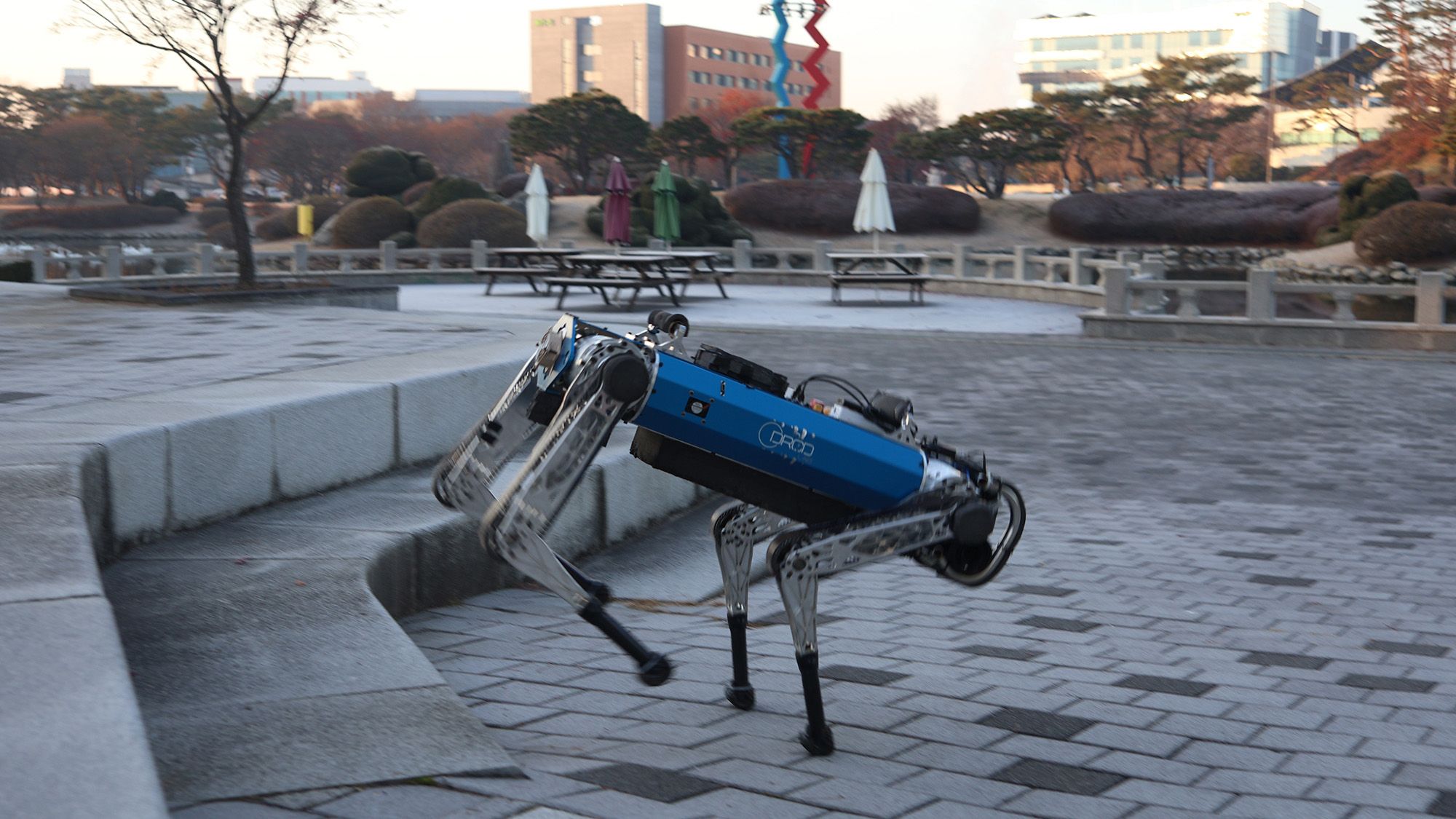
Four-Legged Robot Learns to Adapt Its Gait in Real-Time for Navigation
<>
A quadrupedal robot developed by researchers at the Korea Advanced Institute of Science and Technology (KAIST) has demonstrated the ability to traverse complex outdoor environments, including forests and staircases, by autonomously switching between trotting and bounding gaits. Published July 15 in Science Robotics, the study details a novel artificial intelligence framework that allows the 100-pound machine, known as KAIST HOUND, to adapt its locomotion in real time without human intervention.
- Researchers utilized an action pretrained transformer–based reinforcement learning (APT-RL) framework to enable seamless gait transitions in a quadrupedal robot.
- The system allows the robot to select optimal movement patterns—trotting or bounding—based on terrain topography and speed requirements.
- This advancement reduces mechanical latency and stumbling, potentially increasing the utility of autonomous robotics in disaster relief and inaccessible environments.
Mechanisms of Gait Adaptation and Neural Control
Biological systems inherently modulate gait based on environmental feedback and kinetic demands. Achieving this fluidity in robotics has historically been impeded by the computational lag inherent in switching between specialized, discrete control codes. The KAIST team addressed this through the APT-RL framework, which utilizes a transformer architecture to synthesize movement patterns. By training on 180,000 simulated sequences, the robot learned to generalize beyond its initial training data, allowing for corrective maneuvers in three-dimensional, irregular terrain.
The system integrates real-time data from onboard lidar scanners and depth cameras, enabling the robot to perceive environmental obstacles such as logs, roots, and vertical staircases. According to the study, the integration of these sensors into the reinforcement learning loop allowed the machine to achieve speeds of up to 9.5 mph while maintaining stability.
Data Synthesis and Training Efficiency
The training methodology represents a significant departure from traditional, manually coded locomotion. The researchers used trajectory optimization to generate physically viable movement sequences, effectively creating a 15.5-hour training dataset in just eight minutes of computational time. This efficiency is critical for developing robust robotic systems that must adapt to dynamic, unpredictable physical environments.
While the current iteration focuses on forward motion and two primary gait modes, the framework provides a foundation for more complex behaviors. Future development goals include incorporating multidirectional movement, such as rapid turning and lateral motion.
Clinical and Operational Implications
The ability of autonomous systems to navigate terrain that is hostile to wheeled vehicles has significant implications for sectors ranging from search-and-rescue to specialized logistics. By minimizing the risk of mechanical failure—often caused by gait-transition lag—this technology provides a more reliable modality for navigating disaster zones or environments where human access is limited. The research was supported by the Korea Advanced Institute of Science and Technology.
As the research team moves toward addressing more complex, non-linear movements, the integration of these systems into public and private infrastructure will depend on the continued optimization of these gait-selection algorithms. The current results suggest that a versatile, adaptable gait is a fundamental requirement for the next generation of autonomous mobile machines.