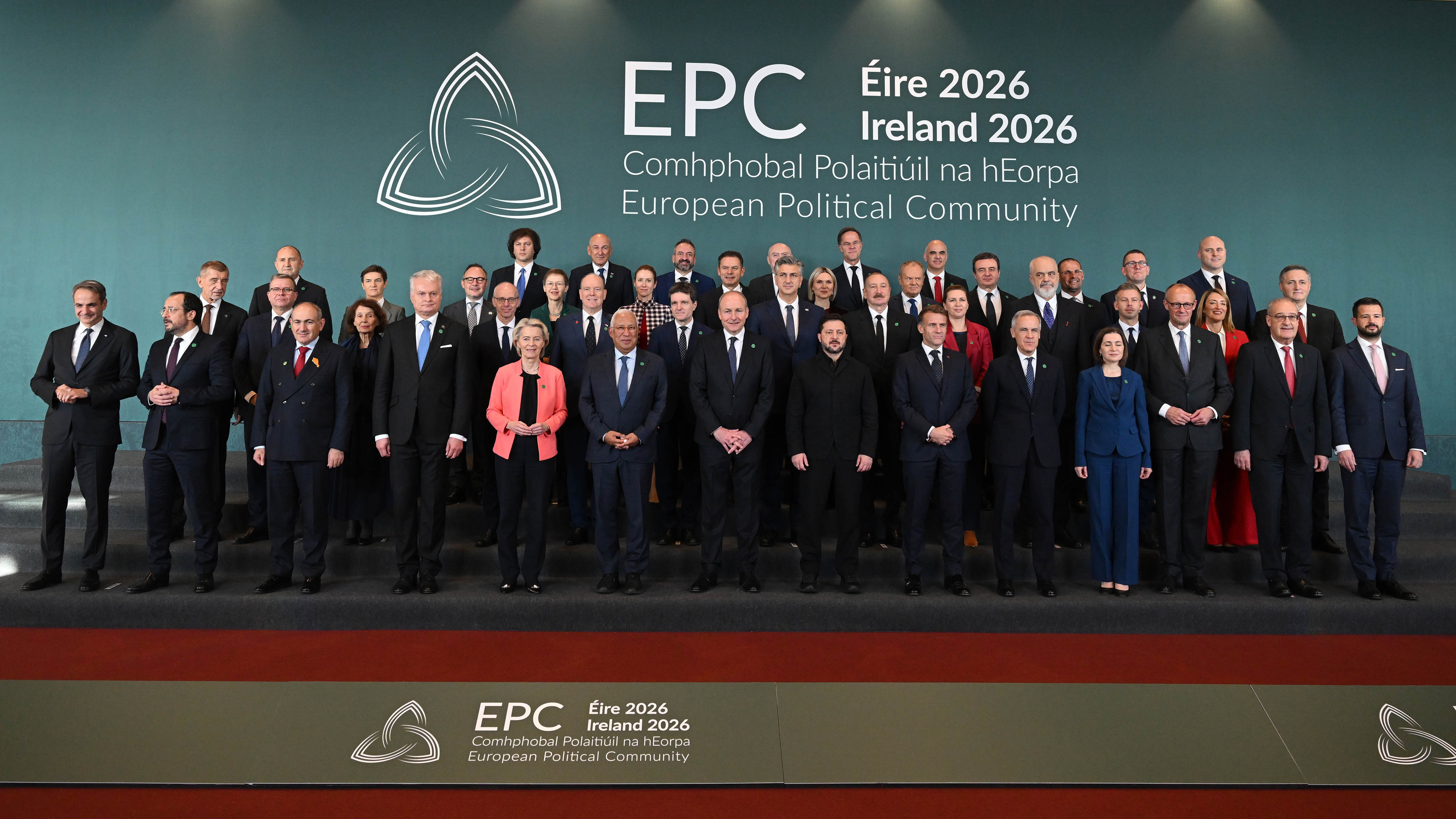
Forty Nations Sign Declaration on European Security in Dublin
Forty European countries signed the Declaration on key principles of European security on the margins of the European Political Community Summit in Dublin.
Vision for European Security
The non-binding political declaration outlines 10 principles and 13 common objectives aimed at demonstrating political unity and backing for Ukraine. Only seven members of the broad European Political Community—stretching from Iceland to Azerbaijan while excluding Russia and Belarus—withheld their signatures.
The text shows European nations refuse to let outside powers circumvent them during discussions on their own defense framework. Signatories explicitly reject Russia and its spheres of influence approach across the continent.
Abu Dhabi Talks Context
“shared commitment to a strong post-war European security architecture and arrangements.” the statements released by U.S. envoy Steve Witkoff and the European Council on November 10 detailed, said the European Council.
Preparation for a declaration of this scale takes weeks of careful drafting. Consequently, the text was not merely a sudden reaction to the Abu Dhabi meetings.
Coordinating a Future Security Framework
European capitals have quietly coordinated their future security framework for months. “how Europe's stability should be organized” French President Emmanuel Macron said in his March 2026 Île longue speech delivered in France, noting that initial work had started with Germany and the United Kingdom and inviting other regional partners to join.
That address established a clear methodology. The nations aimed first to define core European security interests before opening a framework for negotiations to control conventional capabilities and force positioning.
Rejecting Russian Demands
European states harbor deep concerns that Moscow might exploit separate negotiations with the United States over the war in Ukraine to push for broader geopolitical demands. The Dublin declaration notes that future developments in strategic stability remain conditional upon the conclusion of the war in Ukraine.
Moscow calculates that the current U.S. administration wants a swift end to the conflict and aims to avoid military escalation. Russian leadership anticipates Washington might accept wider European claims as a shortcut to peace, either by pressuring European allies or by using direct U.S. force deployments on the continent.
Russia’s long-term objective seeks to divide Europe into two distinct spheres. This design matches the draft agreements circulated by Moscow in late 2021 demanding an end to NATO nuclear sharing and a ban on foreign force deployments in allied states that joined the alliance after 1997.
Reaffirming Founding Principles
The new text lists core principles forming the foundation of continental peace, including territorial integrity and the sovereign right of states to freely determine their alliances. Signatories reaffirm the enduring centrality of historic accords such as the 1975 Helsinki Final Act, the 1990 Charter of Paris for a New Europe, and the 1999 Istanbul Charter for Security in Europe.
On November 10 in Abu Dhabi, U.S. envoy Jared Kushner said that the Russians are really ready for peace under the right conditions, but they ask whether Ukrainians and Europeans are genuinely ready for peace.
“the Russians” are “really ready for peace . . . under the right conditions,” but they ask, “are [the Ukrainians and Europeans] really genuinely ready for peace?” Jared Kushner
By signing the Dublin text, forty nations provided a unified answer rejecting any narrative that casts European states as obstacles to a lasting settlement.
Refusing Circumvention
Signatories establish that any matter affecting European security must be decided with the direct participation of Europeans. President Macron previously lamented that historical security frameworks were frequently negotiated about Europe while excluding Europeans entirely.
Strategic reality reinforces this principle. European governments control critical levers required to shape any future architecture, ranging from domestic defense industrial capability developments and military aid for Ukraine to EU membership agreements and international sanctions.
Balancing Defense Strength with Regulatory Norms
European security relies on a dual-track approach balancing defense strength and regulatory norms. This methodology mirrors the strategy forged by NATO in 1979 during the Euromissile crisis, which combined force deployments with arms control negotiations leading to the Intermediate-Range Nuclear Forces Treaty.
Current priorities concentrate heavily on reinforcing military posture and closing capability gaps with Russia. The first common objective in the declaration commits signatories to upholding security under the United Nations Charter, NATO frameworks, the European Union, and bilateral agreements.
While reinforcing posture, signatories also anticipate future discussions on norms. The text supports establishing further risk management and reduction mechanisms once conditions permit and peace is restored.
Upcoming Challenges
Translating political principles into concrete commitments presents three distinct hurdles for European capitals. Maintaining a permanent seat at the negotiating table requires constant vigilance against bilateral deals between Washington and Moscow.
Preserving internal continental unity will test leaders as discussions progress. Frontline states directly exposed to Russian threats may resist any engagement on risk reduction norms out of fear that it could dilute deterrence or distract from military readiness.