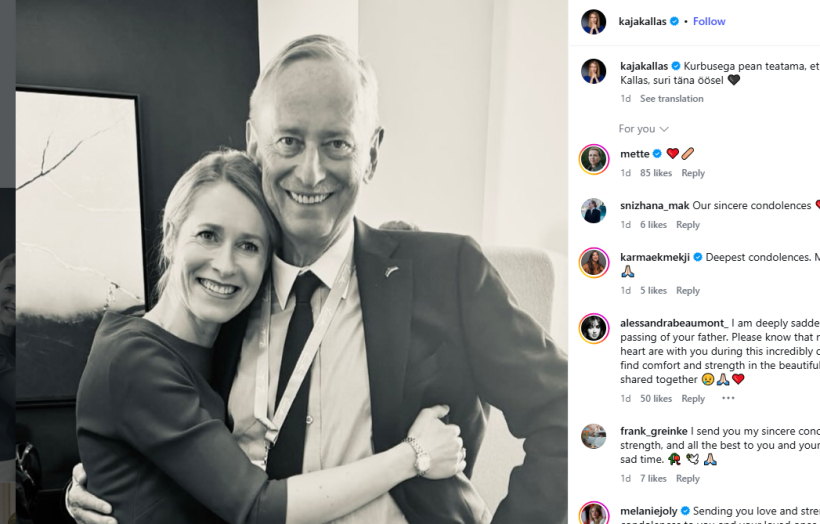
Former Estonian Prime Minister Siim Kallas Dies
Sīms Kallass, a former Estonian prime minister, European Commission vice-president, and one of the most influential political figures in modern Estonian history, has died at the age of 83, according to social media statements made by his daughter, European Union High Representative Kaja Kallas, and corroborated by regional reporting from TVNET.
The death of the former statesman marks the passing of a foundational architect of post-Soviet Baltic independence and market integration. According to coverage published by TVNET, Kaja Kallas announced the passing of her father, stating, “With grief I must announce that my beloved father died this night.” The loss removes a central figure from the Baltic political landscape, whose career shaped both Estonia’s domestic monetary policy and its deeper integration into Western European institutions.
Monetary Reform and the Rise of the Reform Party
Kallass played an instrumental role in establishing Estonia’s post-Soviet economic sovereignty. Following the restoration of Estonian independence, he served as the president of the Bank of Estonia from 1991 to 1995. During this tenure, he spearheaded the introduction of the Estonian kroon and managed the crucial monetary reforms of 1992 that detached the nation from the ruble zone and stabilized its nascent economy.
https://x.com/edgarsrinkevics/status/2091449616629702692
Beyond his central banking work, Kallass cemented his political influence by co-founding the Estonian Reform Party, serving as its long-standing chairman. His political ascent continued through several high-profile government portfolios. He served as foreign minister from 1995 to 1996 and held the position of finance minister between 1999 and 2002. He subsequently served as Estonia’s prime minister from 2002 to 2003, steering the country’s executive branch during a critical phase of European alignment.
European Commission Tenure and Transnational Impact
Kallass transitioned from domestic governance to the European stage in 2004, taking on the role of European Commission vice-president, a post he held for a decade until 2014. His long tenure in Brussels coincided with a period of massive EU enlargement and regulatory consolidation.

Legacy on the Global Stage
His multifaceted career—spanning central banking, national ministries, the prime minister’s office, and a decade at the European Commission—underpins the institutional stability that defines modern Estonia within the Euro-Atlantic community.