
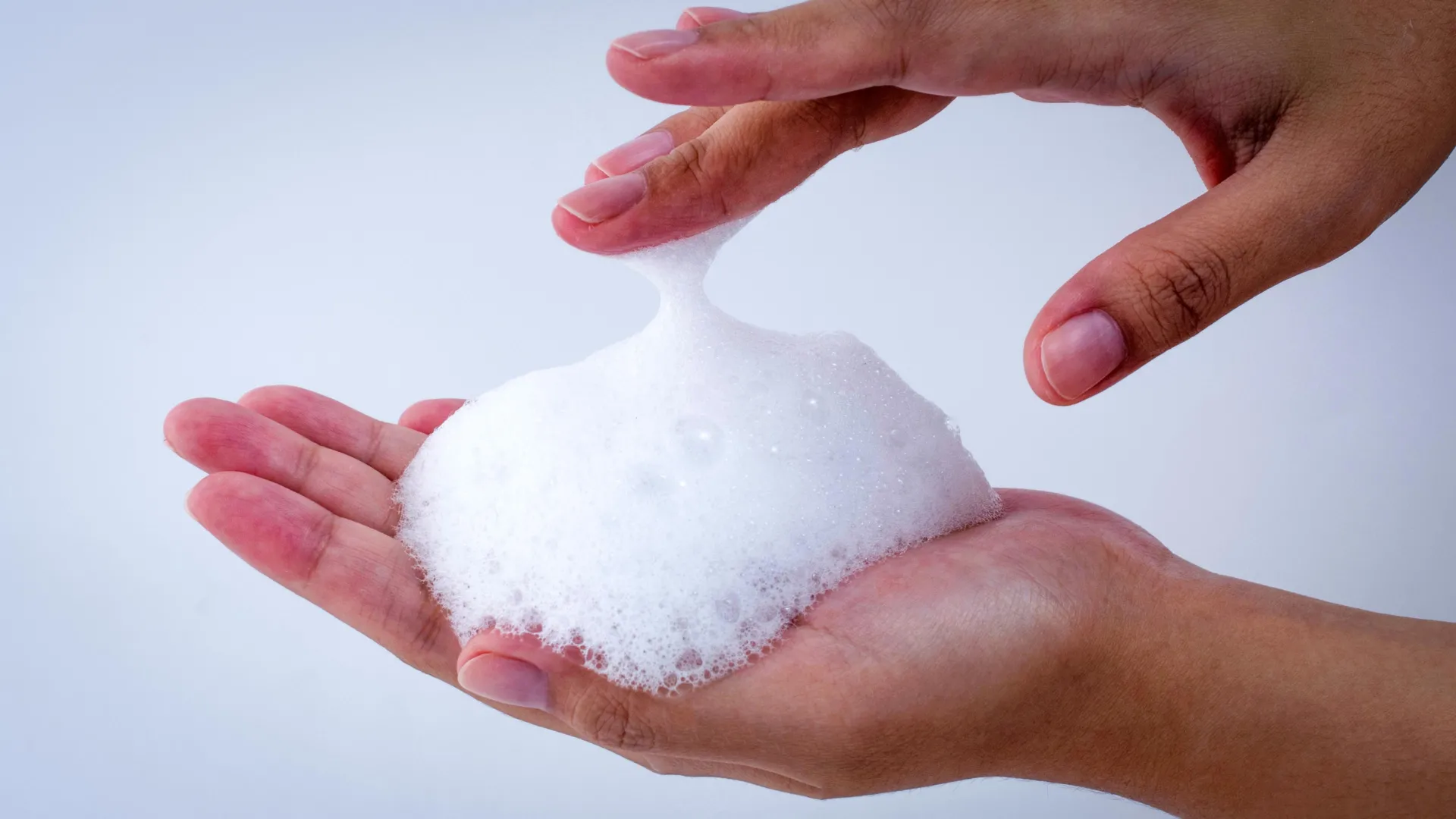
Foam Drainage Mystery Solved: Bubble Movement, Not Pressure, Is Key
For decades, scientists have struggled to explain why even relatively small volumes of foam readily drain, defying predictions based on established physics. Researchers at Tokyo Metropolitan University have now identified the key factor: the pressure required to rearrange the bubbles within the foam itself, rather than simply liquid flowing through a static structure.
The seemingly simple act of foam drainage – the formation of droplets and leakage from the bottom of a foamy substance – has presented a persistent puzzle. Foams, composed of bubbles separated by thin liquid films, create a complex network through which liquids can move, either draining away or being absorbed. Traditional models posited that this process was governed by “osmotic pressure,” a measure of the energy change when bubbles compress and the contact area between liquid and gas shifts. This concept led to the “absorptive limit,” which predicted that foam would demand to be approximately one meter tall before drainage began.
However, observations consistently contradicted these calculations. Even foams only tens of centimeters high routinely exhibited leakage, creating a significant discrepancy between theory and reality. This gap in understanding has been particularly relevant given the widespread use of foams in diverse applications, from cleaning products and shaving creams to pharmaceuticals and even potentially in disinfecting surfaces, where stability is crucial.
The Tokyo Metropolitan University team, led by Professor Rei Kurita, conducted experiments using simple foam systems created with varying surfactants. They observed these foams between transparent plates, allowing for direct visualization of liquid movement. Their findings revealed a consistent inverse relationship between foam drainage and liquid content – the lower the liquid content, the sooner drainage commenced, irrespective of the surfactant type or bubble size. Crucially, they calculated an “effective osmotic pressure” that was significantly lower than previously predicted based on bubble size and surface tension alone.
Detailed video analysis of the foam’s internal dynamics revealed that drainage wasn’t simply a matter of liquid flowing through fixed channels. Instead, the onset of drainage coincided with the shifting and rearrangement of the bubbles themselves. This led the researchers to identify “yield stress” – the pressure needed to move and reorganize the bubbles – as the controlling factor. Their modern model, incorporating this concept, accurately predicts the heights at which drainage occurs in various foam types.
According to a news release from Tokyo Metropolitan University, this discovery represents a shift in how scientists approach foam drainage. Rather than viewing foam as a static structure, it should be understood as a dynamic system capable of structural change. This new perspective, the researchers believe, could lead to a more profound understanding of soft materials and inform the development of improved foam-based products.
The research was supported by a JSPS KAKENHI Grant, project number 20H01874.