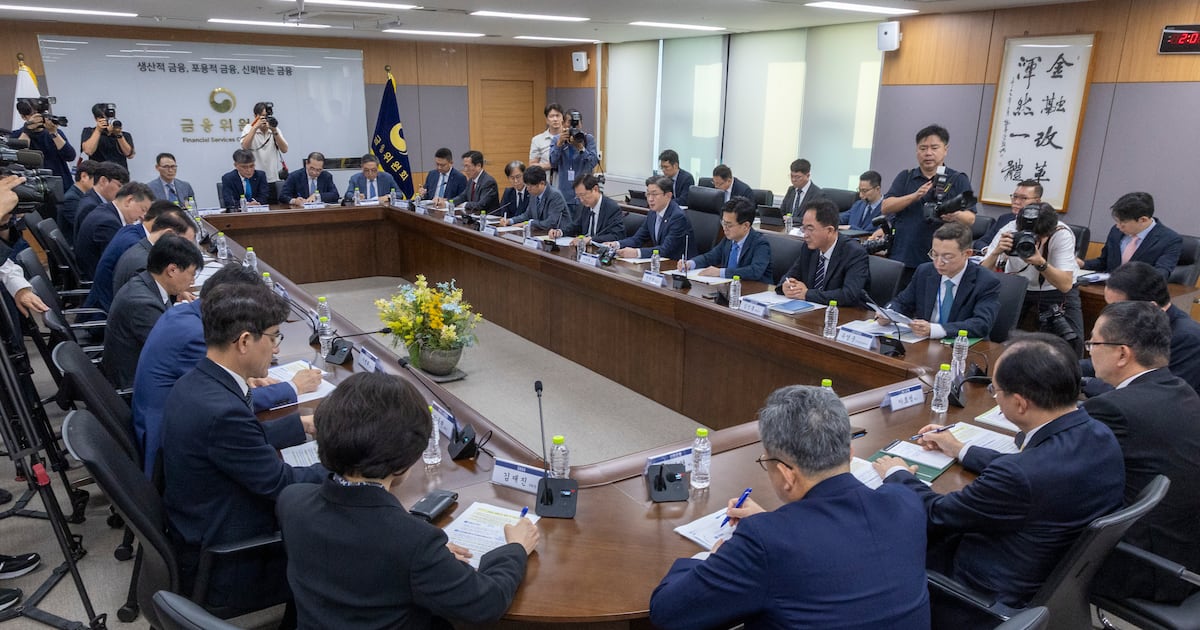
Financial Services Commission holds emergency meeting after cyberattacks
Financial Regulators Hold Emergency Meeting Following Automated Cyberattacks
Personal and corporate customer information has leaked across multiple major financial institutions after automated cyberattacks exploited peripheral employee systems rather than core banking networks. The Financial Services Commission convened an emergency inspection meeting at the Seoul Government Complex on October 4, to address the sweeping data breaches.
The confirmed institutions impacted by the data leaks include Shinhan Bank, KB Kookmin Bank, Hana Bank, BNK Busan Bank, Hyundai Capital, Yegaram Savings Bank, and Welcome Savings Bank. Rather than breaching high-security mainframes like internet and mobile banking portals, hackers focused their automated tools on secondary operational systems utilized by loan solicitors and internal staff members, according to financial sector findings.
Attackers Bypass Traditional Account Lockouts Using Automated AI Tools
Hackers utilized artificial intelligence to scan multiple financial systems simultaneously, identifying and penetrating the least secure access points. The attacks targeted loan recruitment verification systems at Shinhan Bank and Hyundai Capital, mobile work support systems at KB Kookmin Bank, and sales support infrastructure at Hana Bank.
Security protocols that normally flag suspicious entry attempts were actively circumvented during the incidents. Financial sector IT sources explained that if entering an incorrect password five times triggers a system lockout and an alert, automated scripts instructed the AI to attempt entry only four times before cycling to a different account, thereby dodging detection thresholds across massive volumes of stolen credentials.
Authorities Investigate Extent of Compromise as International IP Addresses Emerge
The identity and backing of the cyberattackers remain unconfirmed as police investigations continue. Financial authorities identified matching internet protocol addresses across multiple targeted institutions, though officials cautioned that shared IP footprints do not yet confirm a single orchestrating organization or specific nation-state actor.
The intrusion at Shinhan Bank alone involved traffic routed through IP addresses spanning South Korea, the United States, Japan, Hong Kong, Singapore, Vietnam, Thailand, and the United Kingdom.
Disclaimer: The views and cultural analyses presented in this article are for informational and entertainment purposes only. Information regarding legal disputes or financial data is based on available public records.