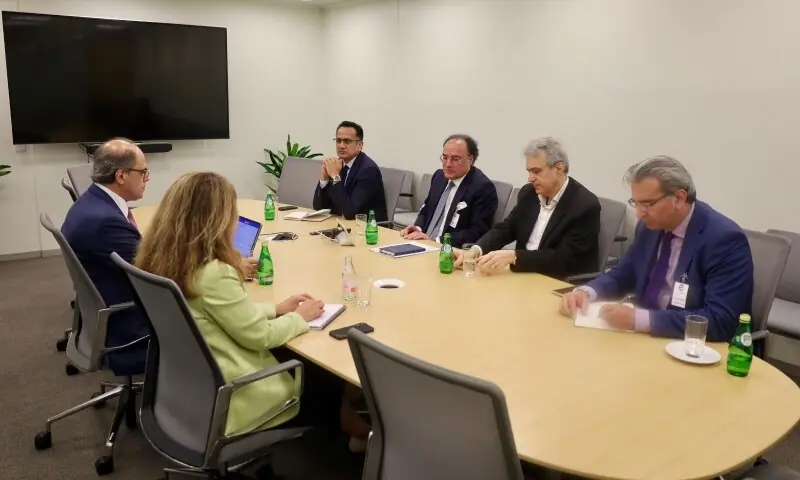
Finance Minister Muhammad Aurangzeb Reviews Pakistan’s Economic Progress with IMF Officials
Finance Minister Muhammad Aurangzeb met with senior International Monetary Fund officials in Washington on July 22, 2026, to review Pakistan’s macroeconomic performance under the Extended Fund Facility, the Resilience and Sustainability Facility, and broader structural reform commitments, according to an official finance ministry statement published on X.
Evaluating Macroeconomic Performance Under IMF Oversight
During the high-level meetings in Washington, Aurangzeb sat down with IMF First Deputy Managing Director Dan Katz, Deputy Managing Director Nigel Clarke, Director of the Middle East and Central Asia Department Jihad Azour, and Mission Chief for Pakistan Iva Petrova. The discussions focused on tax and energy reforms, privatisation, tariff rationalisation, debt management, diversification of financing sources, and Pakistan’s return to international capital markets.
The finance ministry reported that Aurangzeb pointed to improved fiscal and external balances, noting the successful achievement of revenue targets and stronger foreign exchange reserves. Officials also cited record remittances and a stabilized current account position as evidence of policy traction.
Structural Reforms and Capital Market Access
Beyond immediate fiscal metrics, the talks addressed long-standing structural vulnerabilities. The federal government aims to diversify its financing sources while charting a clear path back to international capital markets.
Both sides also exchanged views on human capital development, demographic shifts, technology-led growth, and private sector-led export diversification. Aurangzeb thanked the Fund for acknowledging Pakistan’s strong program ownership, reaffirming a strict adherence to fiscal discipline and policy credibility.
Bilateral Trade and US EXIM Bank Discussions
The Washington mission extended beyond multilateral lenders. Aurangzeb met with US Export-Import Bank President and Chairman John Jovanovic to negotiate expanded commercial cooperation. The talks prioritized financing for long-term infrastructure projects and increased agricultural and energy trade, including cotton, soybeans, and hydrocarbons.
The finance ministry confirmed that both parties agreed to establish a multi-year transaction pipeline. This framework is slated for formal signing on the sidelines of the United Nations General Assembly session in September 2026.
These bilateral engagements coincide with ongoing negotiations regarding US tariff policy. Following the initial imposition of a 29 percent tariff on Pakistani exports under the International Emergency Economic Powers Act in April 2025, a dedicated negotiating team successfully reduced the proposed levy to 19 percent in July 2025.
Technology Integration and Sovereign Support Requests
Energy security and industrial modernization also featured prominently in the itinerary. Aurangzeb met with executives from Honeywell Technologies to review proposed modernization blueprints for Pakistan’s refining sector, aiming to boost operational efficiency and downstream yield.
These industrial talks followed a high-stakes meeting earlier in the week where Aurangzeb formally requested a $10 billion Exchange Stabilisation Support Facility from US Treasury counterparts.