Federal student loan default rates hit 19%, CRS analysis finds
Federal student loan default rates climbed to 19 percent by the fourth quarter of fiscal 2026, encompassing 8.8 million recipients, as pandemic-era relief policies expired and administrative errors compounded credit reporting issues across the portfolio, according to an analysis by CRS.
A federal student loan made under Title IV of the Higher Education Act of 1965 is considered delinquent the first day after a borrower fails to make a scheduled payment. The Department of Education, through its contracted loan servicers, reports delinquencies to private consumer reporting agencies after 90 days or more of delinquency, with default generally occurring after 270 days of missed payments.
Pandemic Relief Policies Masked Underlying Portfolio Stress
Borrowers of these loans received up to two distinct periods of repayment relief following the onset of the COVID-19 pandemic. Congressional and administration-authorized forbearances suspended monthly payment obligations between March 2020 and August 2023. Following the end of that payment pause under Public Law 118-5, the Department of Education instituted an on-ramp policy running from September 2023 through September 2024. During this on-ramp window, monthly payments were technically due, but the agency placed borrowers more than 90 days delinquent into a retroactive administrative forbearance. This shifted loan statuses back to current repayment and delayed negative credit reporting until January 2025.
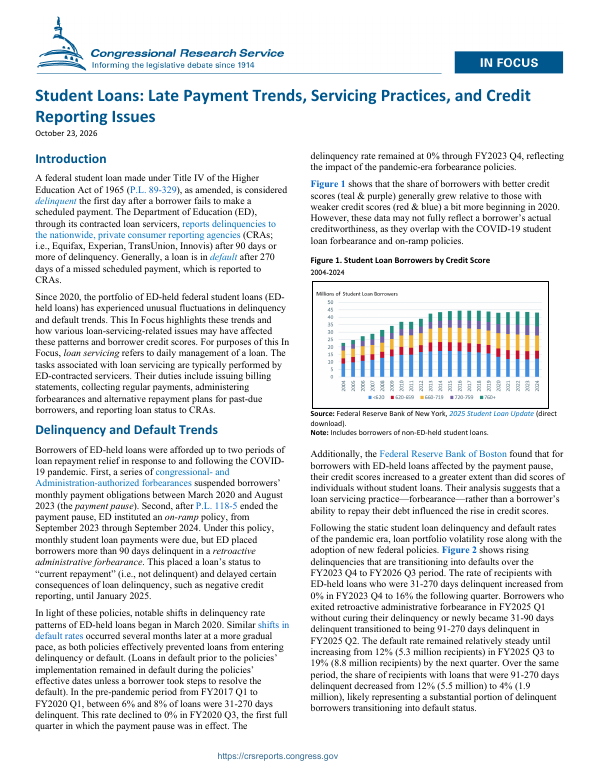
In the pre-pandemic period spanning fiscal 2017 Q1 through fiscal 2020 Q1, between 6% and 8% of loans were 31 to 270 days delinquent. That rate dropped to 0% by the third quarter of fiscal 2020 and remained there through the final quarter of fiscal 2023. Concurrently, an analysis by the Federal Reserve Bank of Boston found that credit scores for borrowers with loans affected by the payment pause increased more than the scores of individuals without student loans. That research suggests loan servicing forbearance, rather than an underlying shift in a borrower’s capacity to repay, drove the initial credit score gains.

The Default Cliff Emerges After Administrative Protections End
Portfolio volatility surged alongside the adoption of new federal policies once the protective window closed. The share of recipients with loans 31 to 270 days delinquent jumped from 0% in the fourth quarter of fiscal 2023 to 16% the following quarter. Borrowers who exited retroactive administrative forbearance in the first quarter of fiscal 2025 without resolving their delinquency—or who newly fell 31 to 90 days behind—pushed 91-to-270-day delinquency figures higher in the subsequent quarter.
Default rates held relatively steady before climbing from 12%, representing 5.3 million recipients in the third quarter of fiscal 2025, to 19%, representing 8.8 million recipients by the next quarter. Over that same timeframe, the share of recipients with loans 91 to 270 days delinquent dropped from 12% down to 4%, representing 1.9 million borrowers. This shift likely captured a substantial volume of delinquent borrowers transitioning directly into default status.
Servicing Errors and Transfer Complications Compound Borrower Penalties
Various factors contributed to the rising delinquencies and defaults that began in fiscal 2024 Q1, prominently including loan administration practices. The Consumer Financial Protection Bureau reported in 2024 that loan servicers routinely made basic payment processing errors, such as misreporting payment amounts, while providing conflicting or inaccurate information that resulted in mistaken delinquencies.
The Department of Education directed the transfer of servicing rights among contractors in 2023, a move that may have contributed to nearly 2 million credit reporting errors. Consumer reporting agencies allegedly were not informed of these transfers. Consequently, single debts sometimes appeared as two duplicate loans, open histories were incorrectly shortened by treating existing loans as closed and new loans as opened, and on-time payment histories failed to carry forward properly.
Additional administrative strain arrived with the implementation of 2025 statutory changes to federal loan programs, including the repeal and authorization of new repayment plans. Litigation challenging the Department of Education's authority to establish the Saving on a Valuable Education plan led to millions of enrollees being placed in forbearance starting in July 2024. Because research indicates that borrowers in income-driven repayment plans historically maintain lower default rates than those in standard plans, shifting SAVE plan enrollees who fail to select an alternative income-driven plan into standard repayment raises fresh concerns about future defaults.
Loan Delinquencies Lower Credit Scores and Trigger Federal Restrictions
Student loan delinquencies can reduce credit scores by more than 150 points, restricting future credit access. Negative payment history is also reported to the Credit Alert Verification Reporting System, a federal database managed by the Department of Housing and Urban Development and used by agencies including the Federal Housing Administration, the Department of Veterans Affairs, and the Small Business Administration to screen loan applicants.
Unlike private credit bureaus, CAIVRS includes only information regarding federally made or insured loans that are 90 days or more past due or in default, and it is accessible exclusively by authorized loan originators and federal agencies. Because federal agencies may report negative information to CAIVRS without notifying private credit bureaus, an individual might appear creditworthy on a private credit inquiry while facing federal screening rejections. Borrowers frequently discover this reporting only when applying for federally guaranteed mortgages or small business loans, leaving them to dispute inaccurate data even after resolving underlying issues with the Department of Education.