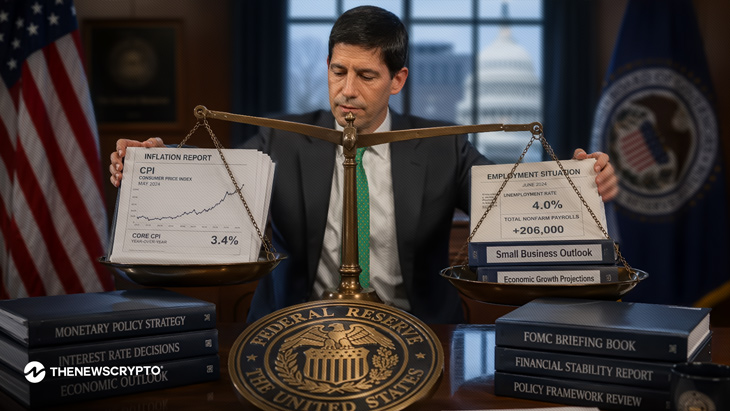
Fed Chair Kevin Warsh Signals Potential Rate Hikes to Combat Inflation at Jackson Hole
Federal Reserve Chairman Kevin Warsh affirmed during the Jackson Hole Economic Symposium that the central bank remains determined to drive inflation down to its 2% target, explicitly warning that policymakers may need to raise interest rates to accomplish it, according to reporting by Axios.
Markets wobbled following the remarks, which marked a sharp pivot toward conventional monetary policy after weeks of vague ruminations from the new central bank head. Warsh stated that underlying inflation remains too high and financial conditions look frothy, signaling that buoyant corporate profits, capital spending, and lending activity could soon compel a tighter policy stance.
The speech represents a significant recalibration for a central bank leader who assumed office in May with a reputation for unconventional management.
Shifting Away from Vague Ruminations and Forward Guidance
Warsh engaged in standard central banker speechifying in Wyoming, addressing colleagues from around the world just weeks after unsettling the bond market during a late July press conference. His previous remarks had left investors questioning his commitment to the meat-and-potato work of analyzing incoming economic data. According to Axios, Warsh explicitly reiterated that the Fed is aiming for a firm, fixed 2% inflation target using traditional measurements.
Eccles Building. Business Insider reports that the 56-year-old former Morgan Stanley executive and Bush White House economic adviser is running the central bank more like a C-suite than a traditional academic institution. Warsh has dismantled the prior reliance on extensive forward guidance, arguing that oversharing policy deliberations leads markets and households astray.

The divergence in communication style from predecessors like Jerome Powell and Janet Yellen is stark. The two interest rate decision briefs released under Warsh’s tenure thus far have been short and nearly verbatim, offering minimal insight into future rate adjustments. Warsh abstained from the June economic projections entirely, declining to publish his own dot on the dot plot.
“It appears Chairman Warsh realized that he couldn’t appear as the monetary policy maestro that he aspires to be without leading the orchestra to a flawless symphony first,” said EY chief economist Greg Daco in a note cited by Axios.
Managing Capital Spending and Yield Curve Pressures
Economic indicators suggest that the broader economy retains considerable momentum, complicating the central bank’s path forward. Warsh noted that summer inflation readings, while better than expected, failed to signal a meaningful improvement in underlying trends. With corporate lending active and capital expenditure buoyant, Warsh told symposium attendees that he would be hard-pressed to describe broad financial conditions as restrictive.
That assessment maps directly into the rationale for potential rate hikes. Yet Warsh stopped short of locking the Fed into a specific move for upcoming meetings, emphasizing a data-dependent stance without the detailed policy rationales favored by past chairs.
Warsh acknowledged that the economy and monetary policy are rapidly re-wiring through innovations such as artificial intelligence, but he stressed that the central bank must set policy based on the immediate reality of the U.S. economy.