Fastest Star in Milky Way Discovered Orbiting Supermassive Black Hole
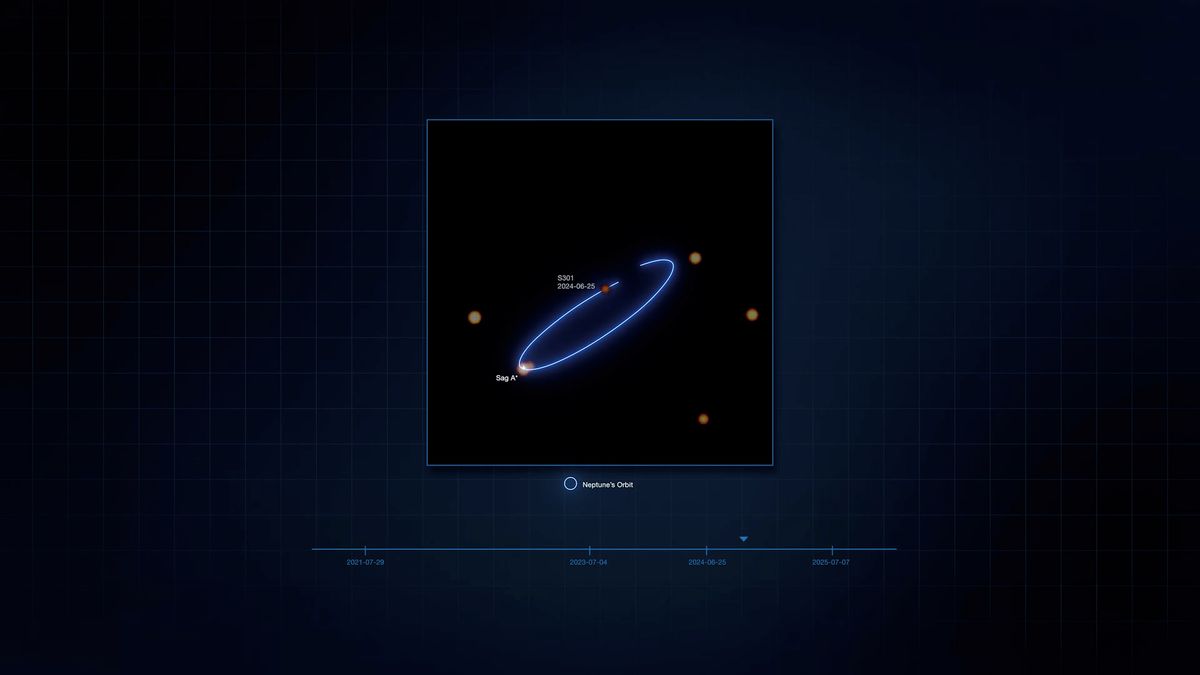
Astronomers have discovered the fastest star in the Milky Way. Designated S301, it sprints around the supermassive black hole Sagittarius A* in just 8.7 years according to reports from Novinky, ČT24, and cdr.cz. During its closest approach, the star reaches velocities of approximately 25,000 kilometers per second, according to cdr.cz, translating to more than eight percent of the speed of light.
Inside the Orbit of S301
The international team leading the research described the findings in a study titled “Discovery of a star sensitive to the spin of Sgr A*”, headed by K. Abd El Dayem, as detailed by cdr.cz.
S301 belongs to the category of S-stars orbiting in the immediate vicinity of the galactic center. Sagittarius A* possesses a mass equivalent to approximately 4.3 million Suns. Meanwhile, S301 functions as a faint main sequence object that is somewhat more massive than the Sun.
Capturing the Galactic Center
Astronomers first captured the star in the spring of 2023. They utilized the GRAVITY instrument, which combines the telescopes of the European Southern Observatory’s Very Large Telescope array in Chile, according to cdr.cz.
The orbit of S301 is heavily elongated. It brings the star within roughly 24 astronomical units of the black hole at its closest point, where one astronomical unit represents the average distance between Earth and the Sun.
If Sagittarius A* occupied the Sun’s position, S301 would sweep through a region situated between the orbits of Uranus and Neptune during periapsis. Yet it remains sufficiently distant to prevent tidal forces from tearing the stellar body apart, as reported by cdr.cz.
Testing Einstein’s Predictions
The extreme velocity and tight proximity generate prominent relativistic phenomena predicted by Einstein’s general theory of relativity.
According to cdr.cz, the closest point of the orbit shifts by roughly two degrees following each complete circuit. This effect is comparable to but vastly more pronounced than the orbital precession observed in Mercury.
This motion allows researchers to track gravitational redshift, the transverse Doppler effect, and additional relativistic consequences.
Measuring the Spin of Sagittarius A*
The primary significance of S301 lies in its potential to measure the rotation of Sagittarius A*. Rotating black holes drag surrounding spacetime and subtly alter nearby trajectories through Lense-Thirring precession.

That effect proved too weak to measure clearly with previously tracked stars like S2. Now, S301 approaches the black hole closely enough to become measurably sensitive to the black hole’s spin over the coming decade, according to cdr.cz.
Observational Hurdles Ahead
Observations remain constrained by dense dust that obscures the center of the Milky Way in visible wavelengths. Furthermore, S301 is intrinsically faint even in the infrared spectrum.
While astronomers can currently track its position and trajectory, acquiring more detailed spectroscopic measurements will require advanced technical upgrades, as noted by cdr.cz.