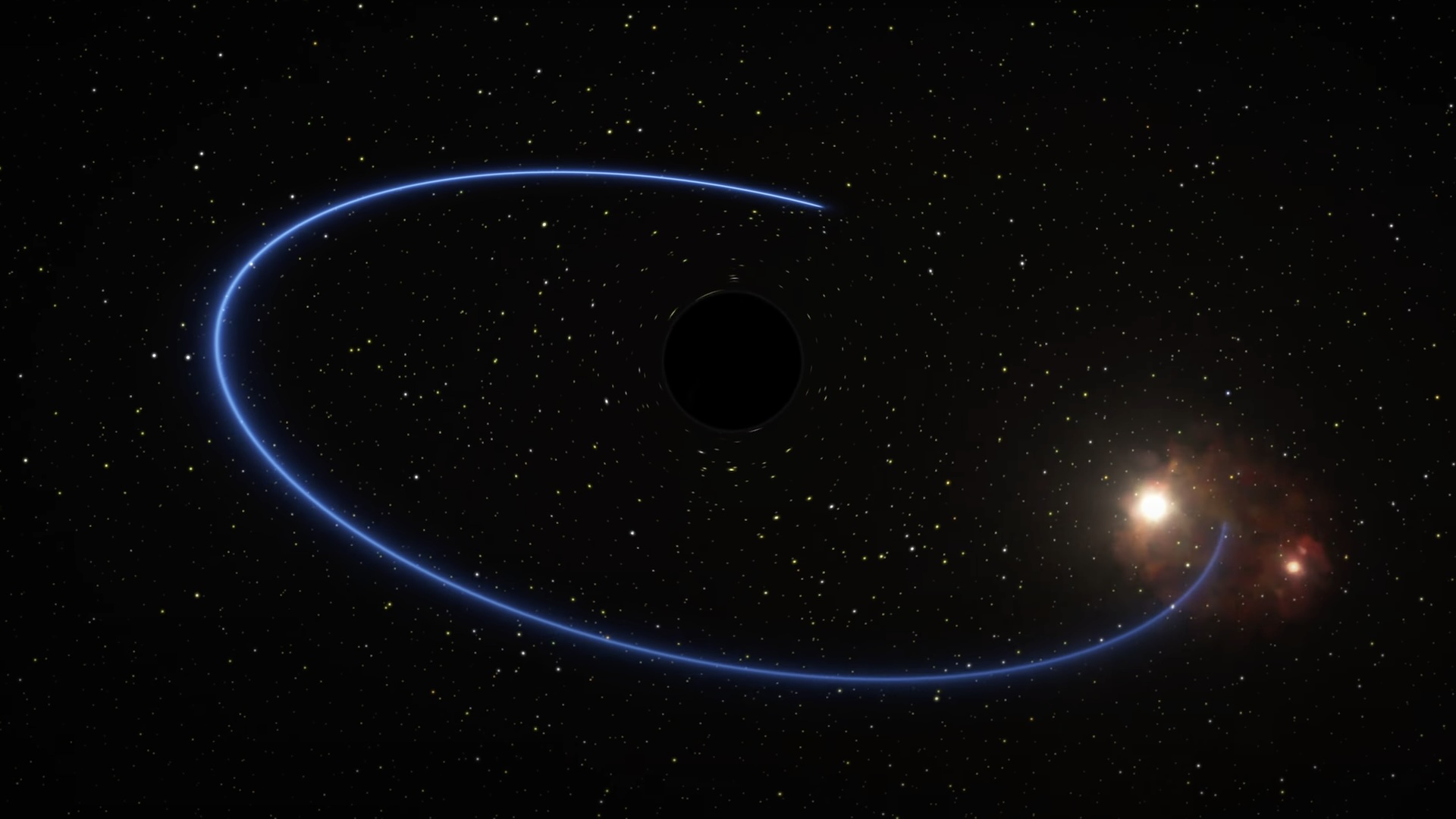
Fastest Known Star Discovered Orbiting Milky Way’s Central Black Hole
Fastest Star in Milky Way Tracked Whipping Around Sagittarius A* Black Hole
Astronomers have identified the fastest star ever observed in our galaxy, racing along an 8.7-year orbit around Sagittarius A*, the supermassive black hole at the center of the Milky Way, according to research published in the journal Nature on Wednesday. The star, designated S301, reaches speeds exceeding 15,000 miles per second—approaching roughly 8 percent of the speed of light—during its closest approach to the gravitational well.
The Tech TL;DR:
- The Discovery: Researchers detected S301, the fastest star recorded in the Milky Way, utilizing infrared observation arrays.
- The Mechanics: The star follows an elongated elliptical orbit, accelerating dramatically as it slingshots around the four-million-solar-mass black hole at the galactic core.
- The Utility: Astrophysicists are leveraging S301 as a direct probe to measure how extreme gravity distorts space and time under general relativity.
Decoding the Galactic Core via Infrared Astrometry
Pinpointing objects deep inside the galactic nucleus requires bypassing dense clouds of cosmic dust and gas that block standard optical wavelengths. To solve this latency and visibility bottleneck, scientists deployed four of the European Southern Observatory’s telescopes located at the Very Large Telescope site in Chile. By focusing on infrared light streams, Felix Mang, a Ph.D. student at the Max Planck Institute for Extraterrestrial Physics, first isolated a faint flicker of light moving at anomalous velocities within the telemetry data.
Tracking historical positions and forward projections revealed that S301 operates with predictable mechanical precision. Stefan Gillessen, an astronomer at the Max Planck Institute, noted that once the orbital trajectory is mapped, the system functions with the reliability of the Swiss railway system. The star inbound accelerates toward Sagittarius A*, executes a sharp turn at its periapsis, and subsequently decelerates on its outward trajectory.
Relativistic Physics and Orbital Benchmarks
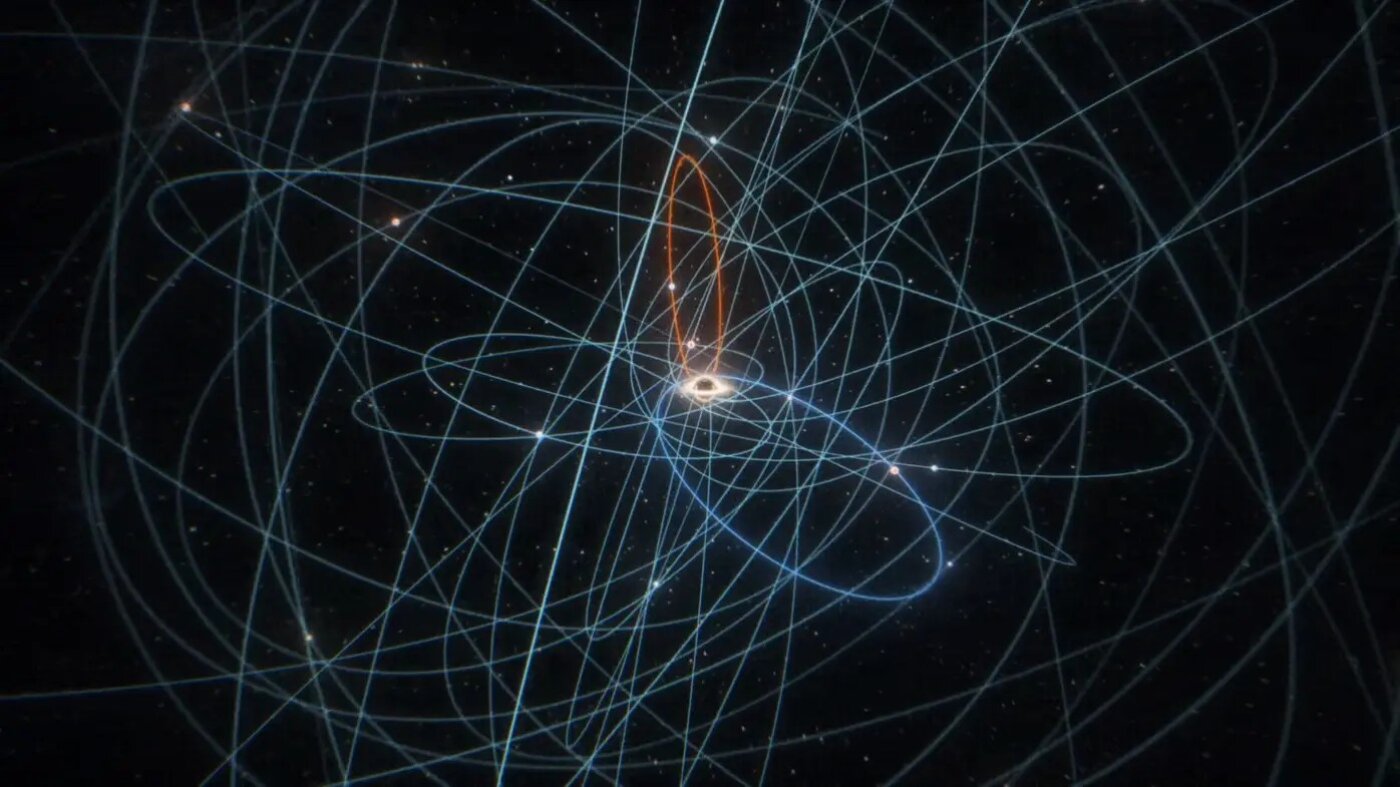
The significance of S301 extends far beyond its raw velocity metrics. While the four-million-solar-mass black hole shares structural visual similarities to cinematic depictions like the film Interstellar, according to Gillessen, its actual physical utility lies in relativity testing. Mang applied Newton’s law of gravity augmented with general relativity corrections to verify Einstein’s predictions regarding how massive bodies warp local spacetime.
# Python conceptual orbital velocity calculation model
import numpy as np

def calculate_orbital_speed(G, M_bh, r):
    # Vis-viva equation approximation for eccentric orbits
    # G: Gravitational constant
    # M_bh: Mass of Sagittarius A* (4 million solar masses)
    # r: Distance from singularity
    v = np.sqrt(G * M_bh * (2.0 / r - 1.0 / a))
    return v
By measuring how S301 reacts to the intense gravitational gradient, researchers obtain empirical datasets regarding the black hole’s immediate environment.
Astrophysical Probes and Enterprise Data Pipelines
As Erin Kara, an astrophysicist at MIT who was not involved in the study, noted regarding the findings, precise orbital mapping sets the stage for advanced gravitational research.
