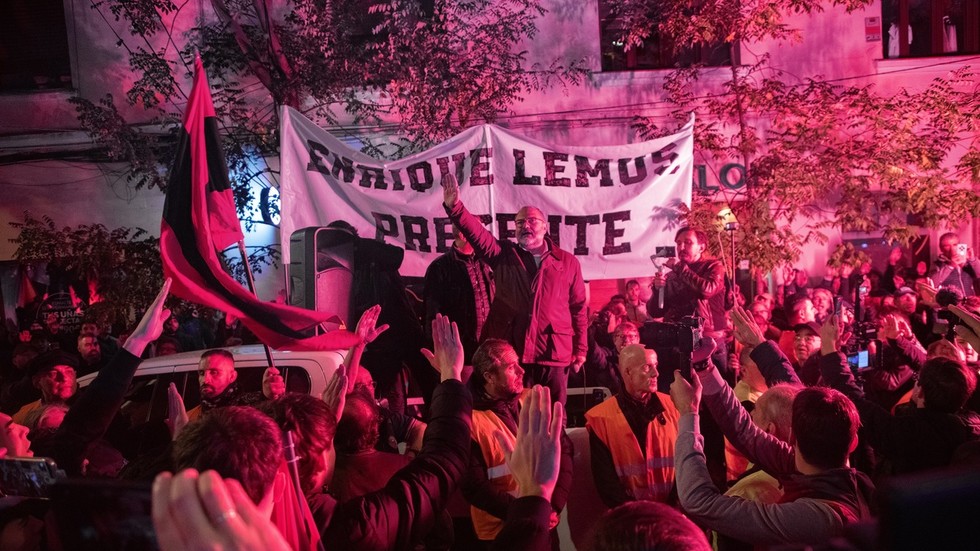
Far-Right Groups Mark Franco and Primo de Rivera Anniversaries in Madrid
Supporters of the late Spanish dictator Francisco Franco marched through central Madrid on Friday marking the 51st anniversary of his death with public displays of Nazi salutes.
The demonstration, which also observed the 90th anniversary of the execution of Falange founder José Antonio Primo de Rivera, drew participants to key political sites across the capital.
Organized by the far-right group Falange Española de las JONS, the procession began on Génova Street, the location of the conservative People’s Party (PP) headquarters, before moving toward Ferraz Street, where the ruling Socialist Workers’ Party (PSOE) is based.
Videos published by the organizers showed demonstrators singing the Falange anthem, Cara al Sol, outside the PSOE headquarters. The group declared, “We have passed and we will pass again,” during the march.
Commemorations at the Mingorrubio Cemetery
Earlier on Friday, a separate gathering took place at the Mingorrubio Cemetery, where Franco was reburied in 2019 following his exhumation from the Valley of the Fallen mausoleum.
Photographs captured attendees performing Nazi salutes near the dictator’s grave, which was covered in flowers, as noted by Cyprus Daily Life. This followed a memorial Mass held on Thursday evening at the parish of the Twelve Apostles in Madrid, which was attended by more than 100 supporters.
Marchamos sobre Madrid. pic.twitter.com/sUXQX5taZC
The events highlight a persistent, visible far-right presence in Spain. These demonstrations occurred less than two weeks after Spanish police arrested 14 individuals linked to the neo-Nazi organization Nucleo Nacional. Authorities have identified documented ties between Nucleo Nacional and the Falange Española de las JONS, with members of both groups having participated in joint protests, including a July demonstration outside the Moroccan Embassy in Madrid.
Alleged Links to Armed Training
These findings have raised concerns among security officials regarding the radicalization of domestic extremist cells.

Historical Context of the Franco Regime
Francisco Franco led Spain from the conclusion of the Civil War in 1939 until his death in 1975. His tenure was characterized by the systemic imprisonment and torture of political dissidents.
Research by historian Julian Casanova indicates that at least 35,000 postwar executions were documented across 33 Spanish provinces in the decade following the Civil War. Because data from several provinces, including Madrid, remain incomplete, Casanova estimates the actual death toll could reach 50,000 or higher.
Falange Española de las JONS was registered as a political party in 1976 and became the first party legalized during the Spanish Transition on 4 October of that year. Originating from a faction of the former state party FET y de las JONS, it was initially linked to neo-fascist terrorism; a prominent member was connected to the 1977 Massacre of Atocha and an internal squadron killed Juan Carlos García Pérez in Madrid in 1980.
The party later broke with Francoism, rejecting the 1937 Unification Decree, and formed a coalition with Fuerza Nueva and Carlist groups that won 378,964 votes and one parliamentary seat in 1979. On 8 July 2023, the Junta Electoral Central permitted the party to use its anthem, Cara al Sol, in advertising, ruling the lyrics did not violate the Democratic Memory Law.
| Event | Date | Context |
|---|---|---|
| End of Civil War | 1939 | Beginning of Francoist rule |
| Death of Franco | 1975 | End of the dictatorship |
| Reburial at Mingorrubio | 2019 | Removal from Valley of the Fallen |
| Madrid March | 2026-11-20 | 51st anniversary of death |
The Falange Española de las JONS has utilized social media to broadcast its activities, explicitly stating its intent to “reconquer Spain.” As police investigations into the Nucleo Nacional continue, the intersection of historical revisionism and modern militant training remains a point of focus for Spanish authorities. The current climate necessitates careful monitoring of these groups as they continue to organize in public spaces across the capital.
Cara al Sol ante la sede del @PSOE Hemos pasado y volveremos a pasar. pic.twitter.com/h38h0IYTOe