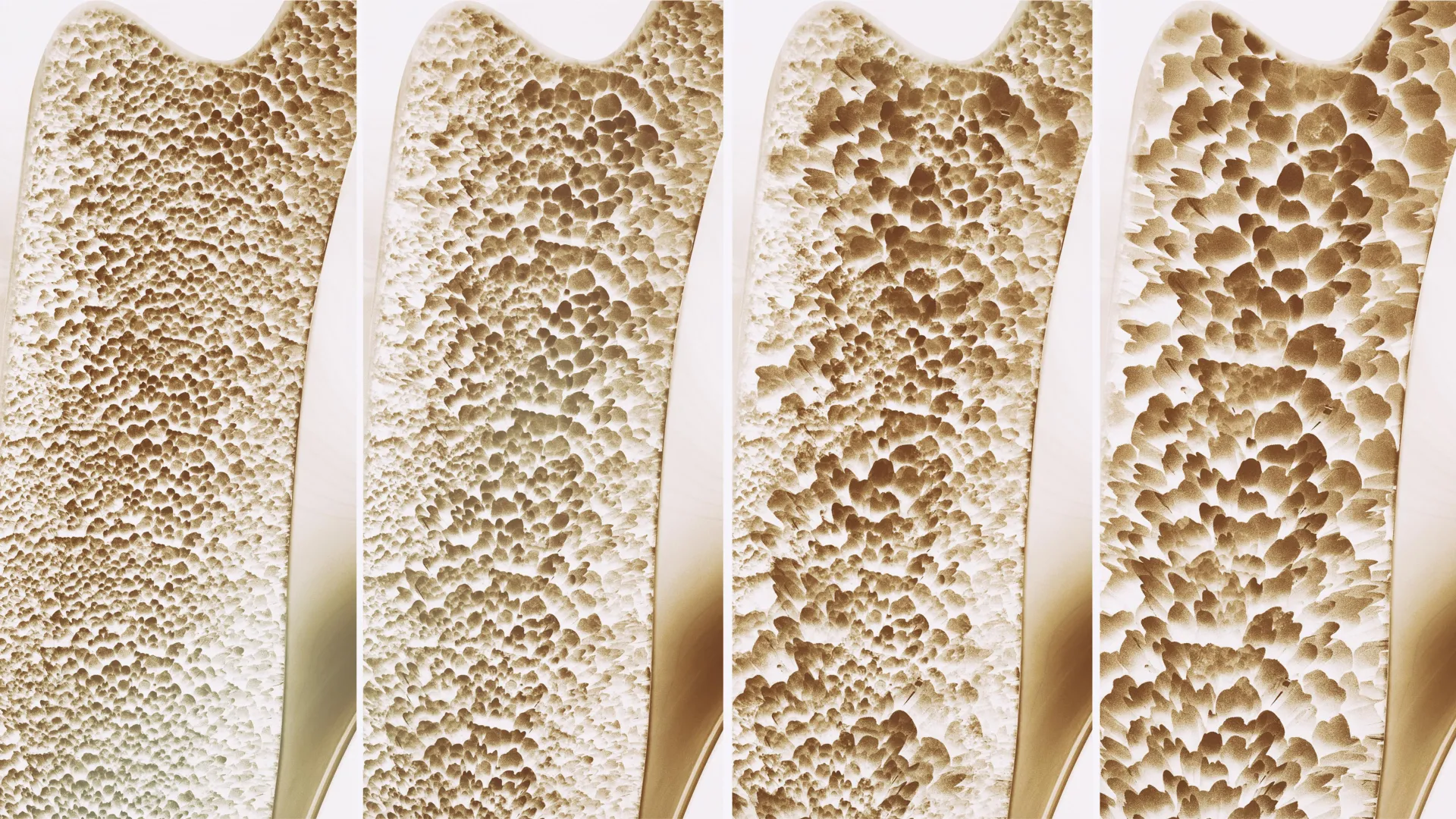
Experimental Compound AP503 Strengthens Bones and Fights Osteoporosis in Mice
Researchers at Leipzig University have identified an adhesion G protein-coupled receptor known as GPR133 that acts as a biological bone-building switch, according to a study published on June 30, 2025, in the journal Signal Transduction and Targeted Therapy. By testing an experimental compound called AP503, scientists successfully stimulated this receptor to boost bone density and reverse osteoporosis-like symptoms in murine models.
- The Target: GPR133 is an adhesion G protein-coupled receptor essential for forming and maintaining bone durability.
- The Mechanism: Activating the receptor with AP503 stimulates bone-forming osteoblasts while suppressing bone-breaking osteoclasts.
- The Clinical Promise: Preclinical tests on mice demonstrated restored bone strength, pointing toward potential new therapies for postmenopausal osteoporosis.
Unlocking the GPR133 Receptor Pathway
Osteoporosis affects roughly six million people in Germany alone, with postmenopausal women making up the vast majority of cases, per data outlined by Leipzig University researchers. Current medical strategies target long-term bone preservation, but clinicians continually face the challenge of developing therapeutics that halt bone degradation without severe adverse effects. The newly isolated GPR133 receptor—also designated as ADGRD1—belongs to a largely underexplored family of cellular targets that respond directly to mechanical strain and interactions between neighboring skeletal cells.
According to Professor Ines Liebscher, lead investigator of the study from the Rudolf Schönheimer Institute of Biochemistry at the Faculty of Medicine, genetic impairment of this receptor triggers early-onset reductions in bone density that mimic human pathology. Utilizing AP503, a compound identified via computer-assisted screening, the research team successfully reversed these deficits. Using the substance AP503, which was only recently identified via a computer-assisted screen as a stimulator of GPR133, we were able to significantly increase bone strength in both healthy and osteoporotic mice,
Liebscher stated.
Cellular Signaling and Pharmacological Efficacy
When the GPR133 receptor engages with mechanical stress inside skeletal tissue, it initiates a molecular cascade that shifts the cellular balance toward growth. Specifically, the signaling pathway upregulates osteoblasts—the cells responsible for synthesizing bone matrix—while downregulating osteoclasts, which resorb bone tissue. AP503 replicates this precise biological feedback loop pharmacologically.

Broader Implications for Musculoskeletal Health
The discovery extends beyond skeletal density alone. Earlier investigations conducted by the same Leipzig research group demonstrated that AP503 activation also strengthens skeletal muscle tissue. This dual action positions the compound as a dual-utility candidate for addressing age-related frailty and sarcopenia alongside osteoporosis.
The newly demonstrated parallel strengthening of bone once again highlights the great potential this receptor holds for medical applications in an ageing population,
noted Dr. Juliane Lehmann, lead author of the study and researcher at the Rudolf Schönheimer Institute of Biochemistry. The findings are rooted in more than a decade of GPCR investigations spearheaded by Leipzig University within Collaborative Research Centre 1423, titled Structural Dynamics of GPCR Activation and Signaling.
*Disclaimer: The information provided in this article is for educational and scientific communication purposes only and does not constitute medical advice. Always consult with a qualified healthcare provider regarding any medical condition, diagnosis, or treatment plan.*