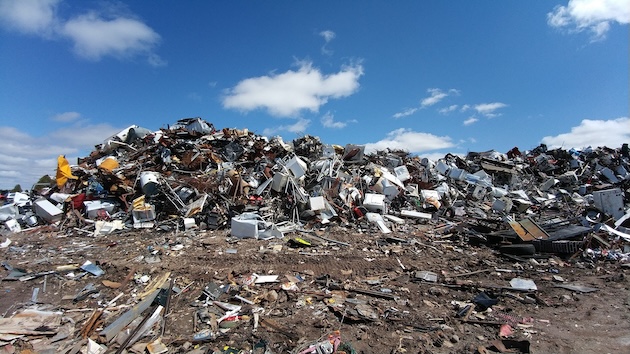
Europe’s Waste: A Hidden Goldmine for Critical Raw Materials in the Green & Digital Transition
By 2030, Europe’s discarded electronics, construction debris, and industrial waste could supply over half of its demand for critical raw materials—yet the continent’s legal and logistical systems are woefully unprepared. A landmark report released today reveals how the EU’s 27 nations sit atop a goldmine of lithium, cobalt, and rare earth metals hidden in landfills, but only if member states act decisively. The stakes? Avoiding a supply chain crisis that could derail the green transition while empowering a new wave of circular economy businesses to thrive.
The Problem: A Geopolitical Wake-Up Call
Europe’s reliance on foreign imports for critical raw materials (CRMs)—like lithium for electric vehicles and rare earths for wind turbines—has become a national security issue. The Critical Raw Materials Act (CRM Act), adopted in 2023, aims to diversify supply chains, but its success hinges on one often-overlooked source: domestic waste. According to the report, Europe’s urban waste streams contain enough recoverable CRMs to meet 53% of projected demand by 2030. Yet only 1% of this potential is currently extracted.
“We’re not just talking about recycling—we’re talking about redefining waste as a strategic asset. The technology exists, but the policy frameworks don’t. Cities like Berlin and Rotterdam are already leading the charge, but without EU-wide standards, we risk patchwork solutions that leave gaps in the supply chain.”
Why This Matters Now
The timing couldn’t be worse. Global demand for lithium is projected to increase twelvefold by 2030, while China controls over 80% of refining capacity. The EU’s green transition—from electric vehicles to offshore wind farms—depends on securing these materials. Yet the continent’s current waste management systems are optimized for volume, not value. Most municipalities treat CRMs as contaminants, sending them to incineration or landfills rather than recovery.

This isn’t just an environmental issue. It’s a geopolitical and economic one. The European Parliament’s recent resolution on critical minerals warns that failure to act could lead to “strategic dependencies that undermine EU sovereignty”. The waste sector, however, offers a rare opportunity to reduce these risks—if Europe can overcome three major hurdles:
- Legal fragmentation: Waste laws vary wildly across the EU, with some nations treating e-waste as hazardous and others as low-value scrap.
- Technological gaps: Advanced sorting and extraction methods (like bioleaching for lithium) exist but aren’t scaled for municipal use.
- Market incentives: There’s no profit motive to recover CRMs from waste when virgin materials remain cheaper—despite their geopolitical costs.
Regional Disparities: Who’s Leading—and Who’s Falling Behind?
The report highlights stark regional differences in CRM recovery potential. Northern Europe, with its advanced recycling infrastructure, leads the way, while Southern and Eastern member states lag due to underfunded waste management systems.
| Region | CRM Recovery Potential (2030) | Key Barriers | Local Innovators |
|---|---|---|---|
| Nordic Countries (Sweden, Finland, Denmark) | Up to 70% of demand met via waste streams | High energy costs for extraction processes | Specialized e-waste processors like Retech (Sweden) |
| Benelux (Netherlands, Belgium, Luxembourg) | 45% of demand met via urban mining | Regulatory hurdles for cross-border waste transfers | Environmental law firms specializing in CRM waste permits |
| Southern Europe (Italy, Spain, Portugal) | 20% of demand met; high untapped potential | Outdated sorting infrastructure | Public-private partnerships to upgrade recycling plants |
| Eastern Europe (Poland, Romania, Bulgaria) | 10% of demand met; lowest recovery rates | Lack of funding and technical expertise | EU circular economy grants for CRM extraction pilot projects |
A Closer Look: Germany’s E-Waste Dilemma
Germany, Europe’s largest economy, generates over 2 million tons of e-waste annually, yet only 15% of Here’s formally recycled. The rest ends up in informal channels or landfills. This isn’t just a missed opportunity—it’s a national security risk. A 2025 study by the Fraunhofer Institute found that Germany’s e-waste contains enough gold, silver, and rare earths to cover 30% of its annual CRM imports.

“The problem isn’t a lack of materials—it’s a lack of will. German municipalities treat e-waste as a liability, not an asset. We need to shift the mindset: this isn’t trash; it’s a domestic mine waiting to be tapped.”
Berlin, however, is taking action. The city’s new Circular Economy Strategy mandates CRM recovery from e-waste by 2028, partnering with private firms to deploy AI-driven sorting robots. But scaling this across Germany—and the EU—requires three critical steps:
- Standardized CRM recovery targets: The EU must set binding recovery rates for each member state, tied to national climate goals.
- Incentivized markets: Create a CRM recovery credit system, where companies earn tradable credits for extracting materials from waste.
- Public-private R&D: Fund pilot projects to test bioleaching for lithium in battery waste and plasma smelting for rare earths in magnets.
The Solution: Who’s Already Solving This?
The report isn’t just a warning—it’s a blueprint for action. Here’s how Europe can turn waste into a strategic advantage:
1. Advanced Waste Processing Firms
Companies like Boliden (Sweden) and Acciona (Spain) are already extracting CRMs from slag and ash. Their success hinges on three factors:
- Precision sorting: Using X-ray fluorescence and AI to isolate CRM-rich fractions.
- Hybrid extraction: Combining mechanical, chemical, and biological methods.
- Policy alignment: Working with local governments to classify CRM-bearing waste as valuable, not hazardous.
2. Environmental Law Firms Specializing in CRM Waste
Navigating the EU’s Waste Framework Directive and the CRM Act is a legal minefield. Firms like Latham & Watkins (Brussels) and Freshfields (Berlin) are helping clients:

- Secure permits for cross-border CRM waste transfers.
- Litigate against municipalities blocking CRM recovery projects.
- Design extended producer responsibility (EPR) schemes that fund CRM extraction.
3. EU Funding Programs for Circular Economy
The European Innovation Council (EIC) and LIFE Program offer grants up to €10 million for CRM recovery pilots. Key opportunities include:
- Horizon Europe: Grants for urban mining technologies (e.g., bioleaching for lithium).
- Just Transition Fund: Support for Eastern European regions to upgrade CRM recovery infrastructure.
- Regional Development Funds: Co-financing for municipal waste-to-CRM plants.
The Kicker: A Race Against Time
Europe’s waste isn’t just trash—it’s a geopolitical leverage point. The continent’s ability to extract CRMs from domestic waste streams will determine whether it remains a supplicant to China’s mining dominance or a leader in the circular economy. The next 18 months are critical: the EU must fast-track CRM recovery standards, incentivize private investment, and retrain workers for a new era of urban mining.
For businesses and governments navigating this shift, the time to act is now. Whether you’re a waste processor, a corporate attorney, or a municipal official, the tools to turn Europe’s waste into a strategic asset are already here. The question is: Will you be part of the solution—or left behind?