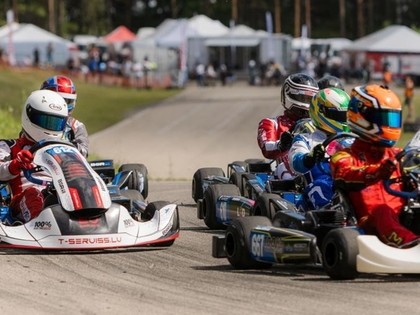
Europe’s Most Powerful Electric Karts Head to Jelgava for BSR League
The BSR European Electric Karting Series (EEKL) heads to the Rullītis sports complex in Jelgava for its second round of the 2026 season on August 14–15, bringing elite electric motorsport technology, high-voltage acceleration, and international racing grids directly to Latvian fans.
Schedule and Format for the Jelgava Showdown
According to reports from Sportacentrs.com and Europesays.com, the two-day event at the Rullītis sports complex begins on Friday with four official practice sessions followed by qualifying at 17.20 for the BSR X5 PRO and OPEN categories. Saturday morning opens with a warm-up at 9.00, leading into the first final at 10.15, the second final at 13.00, and the decisive superfinal at 15.05. These races run concurrently with the fourth round of the Latvian Karting Championship.
The 2026 season marks the inaugural campaign for the EEKL, functioning as the next developmental phase within the international electric karting ecosystem built over several years by Blue Shock Race (BSR). Parallel initiatives operate globally: the United States hosts a six-round American Electric Karting League season that kicked off at the Miami International Autodrome during the ABB Formula E race weekend, while Japan enters its fifth season utilizing BSR technology in the national AUTOBACS All Japan Karting Championship EV Division, featuring eight scheduled races in Tokyo. Meanwhile, the Benelux Electric Kart Series continues to develop youth and adult classes, with its Netherlands round integrated into the European calendar.
Artis Daugins, founder of Blue Shock Race, stated via Sportacentrs.com and Europesays.com, “When we started developing electric karts in Latvia, our goal was not just to build fast machinery — we wanted to create a full sports ecosystem. Today it operates from the Miami Formula E weekend and the Japanese national championship to Benelux and the new European league. The Jelgava round is an opportunity to see with your own eyes that technology created in Latvia is no longer a future concept — it is already competing on world tracks.”
Madona Opener Sets the Baseline for Regional Talent
The series opener took place on June 19–20 in Madona, inaugurating the European electric karting season with 14 drivers representing Latvia, Lithuania, Estonia, Sweden, and Italy. The starting grid featured participants and winners from world, Baltic, and national championships alongside drivers making their competitive karting debuts. Olivers Tams captured the X5 PRO class victory after transitioning from rental karts to competitive sports karts roughly a month prior, following an intensive training program. In the X5 OPEN class, Gustavs Ušakovs secured first place ahead of Lithuania’s Martynas Tankevičius — the 2025 Rotax Max Challenge Grand Finals DD2 Masters class winner — while Porsche AG certified instructor and five-time Latvian karting champion Valters Zviedris finished third, according to source coverage.

Competition rules separate participants into specific weight classes while keeping them on the track together. The X5 PRO group accommodates drivers weighing under 70 kilograms, establishing a minimum total weight of 185 kilograms including the kart and full gear. The X5 OPEN group is designated for drivers weighing 70 kilograms and above, with a minimum total weight of 200 kilograms. This division minimizes the competitive impact of driver weight differences to maintain parity across the field.
Technical Specifications of the BSR-X5 Platform
Drivers in the EEKL compete using the BSR-X5, a high-performance production electric kart platform. In race configuration, the machine delivers up to 33 kW—equivalent to 44 horsepower—and 119 Nm of instant torque, accelerating from 0 to 100 km/h in approximately 3.5 seconds and reaching top speeds up to 135 km/h. An ultra-fast battery swapping system enables crews to replace the power unit in roughly two minutes, allowing race programs to proceed without lengthy charging delays.
Daugins added, “In Madona we saw that interest is not limited to one country or one generation of drivers. In Jelgava we want to bring this sport even closer to the spectator: come to the races, feel free to visit the Blue Shock Race tent and ask about the technology, training, and the opportunity to sign up for a controlled test drive.”
Disclaimer: The insights provided in this article are for informational and entertainment purposes only and do not constitute medical advice or sports betting recommendations.