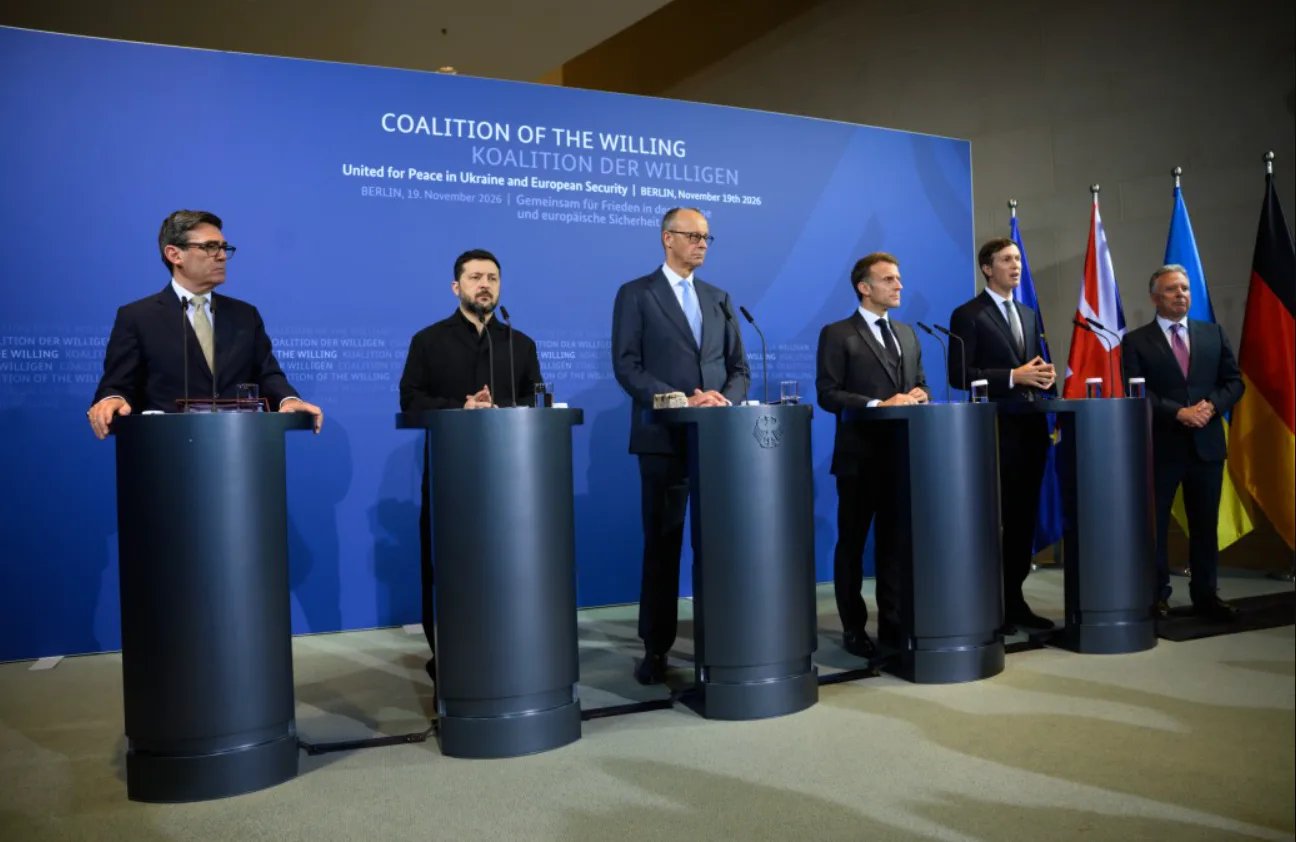
European Leaders, Ukraine Reaffirm 2026 Aid Through 2027, Urge Winter Energy Truce
European leaders and Ukraine met in Berlin on Thursday and agreed to keep military aid at 2026 levels through 2027 while pressing Russia for a winter energy truce, the German chancellery and the Ukrainian presidential office said.
The meeting brought together Chancellor Olaf Scholz, President Emmanuel Macron, Prime Minister Keir Starmer and President Volodymyr Zelenskyy alongside representatives of the Coalition of the Willing and the United States, the German chancellery reported. They issued a joint statement condemning Russian strikes on civilians and infrastructure, sabotage, cyberattacks and information operations in Europe.
“Attacks on Ukrainian cities cannot compensate for the Russian federation’s military failures,” the leaders wrote, according to UNN, citing the Ukrainian presidential website. The statement said Russia had failed to achieve its strategic objectives on the battlefield despite enormous losses.
“A just and lasting peace is critically important for the security of all of Europe.”
the joint statement said
NATO allies reaffirmed a commitment to provide €70 billion in military aid, equipment and training in 2026, with at least equivalent levels in 2027, UNN reported. An additional €90 billion is earmarked through the European Ukraine Support Loan mechanism by the end of 2027 for military and financial needs.

Air defense priority before winter
Strengthening Ukrainian air defenses, including systems capable of intercepting ballistic missiles, was identified as a separate priority. Partners will step up efforts to find additional missile defense systems before winter, the chancellery said.
The leaders agreed to increase economic pressure on Moscow, primarily by restricting revenues from oil and gas exports. Measures are also planned against Russian cryptocurrency operations and illicit financial flows, along with tighter restrictions on the military-industrial complex. Particular attention will focus on combating Russia’s shadow fleet and sanctions-evasion schemes, UNN reported.
Security guarantees tied to U.S. coordination
After a ceasefire, Ukraine must receive reliable security guarantees agreed with the United States, the leaders confirmed. Such guarantees may include long-term military support, international monitoring of ceasefire compliance, and deployment of a Multinational Force — Ukraine under European leadership with U.S. support.
Those forces may operate in the air, at sea and on land, and help rebuild the Ukrainian army, the statement said. Legally binding commitments are envisaged for partners to respond to possible new Russian aggression. The participants welcomed the Koalicja-2026 exercises in Poland, which demonstrate readiness of international forces to deploy.
Frozen assets and peace terms
Frozen Russian assets will remain blocked until Moscow ends the war and compensates Ukraine for damage, the leaders said. They underscored that international borders must not be changed by force and that Ukraine’s sovereign right to choose its own security arrangements and alliances must be fully respected.
European leaders supported Zelenskyy’s readiness for an immediate ceasefire and negotiations with Russia involving the United States and Europe. Any decisions concerning the EU and NATO require the consent of the relevant states and allies, the statement noted.
Energy truce proposal
One key initiative was a call for an energy truce for the entire winter. The leaders urged Russia to agree to halt attacks on energy infrastructure, allowing civilian heating and power supplies to function through the cold months.
The term “coalition of the willing” originated in the early 1970s when MIT professor Lincoln P. Bloomfield and colleague Harland Cleveland proposed voluntary groupings of nations for UN-endorsed peacekeeping. It entered diplomatic usage when Secretary of State Henry Kissinger acknowledged the concept in a 1973 letter. The phrase later described the US-led Multi-National Force in Iraq during the 2003 invasion and the Australian-led INTERFET mission in East Timor from 1999 to 2000.
In the current context, Czech President Petr Pavel publicly called for a new coalition of the willing to end the Russian invasion of Ukraine on March 1, 2025.
The following day, Prime Minister Keir Starmer endorsed the approach after a London summit of 18 European leaders, stating the UK would work with France and others on security guarantees for Ukraine. European Commission President Ursula von der Leyen subsequently applied the label to the emergency summit of European leaders at the White House in August 2025.
The meeting took place as Zelenskyy questioned whether Ukraine and its partners share a common understanding of NATO Article 5, UNN reported. He also expressed hope that the United States will invite Ukraine to the G20 summit.