Europe Wildfires Expose and Detonate Buried World War Bombs
As summer wildfires scorch rural landscapes across Europe in August 2026, emergency response crews are confronting a lethal, long-hidden legacy of past global conflicts: unexploded bombs, mortar shells, and landmines from World War I and World War II. Extreme heat and shifting blazes in France, Belgium, Germany, and the Netherlands have triggered spontaneous detonations, forcing a rapid recalibration of civil protection protocols and demanding the intervention of specialized bomb-disposal teams to clear blackened terrain safely.
Climate Change and the Reactivation of Historical Munitions
Steady temperatures and predictable rainfall historically kept buried wartime munitions dormant beneath the European topsoil. However, according to a study issued last month by the World Weather Attribution group, the current wildfire season was supercharged by heavy January rains that spurred dense vegetation growth. When subsequent summer heatwaves arrived alongside severe drought conditions, low humidity, and stiff winds, that vegetation transformed into ideal kindling.
Sarah Njeri, a peace and conflict scholar at London’s School of Oriental and African Studies, notes that Europe’s climatic luck has run out. “Climate change is now doing the work of unburying and reactivating what was previously stable,” Njeri states, explaining how intense fire activity both ignites old munitions directly and burns away the dense scrub that has hidden them for decades.
Explosions and Recovery Operations in Belgium and France
In the eastern Belgian province of Liege, Gov. Hervé Jamar reports that a few sporadic detonations have echoed through fire zones, prompting emergency services to adapt their strategies to protect frontline personnel. The fires are smoldering across the High Fens, a dense peat-bog forest stretching along the German border that served as a primary theater for heavy engagements, including the Battle of the Bulge.
Bernard Collard, a local historian authorized to scan former battlefields with metal detectors, walks through terrain where blueberry bushes now obscure old foxholes, trenches, and deep artillery craters. Collard remarks on the persistent danger of the region, noting that visitors can never be sure where explosives remain hidden.

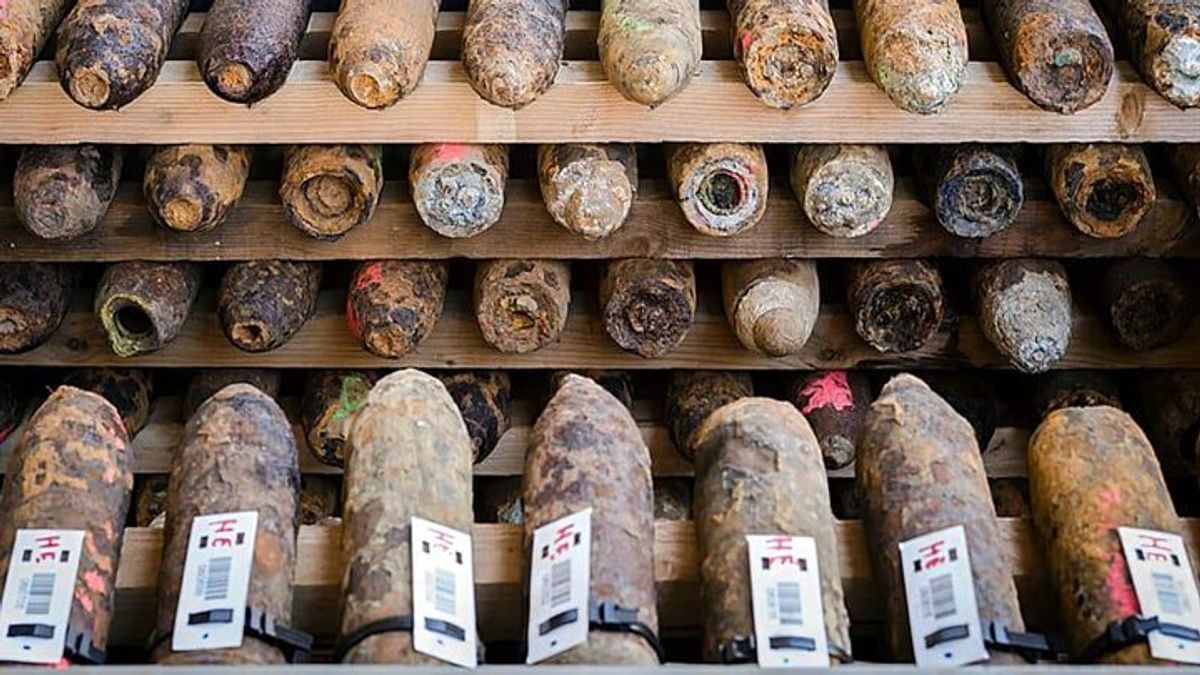
Across the border in France, a massive wildfire outside Bordeaux recently uncovered a cache of approximately 400 shells and pieces of ammunition in the village of Le Porge. Consisting primarily of German and French mortar shells alongside high-explosive anti-tank rounds, the depot exploded as the blaze swept through the municipality. Fire commander Thomas Mimiague and Mayor Martial Zaninetti confirmed that the detonations sounded like “the sound of war,” with one stray munition piercing a residential home before firefighters extinguished the flames.
Regional Risk Profiles and Cross-Border Coordination
While unexploded ordnance discoveries are common throughout Western Europe, the convergence of aggressive wildfire seasons and historical combat zones has elevated risks for rural communities. Jonas Tepe, a spokesperson for North Rhine-Westphalia, points out that wildfires make ordnance significantly more volatile because high ambient temperatures can easily trigger the explosives.

The Belgian Ministry of Defense handles weekly requests from the border region to assist in disarming discovered explosives, though officials note that western provinces often log even higher densities of munitions calls.
As climate pressures continue to alter environmental stability across the continent, governments face the enduring challenge of safeguarding modern populations from the buried remnants of twentieth-century warfare. Mitigating these ongoing threats requires coordination between local authorities, historical experts, and professional agencies to ensure that landscapes shaped by historical conflict can be permanently secured against newly awakened dangers.