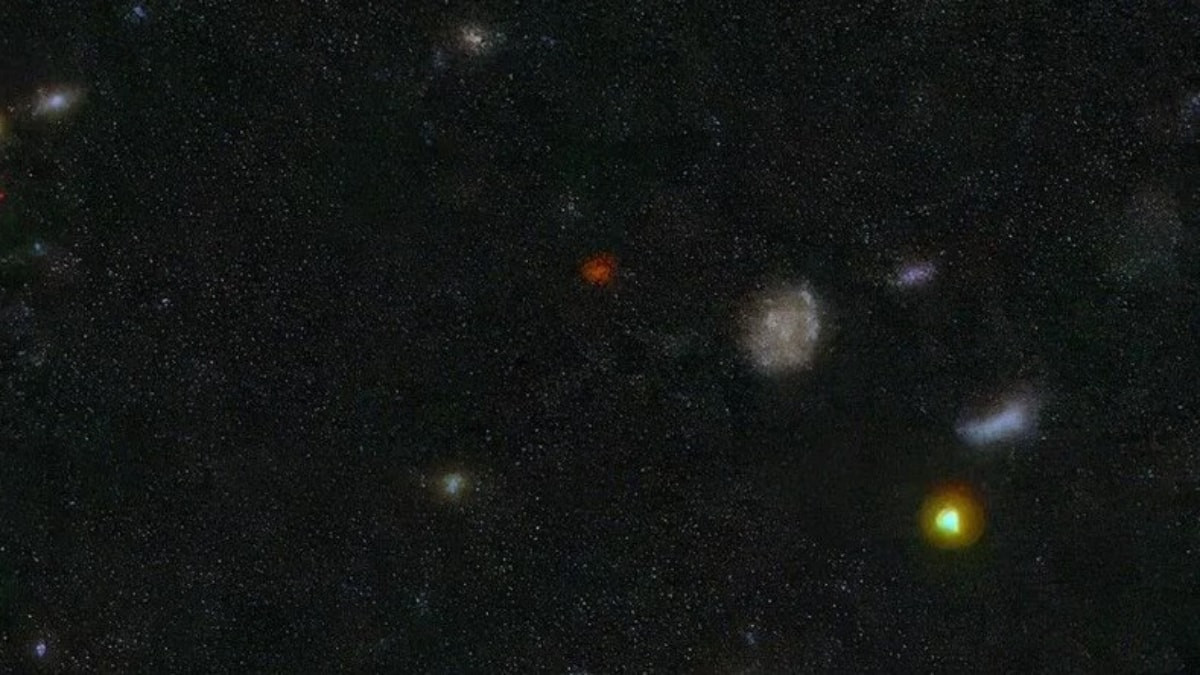
Euclid Telescope Identifies Quasar 630 Million Years After Big Bang, Challenging Black Hole Growth Models
The European Space Agency’s Euclid space telescope has identified a quasar that existed 630 million years after the Big Bang, pushing the observational frontier 40 million years closer to the origin of the universe and challenging models of how supermassive black holes grew so large so quickly, according to Diken – Yaramazlara biraz batar!.
The object, catalogued as J1504+6252 and nicknamed Dun Aonghasa, was picked out of 18 months of Euclid Wide Survey imaging covering millions of sources. Its light traveled roughly 13.1 billion years to reach the telescope, placing it at a redshift of z = 8.13 — about 39 million years earlier than the previous record-holder, also found by Euclid.
Follow-up observations from the Keck Observatory, Hubble Space Telescope, Large Binocular Telescope and the James Webb Space Telescope (JWST) confirmed the detection, according to the study published Nov. 24 in Astronomy & Astrophysics.
A black hole too heavy for its age
JWST’s NIRSpec spectroscopy measured the mass of the central black hole at roughly 360 million times the mass of the Sun — about 85 times heavier than the black hole at the center of the Milky Way. The single-epoch calibrations based on Hβ and Mg II emission lines yield a broader possible range of 210 million to 780 million solar masses, the study reports.
That mass is difficult to explain. The black hole is accreting matter at only 12% to 44% of the theoretical Eddington limit, a relatively sedate pace. At that rate, growing from a typical stellar-mass seed to hundreds of millions of solar masses in just 630 million years is “hard,” implying either a much heavier starting seed or an earlier phase of extreme growth.
Redshift record shifts by 6%
The previous quasar redshift record stood at z = 7.77, announced by Euclid only months ago. Before Euclid, the frontier was z = 7.64, corresponding to about 670 million years after the Big Bang. The new detection moves the boundary by roughly 6% of the universe’s age at that epoch, the paper states.

“Previous records moved the observational boundary by about 39 million years,” said Julien Wolf, according to Kent Gazetesi.
Wolf described the quasar as displaying “the defining spectral signatures of archetypal quasars observed at lower redshift, including a luminous blue power-law continuum and broad permitted emission lines,” indicating a classical broad-line region already in place.
Euclid’s wide field pays off
Launched in 2023 primarily to map dark matter and dark energy, Euclid’s wide-field scanning capability has proven unexpectedly potent for finding rare, high-redshift quasars. The team used machine-learning tools to rank candidates before committing scarce follow-up time on large ground- and space-based telescopes.
ESA expects the full survey to yield only a few dozen quasars beyond redshift 8. Each new JWST confirmation will clarify whether Dun Aonghasa is an outlier or the first member of a hidden population of massive, slowly feeding black holes in the cosmic dawn.
“Every new candidate followed up with Webb will show whether Dún Aonghasa is just an exception or the first example of a hidden population of heavy and quiet black holes at the dawn of cosmic history,” ESA said in its release, according to Anadolu Ajansı.

Euclid team mines wide survey for early quasars
A research group led by Julien Wolf of the European Southern Observatory combed through 18 months of Euclid Wide Survey imaging containing millions of sources to isolate the quasar candidate, according to Cumhuriyet.
ESA announced the confirmed discovery on 24 November 2026, Anadolu Agency reported.
JWST spectroscopy pins down distance and black hole mass
Medium-resolution NIRSpec G395M spectroscopy yielded a systemic redshift of z = 8.129 ± 0.005, corresponding to 630 million years after the Big Bang and moving the quasar frontier by roughly 39 million years, or about 6% of the universe’s age at that epoch, the study reports.
Slow accretion deepens early-growth puzzle
Wolf said the discovery sets a new time boundary for theories of black hole formation. Scientists are now working on models that can account for a black hole reaching 360 million solar masses so soon after the Big Bang.
The European Space Agency (ESA) launched the Euclid space telescope on 1 July 2023 to map dark matter and dark energy by measuring galaxy shapes and redshifts across roughly one-third of the sky over at least six years. Its primary scientific goals are to understand the accelerating expansion of the universe and the distribution of dark matter through weak gravitational lensing, baryon acoustic oscillations, and spectroscopic galaxy surveys.
The study, “Euclid: Discovery of a quasar at z = 8.13 hosting a 360-million-solar-mass black hole,” is available at doi.org/10.1051/0004-6361/202662243.