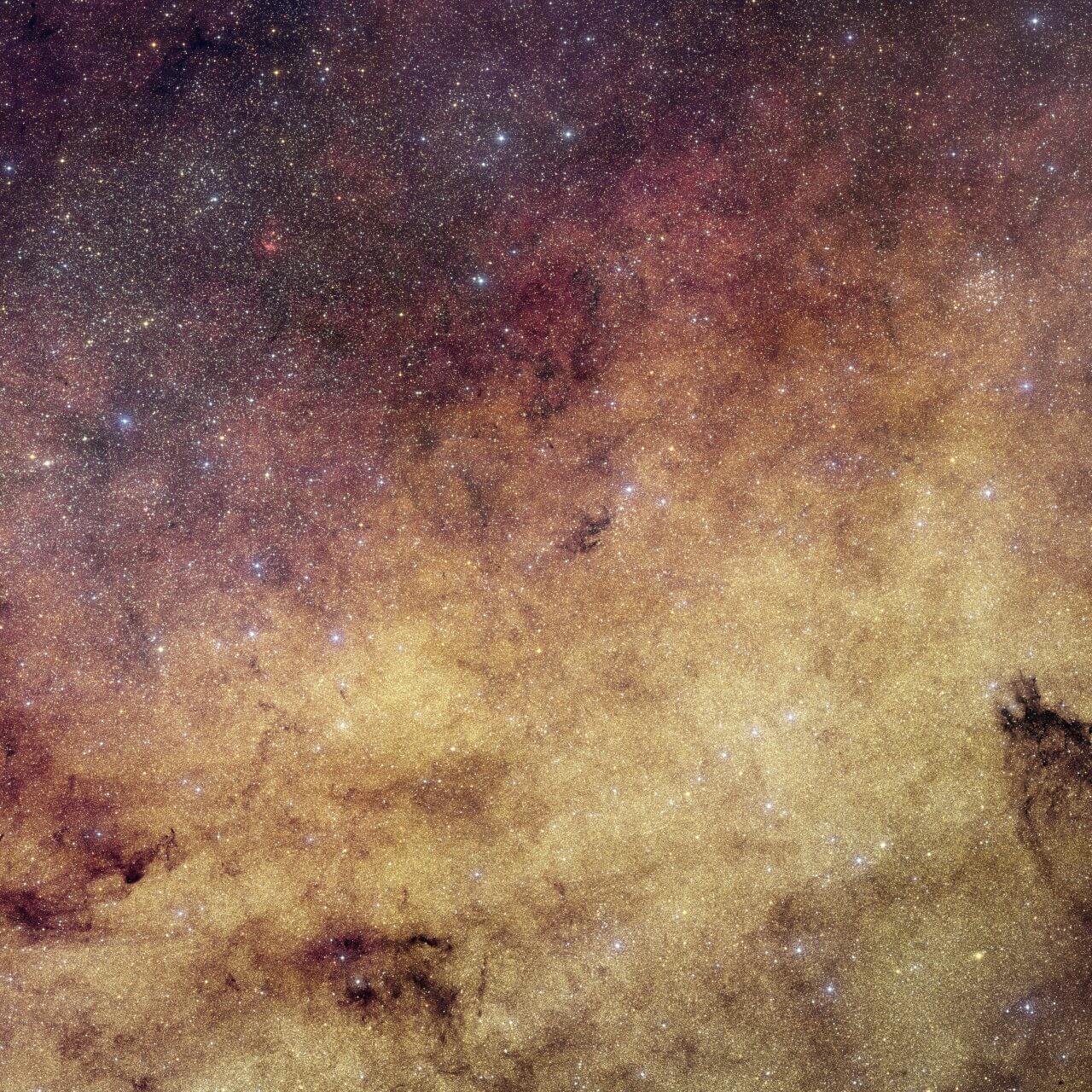
Euclid Telescope Captures 60 Million Stars in the Milky Way’s Center
The European Space Agency’s Euclid Space Telescope has captured the most detailed infrared image yet of the Milky Way’s galactic center, revealing an estimated 60 million stars in a single frame—far exceeding previous surveys and offering new insights into the galaxy’s dense core.
The image, released this month, was taken as part of Euclid’s ongoing mission to map the dark matter and dark energy shaping the universe’s expansion. While the telescope’s primary objective focuses on deep-space observations, its high-resolution infrared sensors have also provided an unprecedented view of the Milky Way’s central bulge, where stars are packed so densely that ground-based telescopes struggle to resolve individual objects.
According to the European Space Agency (ESA), the image spans approximately 1.4 square degrees of the sky—roughly the size of seven full moons—and captures stars as faint as magnitude 24, a depth previously unattainable in wide-field surveys. The data, processed by ESA’s Euclid Consortium, includes stars within 10,000 light-years of Sagittarius A*, the supermassive black hole at the galaxy’s heart.
Why the image matters
The Milky Way’s central region is a high-stakes target for astronomers studying stellar dynamics and galactic evolution. Unlike visible-light telescopes, which are hindered by interstellar dust, Euclid’s infrared sensors penetrate the obscuring clouds, revealing stars clustered around the black hole. The new data could help refine models of how star formation and orbital mechanics operate in extreme gravitational environments.
“This is the first time we’ve seen the galactic center in such detail across a wide field,” said Dr. Giuseppe Cacciatori, Euclid’s survey scientist at the National Institute for Astrophysics (INAF) in Italy. “It’s a game-changer for studying the distribution of stars near the black hole and understanding how they influence the galaxy’s structure.”
How Euclid compares to other telescopes
While the James Webb Space Telescope (JWST) has provided deeper, but narrower, infrared views of the galactic center, Euclid’s strength lies in its wide-field capability. A single Euclid image covers an area 100 times larger than JWST’s NIRCam instrument, making it ideal for statistical studies of stellar populations. The Gaia mission, which has mapped over 1 billion stars in the Milky Way, lacks Euclid’s infrared precision in the galaxy’s dust-choked core.
What happens next

ESA plans to release additional Euclid data in 2025, including deeper observations of the galactic center and other dense star fields. The telescope’s six-year mission, launched in July 2023, is expected to produce a 3D map of the universe covering 15,000 square degrees—one-third of the sky—by its conclusion.
For now, astronomers are analyzing the new image to identify variable stars, star clusters, and potential binary systems near Sagittarius A*. Early findings suggest a higher concentration of red giant stars than previously estimated, which could challenge existing models of the galaxy’s age and metallicity distribution.
The full dataset, including raw and processed images, is available via ESA’s Euclid Science Archive, where researchers can request access for further study. The agency has emphasized that the galactic center observations are a secondary science objective, with primary focus remaining on the telescope’s cosmological surveys.