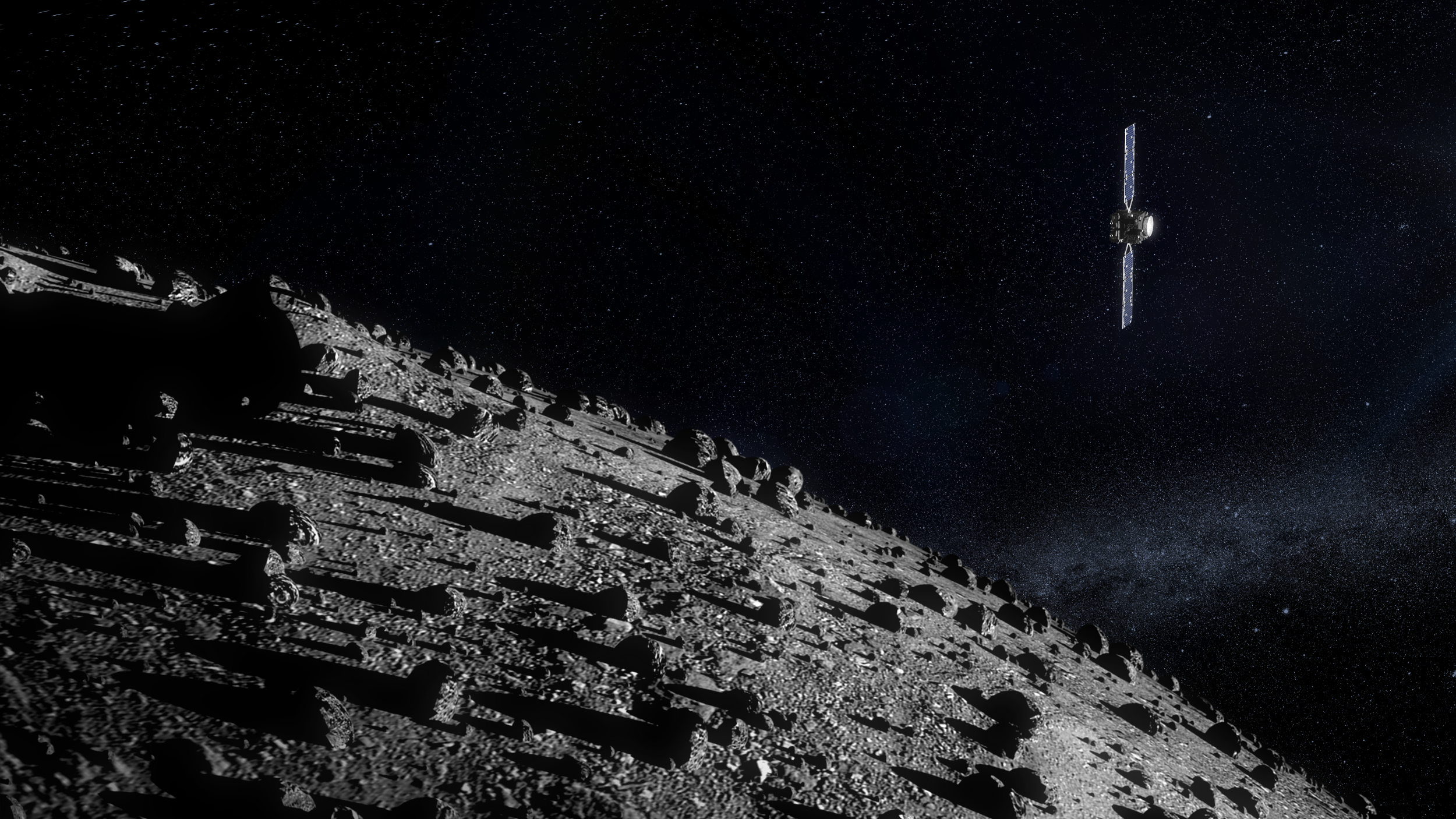
ESA’s Hera Spacecraft Reveals Chaotic Boulder Field Around Asteroid Dimorphos Following NASA’s DART Mission
European spacecraft images have revealed a chaotic boulder field surrounding the asteroid Dimorphos, four years after NASA’s DART mission shifted the space rock’s orbit. The European Space Agency’s Hera probe arrived at the double asteroid system on November 25 to conduct the first sustained study of a deflected asteroid.
What did the Hera spacecraft find at the asteroid?
After a two-year journey following its October 7, 2024 launch atop a SpaceX Falcon 9 rocket from Cape Canaveral Space Force Station, the Hera spacecraft is arriving at the Didymos double asteroid system, Space reported. The target system consists of the larger “rubble pile” asteroid Didymos and its smaller moonlet Dimorphos, which NASA struck with a kinetic impactor in 2022 during the DART test. The DART mission succeeded, shortening the orbit of Dimorphos by just over 30 minutes, confirming that kinetic impacts can alter the trajectories of asteroids to potentially divert them from a crash course with Earth.
Combining 11 long exposure frames from Hera’s hyperspectral camera, an image released by the European Space Agency on Wednesday digitally removed Didymos and Dimorphos to expose dimmer streaks and dots representing hundreds of rock fragments, according to Ars Technica.
Each of these boulders ranges in size from a football to a washing machine.
“In fact, they had a lot of company.”
“Hera came to visit two asteroids, and we found hundreds of companions,” Murdoch said.
What better place to reveal what happens when humanity deliberately changes the path of an asteroid? ☄️ This week at the Museum für Naturkunde Berlin, we revealed the first images of #Dimorphos captured by @ESA_Hera, and they brought some surprises. A huge crater left by @NASA’s… pic.twitter.com/yzqNOz4DuL
Hera reveals hundreds of boulders around impact site
Ground processors digitally removed the bright Didymos and Dimorphos to reveal dimmer streaks and dots representing hundreds of rock fragments, each ranging from a football to a washing machine in size, according to Ars Technica.
Murdoch said that as the spacecraft approached the system, the team quickly realized the asteroids were not alone. One explanation is that the boulders were ejected when DART slammed into Dimorphos in 2022, but scientists cautioned they need more information before confirming that link. The debris might instead be relics from the ancient creation of Dimorphos.
“Hera will allow us to study that in more detail,” Murdoch said. “We really need to know more about these boulders and characterize them to understand if they’re linked to DART, if they’re linked to another process, and what the consequences might be for other asteroid systems in the Solar System.”

Boulder field threatens CubeSat deployment plans
“We saw a couple of images that didn’t reassure me,” said Margherita Cardi, project manager for the Milani CubeSat. “There is a mix of excitement and panic.”
“ESA’s Hera mission has arrived to learn the answers we need to know,” Michel said. “How did the impact change Dimorphos? What is the mass of the asteroid and which of its properties explain its response to DART impact?”
Are the boulders a risk for upcoming probes?
While the debris field likely stems from the 2022 impact, scientists noted they need further data to confirm whether the rocks are linked to DART or relics from the ancient creation of Dimorphos. The dense cluster of boulders presents significant navigation hazards for Hera’s two small CubeSats, which are scheduled for deployment in January.
“There is a mix of excitement and panic.” Claudia Balossi, spacecraft systems engineer for Juventas, explained to Ars Technica that her mission’s planned trajectory will take it right through the boulders as it moves within a couple of miles of the asteroids, culminating in a landing attempt on Dimorphos to measure its gravity field.
Mission principal investigator Patrick Michel stated in an ESA release covered by Space that Hera will provide a complete picture of humanity’s first planetary defense test.
“How did the impact change Dimorphos?” “What is the mass of the asteroid and which of its properties explain its response to DART impact?” The probe is scheduled to remain at the system for months, utilizing visible and infrared light cameras alongside radar instruments to refine planetary defense techniques. The public unveiling of the first images occurred during a livestream that began at 1:45 p.m. ET (1845 GMT) on Wednesday (Nov. 25).
More on Dimorphos
What Happened After NASA Slammed a Spacecraft Into an Asteroid? See for Yourself. https://t.co/TuMDnyHhOy
Two years of travelling. One pair of asteroids. A lot of very excited scientists. Hera's team are live now, talking through the first images. Don't leave early. There may be a surprise 👀 pic.twitter.com/782A7NXdUv
This is fascinating science and engineering. But there is a very practical outcome: ESA's Hera will help us understand what we would need to know if, one day, we had to use this technique to protect our planet. https://t.co/IX5Eifhalp
Our Hera spacecraft can now see Didymos and Dimorphos as two separate asteroids! Coming closer, it will study the effects of NASA's 2022 DART impact and help advance asteroid deflection as a planetary defence technique. The first detailed images of Dimorphos are expected on 25… pic.twitter.com/lHA0jU04jT
BIG NEWS! We have a whole new look at Dimorphos, the first asteroid humans have ever moved 👀☄️ @ESA_Hera mission has captured Dimorphos completing a full orbit around its larger companion, Didymos. Look closely and you will see the impact site come into view, and Dimorphos… pic.twitter.com/jWsuwz3H98
Hera’s second braking manoeuvre yesterday proved successful, reducing the spacecraft’s velocity relative to the Didymos and Dimorphos system by 70 m/s from a distance of 2300 km away. Some 90% of the 31-minute thruster firing took place in the early morning, followed by a… pic.twitter.com/JKOD2HrxUl
🍿Join us live on Wednesday 25 November to see ESA's Hera mission's initial images of asteroid Dimorphos – the 1st body in the Solar System to have had its orbit (& itself) measurably changed by human action! 🛰️🪨🪨https://t.co/wbv8gKjrv4 pic.twitter.com/0SJ6P0jUzv