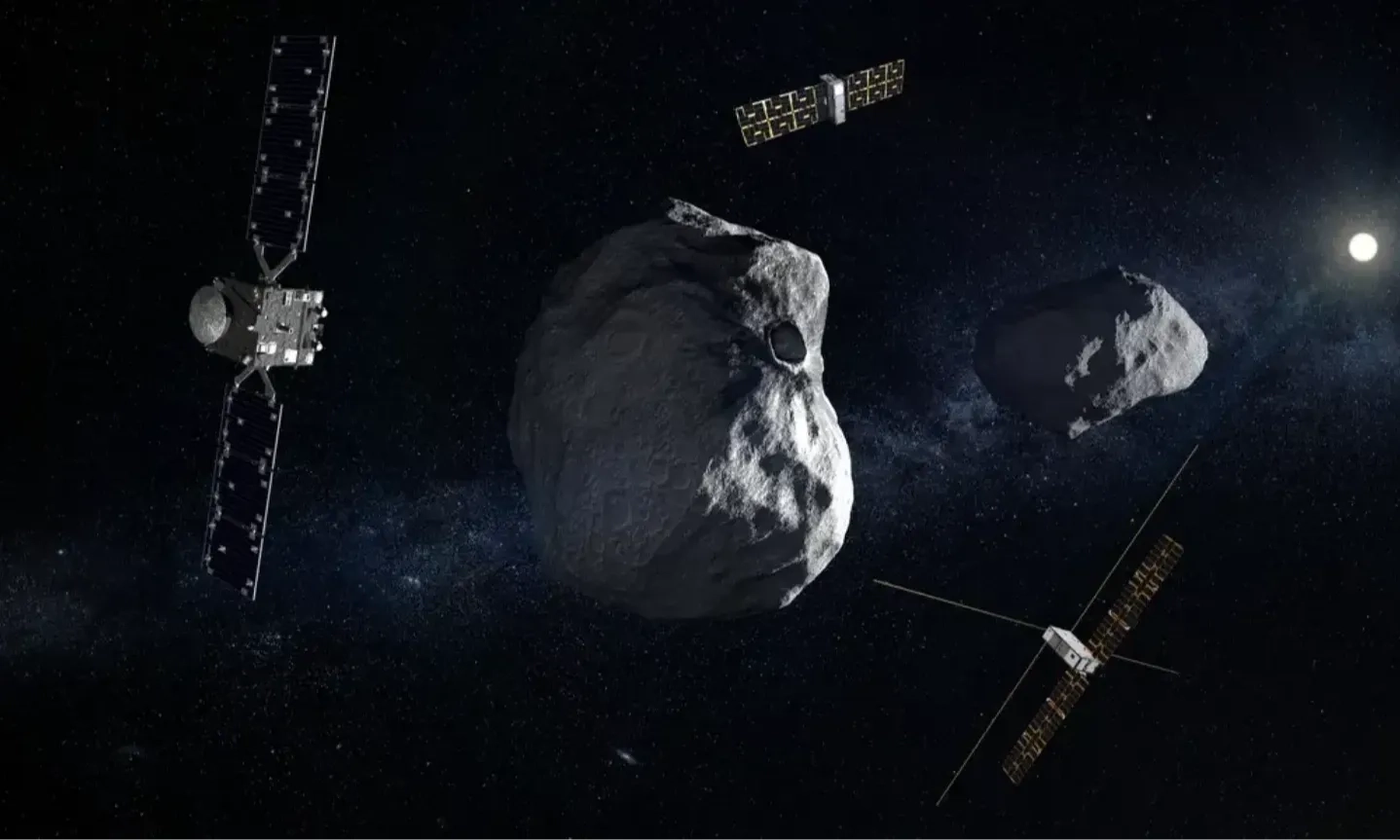
ESA’s Hera Reveals Massive Crater, Debris on Asteroid Dimorphos Years After DART Impact
Four years after a planned spacecraft collision, European Space Agency instruments have captured the first close-up images of asteroid Dimorphos, revealing a heavily deformed impact site surrounded by floating debris.
The images serve as vital visual evidence from humanity’s first planetary defense experiment to alter an asteroid’s orbit through a planned collision.
The Hera spacecraft arrived at the Didymos and Dimorphos system in November 2026 after a journey of more than two years, ValidNews reported. On November 7, 2026, the probe used its Asteroid Framing Camera from a distance of about 29 kilometers to photograph the 150-meter-wide celestial body, achieving a spatial resolution of about 2.7 meters per pixel, according to ValidNews.
The resulting images show a massive crater spanning nearly the entire side of the smaller asteroid that absorbed the strike, with the body measuring about 151 meters in diameter according to Vietnam.vn. Inside the depression, scientists spotted an elongated, cigar-shaped structure that will help researchers understand how asteroid material reacts to high-energy impacts, according to ValidNews.
Earth-based telescopes initially recorded that the DART impact shortened Dimorphos’s orbit around Didymos by about 33 minutes, according to Vietnam. The paired celestial bodies were chosen for study because they pose no threat to Earth.
Additional visuals published by Vietnam.vn revealed hundreds of boulders, some up to 1 meter wide, floating near the surface of the deformed target. Patrick Michel, lead scientist for the Hera mission, said that the impact left the region severely altered without completely destroying the body.
“This is a very large crater, but the celestial body was not destroyed. There are still many structures inside it,” Michel said according to Vietnam.vn.
The kinetic impact also destabilized the rotation of Dimorphos, leaving it tumbling off a fixed axis and experiencing significant changes in its rotational state and direction. Ian Carnelli, Hera project director, described the zone as extremely chaotic and unlike anything researchers predicted regarding how rock masses would settle after such a disruption.
Activities encompassing asteroid impact avoidance are included in the scope of the European Space Agency, alongside space safety and other uncrewed missions to celestial bodies. Furthermore, at the ministerial council of 2025, European Space Agency member states widened the agency’s mandate to include defence, allowing its intergovernmental framework to develop space technologies and systems for security and defence and to implement corresponding activities.
Our planetary defence mission Hera is about to reveal the first detailed images of asteroid Dimorphos since NASA’s DART impact in 2022. 🗓️ Journalists, join our media briefing on 25 November, in Berlin or online. Register by 23 November: https://t.co/xjHOCuipf4 pic.twitter.com/yr1vLlWYpw
Over the next six months, the Hera mission will deploy two shoe-box-sized CubeSats named Juventas and Milani to measure the asteroid’s internal structure, density, and gravitational field.
Those measurements will allow scientists to calculate the exact mass of Dimorphos and determine the true efficiency of the DART kinetic deflection method, helping develop technology to divert asteroids that could potentially collide with Earth and prevent disasters similar to the event believed to have caused the extinction of the dinosaurs about 65 million years ago.