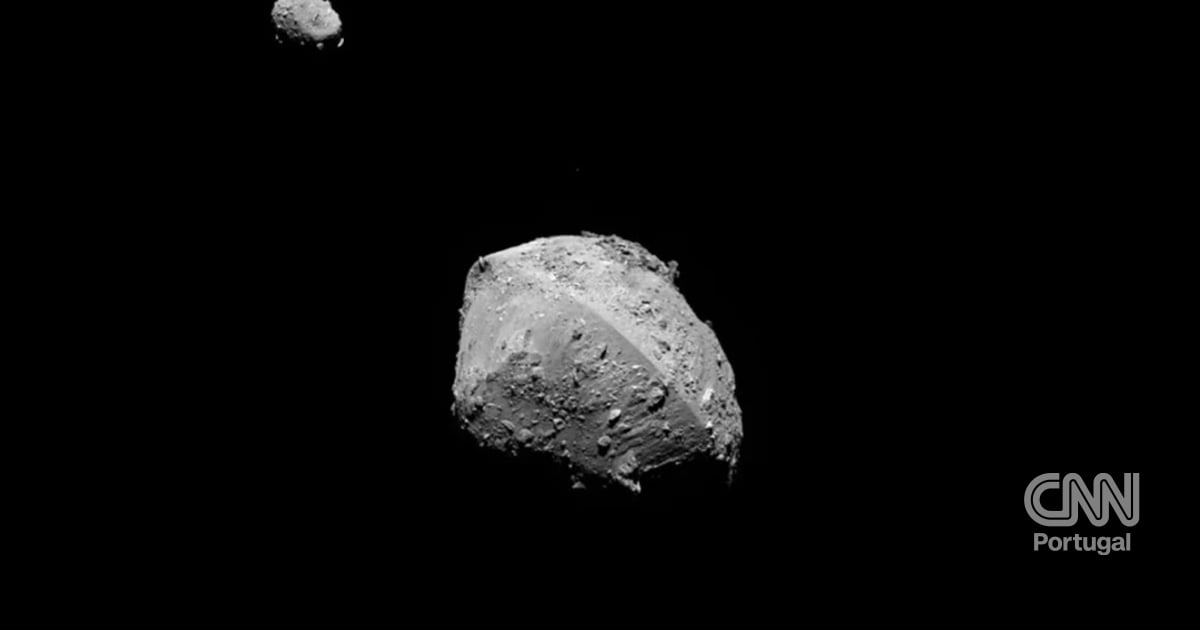
ESA’s Hera Probe Reveals Massive Crater, Chaotic Debris on Dimorphos After DART Impact
The European Space Agency (ESA) released the first close-up images of the asteroid Dimorphos on Wednesday, revealing significant surface deformations and chaotic orbital dynamics following a 2022 planetary defense test.
Four years after NASA’s DART mission intentionally collided with the 151-meter-wide body, the ESA’s Hera probe has arrived at the system to evaluate the impact’s long-term consequences. The binary asteroid system is currently 193.5 million kilometers from Earth.
The Hera probe reached a distance of about 30 kilometers from Dimorphos three weeks ago and transmitted its first images, which were unveiled by project officials from Berlin via YouTube. The images have a resolution of 2.7 meters per pixel.
- The DART impact in 2022 successfully reduced Dimorphos’s orbital period around Didymos by 33 minutes.
- New imagery from the Hera probe shows a massive crater covering nearly one side of the asteroid.
- The mission discovered hundreds of rocky fragments, ranging from soccer ball to washing machine size, orbiting the asteroid system.
- Portugal’s GMV developed critical software for the Hera probe to manage its navigation and trajectory near the asteroid.
Impact Created Massive Crater Without Destroying Asteroid
The images, captured from approximately 30 kilometers away, show that the impact did not merely crater the surface but fundamentally altered the asteroid’s behavior. While scientists previously debated whether the collision would deform the object or create a crater, mission investigators now believe both occurred simultaneously. “Actually, it is both things. We still don’t fully understand how that is possible,” lead Patrick Michel stated, as quoted by AFP and reported by Observador. “It is a huge crater, but it did not destroy the object, and there are elements inside it that we still do not understand,” Michel told euronews.
“It is completely different from what we would rationally expect regarding the appearance and behavior of these rocks.” The impact appears to have flattened one side of Dimorphos, leaving a crater as wide as the asteroid’s entire face.
Inside the crater, several unusual structures are visible, including one shaped like a cigar. “It is total chaos,” Hera project manager Ian Carnelli told euronews, referring to the hundreds of debris blocks, up to one meter in size, now floating around the asteroid.
The asteroid, which once behaved similarly to Earth’s moon by keeping the same face toward its larger companion, Didymos, is now in a state of unstable rotation. “Before the impact, Dimorphos resembled our Moon. It always showed the same face to Didymos and behaved quite regularly. Now, it is very chaotic,” said Sabina Raducan, a planetary scientist at the International Space Science Institute, according to CNN Portugal. She described the movement as being like “a barrel thrown down the stairs that moves in every direction.” “The rotation around its own axis is very chaotic and very unstable. It does not rotate around a single axis; sometimes the crater on the side facing the direction of rotation is visible, and other times it shifts to the opposite side. Therefore, there was also a significant destabilization of its rotation,” Michel explained.
“Before the DART impact, Dimorphos was more like our moon: it always showed the same face,” Raducan explained, adding that Dimorphos now moves like a “barrel rolling down the stairs.” Naomi Murdoch, a planetary scientist at the University of Toulouse and mission team member, said: “With the impact, we changed the appearance of Dimorphos, we changed the way it moves and we observed for the first time a multitude of new companions in this system that we did not count on.”
The Hera team also discovered that Didymos and Dimorphos are not alone. Scientists do not yet know if these objects are a consequence of the impact. “As we approached Didymos and Dimorphos, we quickly realized the asteroids were not alone,” Murdoch said during the conference.
More than 100 blocks with dimensions varying between a soccer ball and a washing machine were counted. The gravitational pull of Didymos is tens of thousands of times weaker than Earth’s, while on Dimorphos that proportion reaches hundreds of thousands of times weaker.
Our Hera spacecraft can now see Didymos and Dimorphos as two separate asteroids! Coming closer, it will study the effects of NASA's 2022 DART impact and help advance asteroid deflection as a planetary defence technique. The first detailed images of Dimorphos are expected on 25… pic.twitter.com/lHA0jU04jT
Hera Mission Uses Autonomous Navigation from GMV Portugal
The Hera mission, launched in October 2024, relies on autonomous navigation systems developed in part by the Portuguese branch of the technology group GMV. This software allows the probe to execute high-precision maneuvers near the asteroid, including detailed mapping of the crater left by the DART impact, the company stated. “This system incorporates an unprecedented degree of autonomy in ESA’s history, allowing high-precision maneuvers and observations near Dimorphos – including the detailed study of the crater left by the DART impact,” GMV Portugal said in a statement.
GMV is a privately owned technology group headquartered in Spain with a presence in 12 countries, including Portugal. The company in Portugal is already involved in the next major European asteroid mission: RAMSES, scheduled for launch in 2028, which will study the asteroid Apophis, a celestial body that will pass in 2029 at a distance from Earth lower than the geostationary orbit, according to Observador.
This investigation is part of a broader European effort to refine planetary defense techniques. The ESA is already preparing for the RAMSES mission, scheduled for launch in 2028, which aims to study the asteroid Apophis as it passes close to Earth in 2029, as reported by euronews. Hera is part of ESA’s Space Safety Programme and will be followed by the Ramses mission, which will rendezvous with Apophis when it passes near Earth in 2029.
Meanwhile, Carnelli is preparing to request funding for an extension of the Hera mission, as the European probe still has plenty of propellant on board.
“In large part, our pre-impact predictions about how DART would change the motion of Didymos and its moon Dimorphos through space were correct,” Derek Richardson who led the analysis of the probe’s impacts, explained in a statement, according to Jornal de Notícias. “It is, therefore, a mixture of enthusiasm and panic.”

In December, the Hera probe is expected to move closer to the asteroid, reducing its distance to approximately 13 kilometers to capture high-resolution imagery and perform mass calculations, CNN Portugal reported. “The first time I saw the images, I said: ‘Wow!'” Patrick Michel, the mission scientist, told AFP. Hera mission manager Ian Carnelli revealed the new images in a dinosaur hall at the Museum für Naturkunde Berlin, as a reminder of the danger of asteroid impacts, such as the one 66 million years ago that caused a mass extinction on Earth, wiping out the dinosaurs.
“66 million years ago, the impact of an asteroid changed the course of life on Earth,” Carnelli declared. “Today, for the first time in history, humanity is validating the way to prevent such an event from happening again.” “It is the first time that a human-built spacecraft has actually hit an interplanetary body with the direct intention of altering its trajectory. At this stage, Dimorphos appears to wobble chaotically, like a boxer after a powerful punch.”
More on Dimorphos
Hera's getting a good look at Didymos after Dart got a handful of images on its way in to impact Dimorphos. And what you can see s the fine material is forming a really clear ridge around the equator. Compare it to Bennu and Ryugu. I expect that the tidal effects of Dimorphos… pic.twitter.com/jjhi3quKuO
ESA's Hera mission for planetary defence has begun surveying its target asteroids from 30-25 km away, flying in 'rectangular orbits' around the ultra-low-gravity Didymos and Dimorphos bodies 🛰️🪨🪨https://t.co/QqO5dXSbmM pic.twitter.com/cuZC9aCtF4