Eritrea faces visa issues and kit fines at World Championships
The UCI Road World Championships in Canada brought severe administrative and financial setbacks for the Eritrean national team, as visa roadblocks depleted elite line-ups and post-race kit infringements triggered financial penalties from cycling’s governing body. According to team leader Biniam Girmay, key riders Amanuel Ghebreigzabhier and Natnael Tesfatsion were forced to miss Sunday’s elite men’s road race due to unresolved visa barriers preventing entry into the country.
Visa Roadblocks Deplete Eritrean Roster
The absence of Ghebreigzabhier and Tesfatsion left the Eritrean squad starting the elite men’s road race with just three of their five named riders. Girmay addressed the media ahead of the race, stating that the two strong powerhouses were unable to secure the necessary travel documentation to enter Canada. While both riders appeared on initial squad announcements, only Ghebreigzabhier made the official start list where he was recorded as a non-starter, reflecting earlier clarity regarding Tesfatsion’s inability to travel. Similar visa complications previously impacted Eritrean participation at the 2023 World Championships in the United Kingdom, highlighting a recurring logistical hurdle for African athletes attempting to compete at the sport’s highest international level. Further compounding the squad’s depth issues, the U23 road race saw only Nahom Efriem start among three originally named riders, with Milkias Maekele and Yafiet Mulugeta absent from the start line.
UCI Commissaires Hand Down Kit Fines
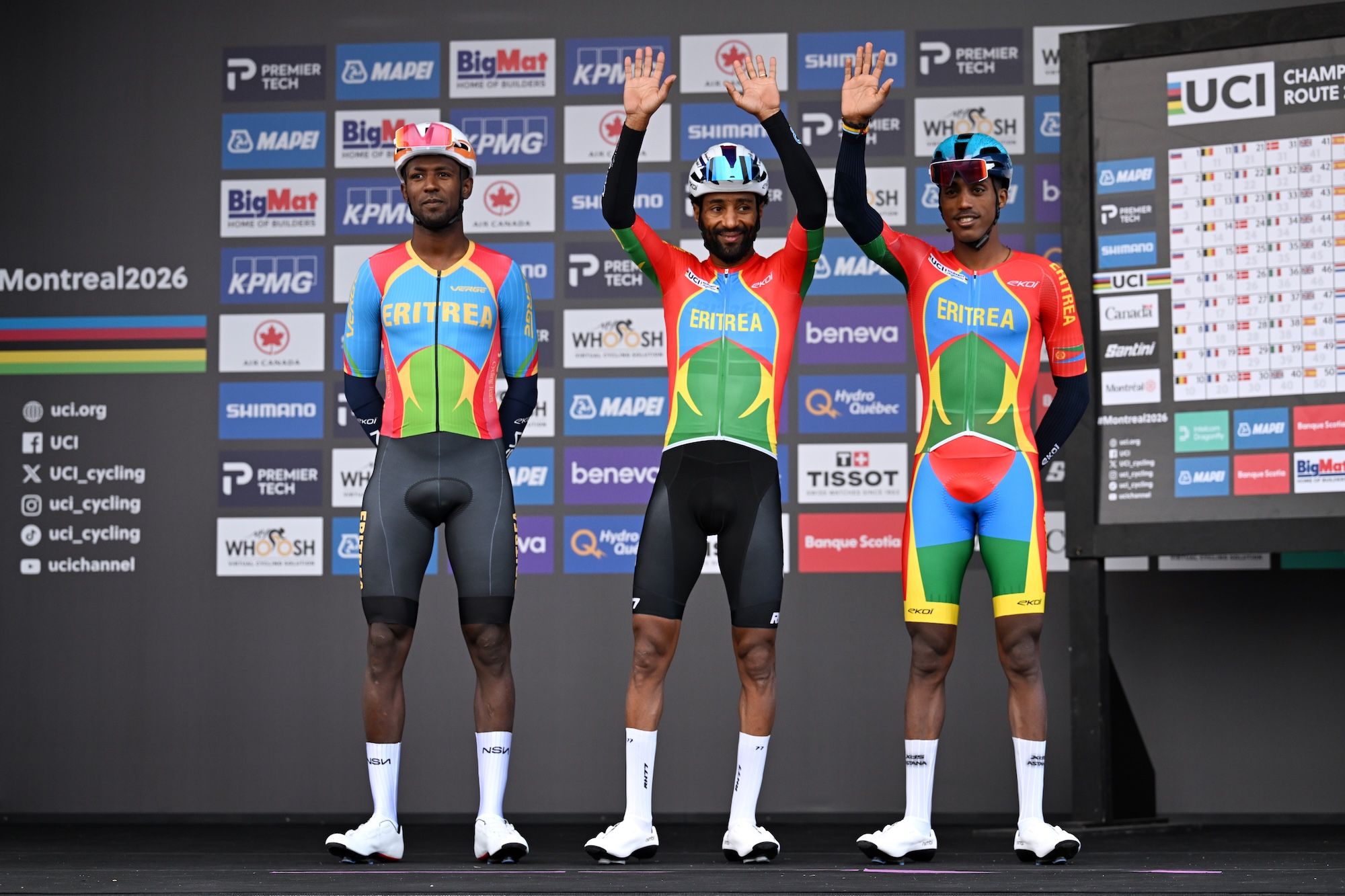
Following the elite men’s road race, the Union Cycliste Internationale commissaires issued financial sanctions via official communiqué. Biniam Girmay and Mulubrhan were each fined 500 Swiss Francs under Article 2.12.007.3.9 of the UCI rulebook, which penalizes teams for ‘Different clothing for the different riders of a team’. In addition, team director Samsom Ghebreyesus received a 1,000 Swiss Franc fine. Race photographs showed riders wearing varying iterations of the national colors alongside trade team outer layers. Girmay competed in a skinsuit produced by Verge featuring Eritrean colors on the upper torso and black lower panels alongside branding for his trade team, NSN Cycling. Mulubrhan wore national colors on both jersey and shorts, though the upper garment differed from Girmay’s design in color distribution across the sleeves. Kudus avoided sanction by altering his apparel between the pre-race podium ceremony and the start line, switching from an Ekoi jersey and RH77 shorts to a multi-colored RH77 kit reminiscent of the previous season’s team design.
Trade Team Layers and Funding Disparities
The controversy extended to the use of trade team gilets and jackets worn during the opening kilometers of the race. Both Girmay and Mulubrhan started the event wearing outer layers from their respective trade teams—NSN Cycling and XDS-Astana—before discarding them approximately 25 kilometers into the breakaway. Kudus likewise wore a neutral black long-sleeve jacket supplied by his trade team, Burgos-Burpellet-BH, without facing punishment. UCI regulations specify restrictions regarding jerseys, shorts, and rain jackets, leaving items like gilets in an operational grey area. Observers noted that funding disparities across national federations often dictate whether teams can supply complete ranges of bespoke garments, placing riders from smaller or less-funded nations at a distinct disadvantage compared to heavily resourced federations equipped with comprehensive national apparel packages.

Disclaimer: The insights provided in this article are for informational and entertainment purposes only and do not constitute medical advice or sports betting recommendations.