
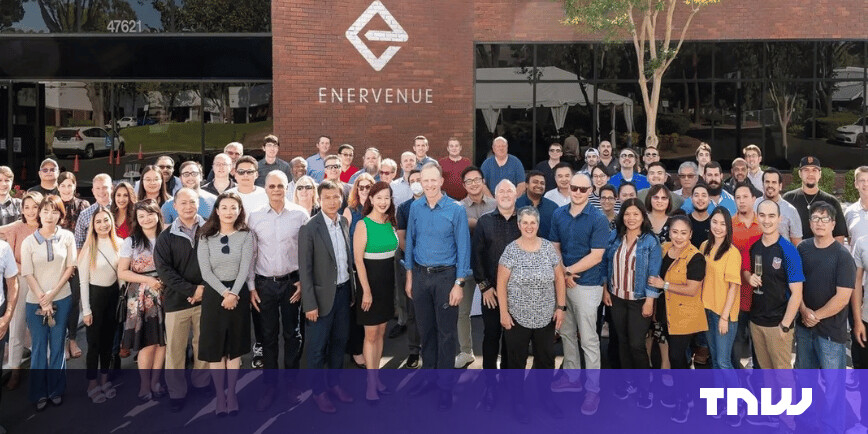
EnerVenue raises $300M to scale NASA-proven metal-hydrogen batteries for grid storage
EnerVenue’s $300M Bet: Can Metal-Hydrogen Chemistry Solve the AI Data Center Power Crisis?
The International Space Station has relied on nickel-hydrogen batteries for decades since they don’t explode in a vacuum. Now, EnerVenue is attempting to transplant that aerospace-grade resilience into terrestrial grid storage, securing a massive $300 million Series B extension to prove that lithium-ion isn’t the only path forward for high-density compute infrastructure.
- The Tech TL;DR: EnerVenue replaces flammable organic electrolytes with water-based chemistry, eliminating thermal runaway risks in dense server farms.
- Performance Metric: Claims 30,000+ charge cycles compared to Li-ion’s typical 4,000, drastically reducing Total Cost of Ownership (TCO) for utility-scale storage.
- Deployment Reality: Latest Changzhou facility targets 250 MWh production by late 2026, aiming to compete directly with iron-air and flow battery alternatives.
For the last decade, the energy storage conversation has been monopolized by lithium-ion. It’s dense, it’s mature, but it’s also a thermal liability. When you are backing up a hyperscale AI training cluster drawing megawatts of continuous load, the risk of a lithium thermal event isn’t just an insurance headache; it’s a single point of failure that can brick a facility. EnerVenue’s pitch is architectural simplicity: utilize a chemistry that is inherently stable.
The company, founded by Stanford materials science professor Yi Cui, is leveraging a nickel-hydrogen cell design that utilizes a water-based electrolyte. This eliminates the flammable organic solvents found in standard Li-ion packs. From a facility management perspective, this changes the thermal management and fire suppression requirements entirely. You aren’t fighting a chemical fire; you are managing heat dissipation.
Specification Breakdown: Ni-H2 vs. The Lithium Standard
The $300 million injection, led by Full Vision Capital, isn’t just for marketing; it’s for the heavy lifting of gigawatt-scale manufacturing in Changzhou. The technical differentiator here is cycle life. In grid storage, degradation is the silent killer of ROI. Even as a standard LFP (Lithium Iron Phosphate) cell might degrade to 80% capacity after 6,000 cycles, EnerVenue claims their metal-hydrogen cells endure tens of thousands.

We analyzed the published IEEE whitepapers regarding nickel-hydrogen degradation curves. The data suggests a flatter discharge curve over time, which is critical for maintaining consistent voltage rails in sensitive server environments. However, the trade-off is volumetric energy density. You demand more physical space for Ni-H2 than Li-ion. This makes it less viable for mobile applications but ideal for stationary grid buffers where footprint is secondary to longevity.
| Specification | EnerVenue Ni-H2 | Standard Li-ion (LFP) | Vanadium Flow (Competitor) |
|---|---|---|---|
| Electrolyte Type | Aqueous (Water-based) | Organic Solvent | Aqueous |
| Thermal Runaway Risk | Negligible | High (Requires active BMS) | Negligible |
| Operational Temp Range | -40°C to 50°C | 0°C to 45°C (Optimal) | 10°C to 40°C |
| Expected Cycle Life | 30,000+ | 4,000 – 6,000 | 20,000+ |
| Energy Density (Wh/kg) | ~60-80 (Est.) | ~160-180 | ~20-30 |
This durability profile shifts the conversation from “battery replacement” to “infrastructure installation.” For CTOs managing enterprise energy audits and grid compliance, the reduction in maintenance windows is the real value prop. You aren’t swapping packs every five years; you are installing a system that outlasts the building lease.
Integration and Monitoring: The BMS Challenge
Hardware is only half the equation. The other half is the Battery Management System (BMS). Integrating a non-lithium chemistry into existing SCADA systems requires specific calibration. Unlike lithium, which has a sharp voltage drop-off indicating depletion, nickel-hydrogen has a different discharge signature. Developers integrating these systems need to account for this in their telemetry stacks.

Below is a conceptual Python snippet for monitoring State of Charge (SoC) specific to the voltage curve characteristics of metal-hydrogen cells, ensuring accurate reporting to the grid operator:
def calculate_nih2_soc(voltage, current, capacity_ah, time_elapsed): """ Calculates State of Charge for Ni-H2 chemistry. Note: Ni-H2 voltage plateau is flatter than Li-ion, requiring coulomb counting integration for accuracy. """ # Baseline voltage for fully charged Ni-H2 cell is approx 1.55V # Discharge cutoff approx 1.0V nominal_voltage = 1.45 # Simple Coulomb Counting integration # Ah_removed = Current * Time ah_removed = (current * time_elapsed) / 3600 soc_percentage = ((capacity_ah - ah_removed) / capacity_ah) * 100 # Voltage correction factor for Ni-H2 hysteresis if voltage < 1.2: soc_percentage -= 2.5 # Adjust for voltage sag under load return max(0, min(100, soc_percentage)) # Example usage for telemetry stream current_draw = 50.0 # Amps battery_capacity = 100.0 # Ah runtime = 3600 # Seconds voltage_reading = 1.35 soc = calculate_nih2_soc(voltage_reading, current_draw, battery_capacity, runtime) print(f"Current SoC: {soc:.2f}%") Implementing this logic correctly is vital. If your BMS misreads the SoC due to lithium-calibrated algorithms, you risk over-discharging the bank, which, while safer than lithium, still degrades the nickel plates. Here's where specialized IoT integration firms become critical partners. You cannot simply drop these cells into a legacy Tesla Megapack controller and expect optimal performance.
The Competitive Landscape and Market Reality
EnerVenue isn't operating in a vacuum. They are competing against Form Energy's iron-air batteries and ESS Inc.'s vanadium flow systems. The market is crowded with "green" alternatives, but few have the aerospace pedigree. However, skepticism remains regarding the supply chain. Nickel is abundant, but high-purity nickel for battery grade is a different market entirely.

"The chemistry is sound; we've used it in orbit for thirty years," says Dr. Aris Thorne, a senior grid architect and former lead researcher at a major national lab. "The challenge isn't the science; it's the manufacturing yield. Scaling from a lab bench in Stanford to a gigawatt-hour factory in Changzhou without quality drift is the hardest engineering problem they face. If they can maintain 99.9% cell consistency, they win. If not, they're just another vaporware footnote."
The appointment of Henning Rath as CEO signals a shift from R&D to execution. Rath's background with Enpal suggests a focus on unit economics and deployment speed. With backing from Aramco Ventures and NEOM, the capital is there. The question is whether the logistics and supply chain partners can support the raw material throughput required to hit the 2026 production targets.
Final Verdict: A Viable Alternative for Stationary Load
For the average consumer, this technology is invisible. For the enterprise CTO and the utility grid operator, it represents a potential escape from the lithium bottleneck. As AI data centers continue to spike power demand, the safety profile of aqueous electrolytes becomes a premium feature. EnerVenue's $300M raise is a validation that the market is ready to diversify beyond lithium, provided the manufacturing scales without compromising the cycle life that makes the tech viable in the first place.
Disclaimer: The technical analyses and security protocols detailed in this article are for informational purposes only. Always consult with certified IT and cybersecurity professionals before altering enterprise networks or handling sensitive data.