
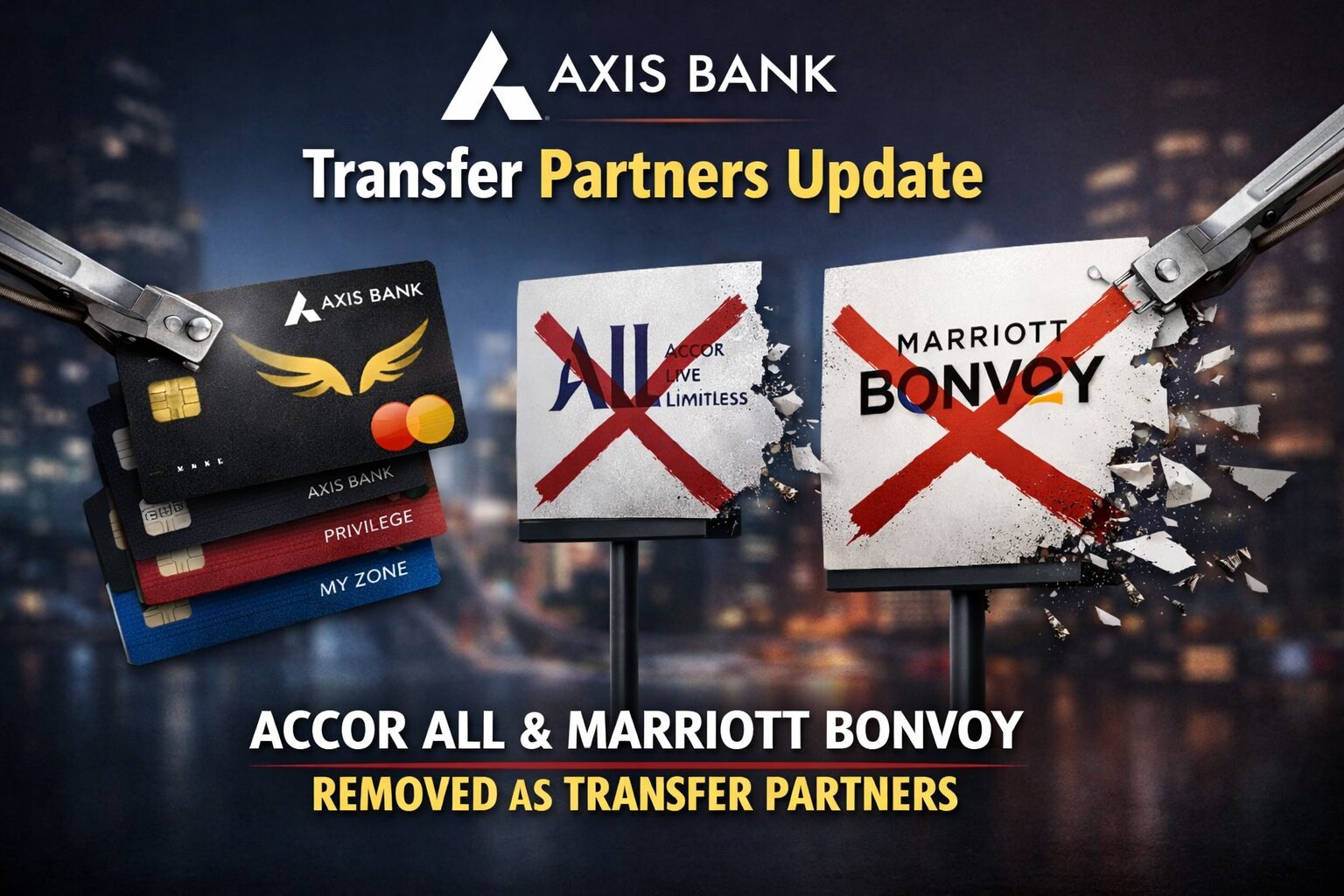
End of an Era: Axis Bank Credit Cards nix Accor, Marriott and Qatar Airways from transfer partner list with immediate effect
Axis Bank Severed Key Loyalty Partnerships Amidst Rising Liability Costs
Axis Bank has officially terminated transfer partnerships with Accor ALL, Marriott Bonvoy, and Qatar Airways effective April 2, 2026. The move, driven by unsustainable liability costs and INR devaluation, slashes conversion ratios for British Airways and Finnair Avios across premium card tiers. This restructuring signals a broader industry pivot away from high-yield travel redemptions toward capped cash-back models.
The “points economy” in India just took a massive hit to its balance sheet. For years, the Axis Bank Magnus and Reserve cards were the gold standard for travel hackers, offering a direct arbitrage where 1 Edge Reward (ER) point could fetch nearly INR 2 in value via Accor transfers. That arbitrage is dead. As of 00:00 IST on April 2, 2026, the ledger has been wiped clean. This isn’t just a program update; This proves a fiscal correction. The bank is effectively capping its exposure to foreign currency volatility and the ballooning cost of loyalty liabilities.
We saw the writing on the wall months ago. In January 2026, industry whispers suggested the valuation model was breaking. The math was simple but brutal. As the Indian Rupee weakened against the Euro and the US Dollar, the cost for Axis Bank to purchase Accor points or Marriott nights skyrocketed. Meanwhile, cardholders were burning points at record volumes, treating the credit card not as a payment instrument, but as a currency mint. Banks cannot sustain a model where the redemption value exceeds the interchange fee revenue generated by the spend.
This creates an immediate problem for high-net-worth individuals and corporate travel managers who built their liquidity strategies around these transfer partners. Suddenly, the “free” hotel stay is costing double in raw spend. It forces a re-evaluation of corporate travel policies and personal wealth allocation. For businesses heavily reliant on employee travel rewards, this volatility introduces a new line item in the risk management ledger. They need stability, not sudden devaluations. This is where corporate travel management firms become critical, helping organizations pivot from volatile points-based systems to fixed-cost negotiated rates that protect the bottom line from currency shocks.
The Math of Devaluation: A Breakdown of the New Ratios
The termination of Accor, Marriott, and Qatar is the headline, but the silent killer here is the ratio compression on the remaining airline partners. Axis Bank didn’t just cut partners; they diluted the value of the currency itself. The shift from a 5:4 ratio to a 5:2 ratio for British Airways Avios on premium cards represents a 50% instantaneous devaluation of accumulated capital.
Consider the impact on the Magnus cardholder. Previously, 20,000 Edge Rewards yielded 16,000 Avios. Today, that same spend yields only 8,000. The purchasing power of the consumer has been halved overnight. This mirrors trends we see in quantitative tightening, where liquidity is pulled from the market to stabilize the issuer’s balance sheet.
The following table illustrates the stark contraction in value across the portfolio:
| Card Tier | Partner | Previous Ratio | New Ratio (Effective Apr 2, 2026) | Value Impact |
|---|---|---|---|---|
| Magnus / Burgundy | British Airways / Finnair | 5 ER : 4 Avios | 5 ER : 2 Avios | -50% Yield |
| Reserve / Magnus | British Airways / Finnair | 5 ER : 2 Avios | 5 ER : 1 Avios | -50% Yield |
| Olympus | British Airways / Finnair | 1 EM : 4 Avios | 1 EM : 2 Avios | -50% Yield |
| Atlas / Horizon | British Airways / Finnair | 1 EM : 2 Avios | 2 EM : 1 Avios | -75% Yield |
This compression forces a migration of capital. Cardholders holding significant balances in Edge Rewards or Edge Miles are now sitting on depreciating assets. The rational economic actor will liquidate these positions immediately, likely flooding the remaining transfer partners like Singapore Airlines KrisFlyer or Virgin Atlantic, potentially causing award space shortages in the short term.
The Strategic Pivot: Why Banks Are Walking Away
To understand the mechanics of this decision, we have to look at the liability side of a bank’s balance sheet. Unredeemed points are a liability. When the cost to fulfill that liability (buying the hotel night or the flight seat) rises due to inflation or currency fluctuation, the bank’s margin evaporates. Axis Bank is not alone in this; it is a sector-wide correction.

“We are seeing a fundamental decoupling of credit card rewards from high-cost travel inventory,” says Rajiv Mehta, a senior analyst at a top-tier Indian financial consultancy. “Banks are moving toward closed-loop ecosystems where they control the cost of goods sold. Relying on third-party partners like Accor or Marriott exposes the bank to external pricing power they cannot control. Expect more banks to bring rewards in-house or partner with domestic vendors where currency risk is neutralized.”
This shift highlights a gap in the market for loyalty program management platforms that allow issuers to dynamically adjust redemption values in real-time based on market rates, rather than committing to static, high-value transfer ratios that become toxic during currency downturns.
Competitor Landscape and Market Opportunities
With Axis Bank exiting the high-value transfer game, the vacuum is immediate. Competitors are already positioning themselves to capture this displaced liquidity. The HSBC Travel One card and the American Express Platinum Charge Card remain the primary beneficiaries. Both maintain robust transfer partnerships with Accor and other global chains, effectively becoming the new safe havens for travel arbitrage.
However, savvy investors understand that no yield lasts forever. The migration of users to these alternative cards will increase their liability burdens, likely triggering similar devaluations in the 2027 fiscal year. The cycle of inflation and devaluation is inherent to the points economy.
For corporate treasurers, this volatility is unacceptable. Relying on credit card points for significant travel budget offsets is now a high-risk strategy. The solution lies in diversification. Companies are increasingly turning to financial compliance and advisory firms to restructure their employee benefit packages, moving away from variable reward schemes toward fixed allowances or direct procurement strategies that bypass the volatility of the loyalty market entirely.
The Bottom Line: Adapt or Lose Value
The era of the “free luxury stay” via credit card churning in India is undergoing a harsh reality check. Axis Bank’s decision is a clear signal that fiscal prudence is trumping customer acquisition hype. The 50% devaluation on Avios transfers and the total removal of Accor and Marriott are not temporary glitches; they are the new baseline.
Consumers must treat points as a depreciating asset class. Hoarding is now dangerous. The smart money moves quick, liquidating balances into the few remaining high-value partners before the next round of corrections hits the wider market. For the B2B sector, this turmoil presents a clear opportunity: provide the tools and advisory services that help businesses and individuals navigate this fragmented, high-risk rewards landscape. Stability is the new luxury.