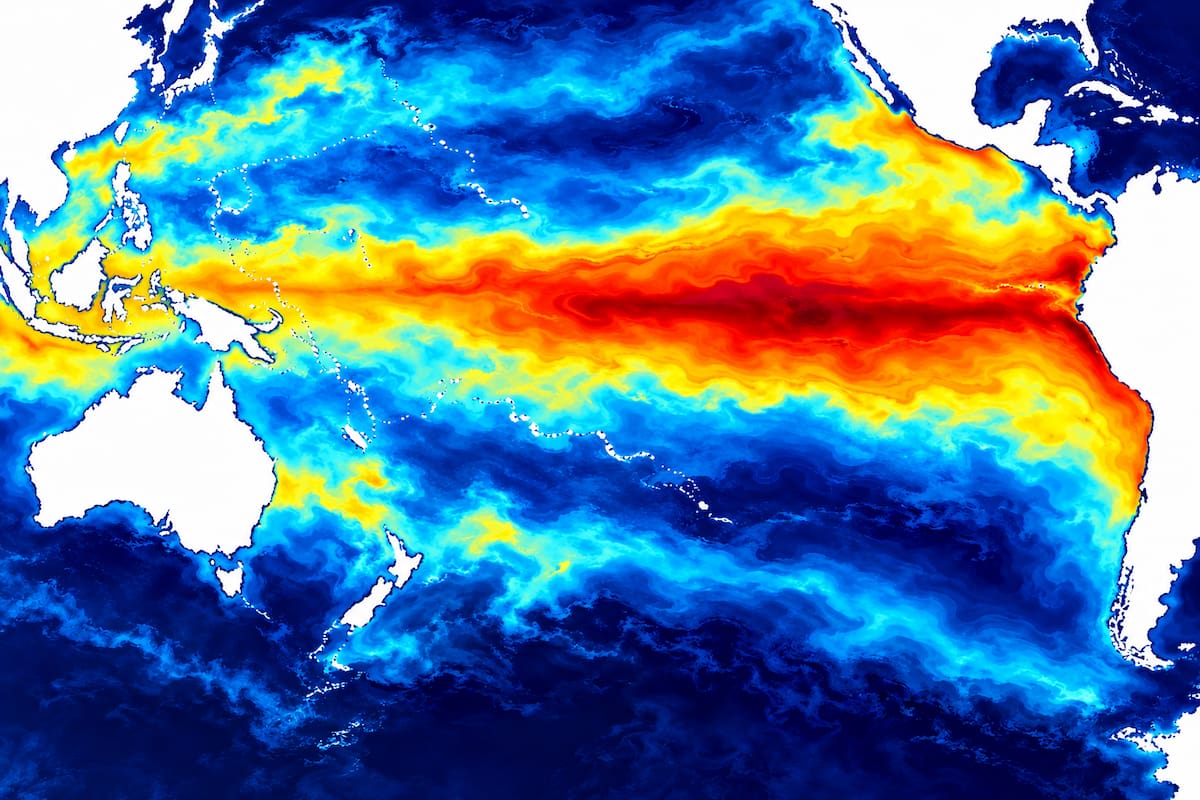
El Niño 2026 Could Become One of the Strongest on Record
The 2026 El Niño episode is intensifying, with surface sea temperatures in the equatorial Pacific reaching an anomaly of +3 °C by mid-September. According to an analysis published on September 21 by the International Research Institute for Climate and Society (IRI) of Columbia Climate School, all 22 forecast models project the event will remain in the “very strong” category through the 2026–2027 southern hemisphere summer, potentially ranking among the strongest recorded.
Tracking the Pacific Temperature Anomalies and Subsurface Heat
The evaluation of intensity relies heavily on the Niño 3.4 index, which measures deviations from habitual sea surface temperatures in the equatorial Pacific. The weekly register centered on September 16 hit +3 °C, following a monthly average of +2.52 °C recorded in August. These figures reflect severe water temperature anomalies within that specific regional strip rather than an equivalent three-degree spike in global temperatures.
Beneath the surface, a substantial reservoir of exceptionally warm water persists across the central and eastern equatorial Pacific. Researchers note that this accumulated sub-surface heat provides the thermal energy necessary to drive further surface temperature increases should existing atmospheric conditions hold steady.
Historical data compiled by the IRI shows that El Niño and La Niña episodes typically form between April and June, peaking anywhere from October to February. While the incoming weeks mark the start of the window for maximum intensity, current models have not pinpointed an exact calendar week for the peak, projecting instead that the warming trend will persist across upcoming months.
Global Forecast Consensus and Duration Projections
All 22 distinct meteorological models analyzed by the IRI agree on a consistent trajectory, projecting a “very strong” El Niño across trimonthly periods from September–November 2026 through December 2026–February 2027. A majority of these models point toward values matching or exceeding +3 °C during the peak activity phase.
Probability metrics assign a 100% chance that El Niño conditions will continue through the February–April 2027 window. That probability drops to 90% for April–June 2027 and recedes to 61% by May–July 2027. These percentages measure the statistical likelihood of persistent El Niño conditions rather than an unbroken duration of peak intensity.
While standard historical episodes endure between nine and twelve months, certain events stretch across two full years. For now, the IRI assessment confirms that the phenomenon will continue to strengthen and maintain high intensity throughout the coming months.