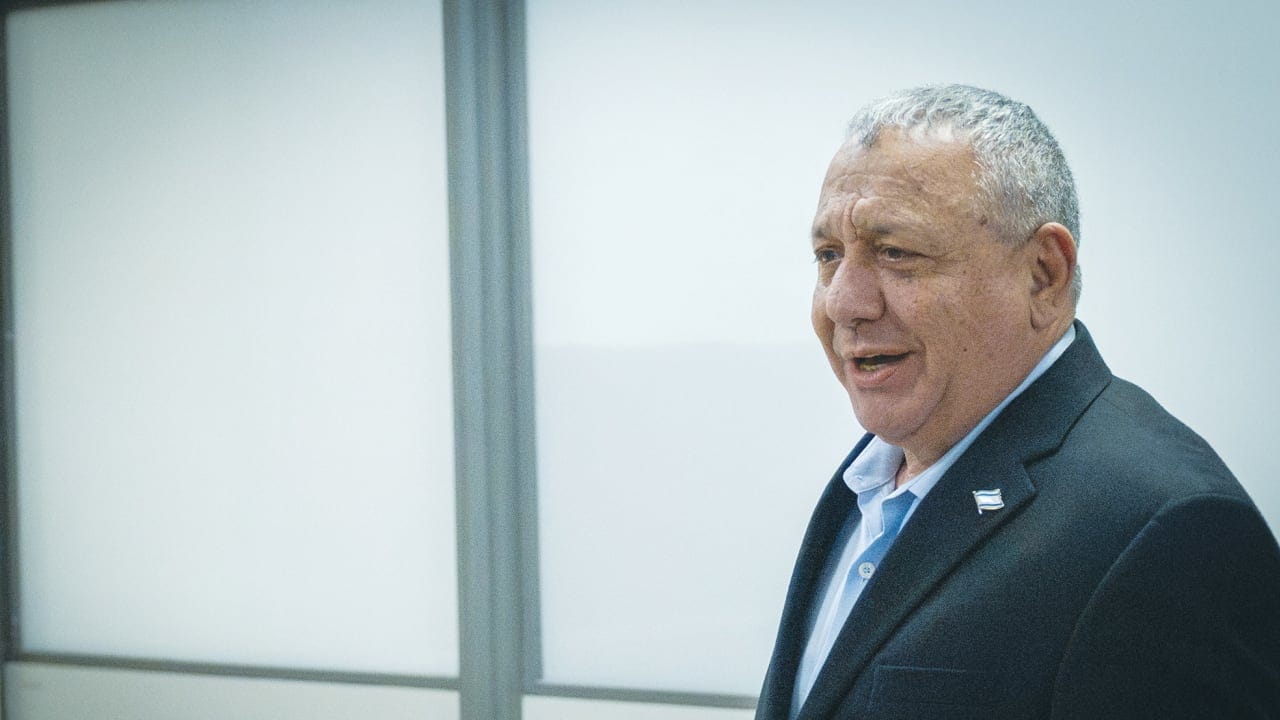
Eisenkot Close to Government Ousting Netanyahu With Unlikely Coalition
Opposition leader Gadi Eisenkot is close to forming a government that would oust Prime Minister Benjamin Netanyahu, relying on an unlikely coalition of secular right-wing, left-wing, and ultra-Orthodox parties.
Eisenkot, tasked by President Isaac Herzog with forming a government after 67 of the 120 Knesset members backed him, has until December 6 to secure a majority. The deadline could be extended by two weeks if necessary. Until a new government is formed, Netanyahu’s cabinet continues in a caretaker capacity.
Eisenkot’s center-right Yashar party has reached agreements with two key partners: the Yisrael Beiteinu party and the Democrats. The Democrats will receive four ministerial portfolios, including an expanded national security ministry, and the agreements include a commitment to “fully cancel the regime coup,” the Democrats announced.
“Political interest can take you a very long way,” said Dahlia Scheindlin, an Israeli pollster and political analyst. “The party leaders inevitably break their promises, and they have to because nobody got the majority they wanted.”
United Torah Judaism, an ultra-Orthodox party, is involved in the most important development. The party has advanced talks with Eisenkot, a move that would have been unthinkable before the October 27 election.
Avigdor Liberman, leader of Yisrael Beiteinu and a key partner in Eisenkot’s talks, has ruled out a government with the Arab-led parties, arguing it would be unstable. He has urged Eisenkot to form a government backed by the ultra-Orthodox parties instead, a move that would require compromising on the contentious issue of military conscription for yeshiva students.
Netanyahu accused of stalling talks
Despite the progress, Eisenkot has accused Netanyahu’s Likud party of delaying the negotiations. “Likud, for its part, was unwilling to compromise and, over two weeks, refused to put a single concrete proposal on the table,” Eisenkot said in a statement on Friday.
🇮🇱 Gadi Eisenkot, tasked with forming #Israel's next government, on Sunday called for caretaker PM Benjamin Netanyahu to immediately leave his post after reports emerged alleging election interference by a Netanyahu aide. Hours after representatives for the two camps met to… pic.twitter.com/cWCGh9JRsh
Eisenkot said that two weeks and five meetings were sufficient to reach an agreement had there been a genuine desire to do so. He also accused Likud of refusing to discuss forming a unity government under the framework he proposed.
The Likud party said in a statement, “While you send teams to negotiate a unity government with one hand, with the other you have already finalized a dangerous left-wing government, distributed ministerial portfolios, and are now working to legitimize sitting alongside the terror supporters upon whom you depend.”
One remaining obstacle is Naftali Bennett, who has met with Netanyahu at the Knesset.
Liberman dismisses Netanyahu's rotation ploy
Yisrael Beytenu chairman Avigdor Liberman dismissed a potential premiership rotation with Benjamin Netanyahu as a mere ploy during a plenum session at the Knesset in Jerusalem on November 25, 2026. He argued that Netanyahu's offer was a political maneuver to derail coalition negotiations, not a genuine attempt at partnership.

Liberman has also ruled out a government with Arab-led parties, calling it unstable.
Eisenkot advocates for Zionist unity government
Opposition leader Gadi Eisenkot has consistently advocated for a Zionist unity government, writing on social media that “by far the best alternative for the State of Israel” is one led by Gadi Eisenkot first, under a rotation agreement for the premiership. He reached out to Netanyahu, stating his door remained open if Likud was prepared for “serious negotiations and partnership that includes compromise.”
Eisenkot accused Netanyahu of putting Israel “in a very dangerous place” with his anti-Arab rhetoric, while negotiations with the ultra-Orthodox parties continued to advance, with hopes to move secret talks into the open in the coming days, according to Israel’s Channel 12.
Arab parties and the path to a majority
With his current bloc of 48 seats falling short of the 61 needed for a majority, Eisenkot must secure additional support. The Arab parties, which won 19 seats, could provide that support either by joining the coalition or offering outside backing. Mansour Abbas, the leader of the Ra’am party, has indicated his party could be willing to support Eisenkot’s government.
Netanyahu has strongly opposed such an arrangement, posting on social media, “You must not form a government with supporters of terrorism!” Joint List chairman Yousef Jabareen accused Netanyahu of fuelling hostility toward Israel’s Arab population, who represent 21 percent of the population.
Avigdor Liberman, leader of Yisrael Beiteinu and a key partner in Eisenkot’s talks, has ruled out a government with the Arab-led parties, arguing it would be unstable. He has urged Eisenkot to form a government backed by the ultra-Orthodox parties instead, a move that would require compromising on the contentious issue of military conscription for yeshiva students.
“I wouldn’t rule out the possibility that [Netanyahu] will offer Gadi Eisenkot a rotation in which Netanyahu would serve second, but everyone needs to understand: this is merely a ploy,” Liberman said.
This coalition's formation reflects political changes in Israel since the election, making previously impossible alliances possible or likely.
“He will drag out negotiations over a ‘unity’ government until the last moment, look for a pretext to blow them up, and even if such a government is formed, he will try to engineer a crisis within a few months to drag Israel back to elections,” Lieberman wrote on X of Netanyahu.
“It still does seem almost unimaginable that you’ll have an [ultra-Orthodox] and an Arab party in a coalition,” said Anshel Pfeffer, Israel correspondent for the Economist. “But it is now conceivable.”