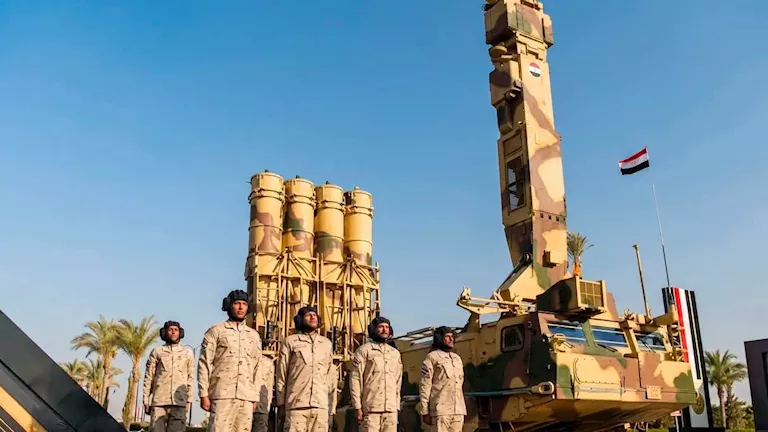
Egypt Debuts S-300VM Antey-2500 Missile System at Octagon Opening
Egypt revealed the S-300VM Antey-2500 missile system for the first time during the inauguration of the “Octagon” Strategic Command headquarters. The deployment marks a significant upgrade to Egypt’s air defense capabilities, integrating advanced Russian technology into a multi-layered shield designed to deter regional aerial threats.
The unveiling of the S-300VM is not merely a hardware update. It is a calculated geopolitical signal. By showcasing the system at the Octagon—a command center—Cairo is demonstrating its ability to synchronize strategic intelligence with immediate tactical response.
The S-300VM, often referred to as the Antey-2500, differs from the standard S-300 series. According to technical specifications cited by Defense Arabia, the VM variant is specifically designed for the protection of critical infrastructure and military assets against a wide array of threats, including cruise missiles, unmanned aerial vehicles (UAVs), and aircraft. It is regarded as the most potent air defense system currently operating in the Middle East.
How does the S-300VM change Egypt’s defense posture?
Egypt has historically relied on a diverse arsenal to avoid dependence on a single supplier. The integration of the S-300VM represents a hybrid approach. The Egyptian military has blended Russian-made systems with American technology to create a “layered” defense. This means low-altitude threats are handled by short-range systems, while the S-300VM and American systems manage medium-to-long-range intercepts.

This diversification creates a complex problem for any potential adversary: the need to defeat two entirely different electronic warfare and radar signatures simultaneously.
The logistical demands of maintaining such a sophisticated fleet are immense. For the private sector, this shift increases the demand for specialized defense logistics and supply chain management services. Companies capable of handling high-precision components and secure transport are now critical to sustaining this readiness.
The “Octagon” serves as the brain for this operation. This new headquarters allows the Strategic Command to monitor the entire Egyptian airspace in real-time, feeding data directly to the S-300VM batteries stationed across the country.
Comparing the S-300VM to previous Egyptian air defenses
The transition from older Soviet-era systems, such as the “Kvadrat”, to the S-300VM is a leap in both range and precision. While older systems relied on simpler radar and had limited engagement envelopes, the Antey-2500 utilizes advanced phased-array radars and high-velocity missiles.

| Feature | Legacy Systems (e.g., Kvadrat) | S-300VM Antey-2500 |
|---|---|---|
| Targeting | Basic Radar / Manual Tracking | Advanced Phased-Array Radar |
| Threat Profile | Primarily Fixed-Wing Aircraft | UAVs, Cruise Missiles, Stealth Craft |
| Mobility | Limited / Slow Deployment | High Tactical Mobility |
Masrawy reports that the appearance of the system during the Octagon opening was intended as a “decisive message” to regional neighbors, emphasizing Egypt’s commitment to stability and its refusal to allow its airspace to be violated.
What are the regional implications of the “Octagon” inauguration?
The inauguration of the Octagon is a statement of sovereignty. By centralizing the Strategic Command, Egypt can now coordinate responses across different military branches—Air Force, Navy, and Ground Forces—from a single point of truth. This reduces the “sensor-to-shooter” time, meaning the gap between detecting a threat and launching a missile is significantly shortened.
This level of military expansion often triggers a ripple effect in the local economy. The construction and maintenance of such massive, secure facilities require specialized industrial engineering and security consultancy firms. These entities must adhere to strict government specifications regarding electronic shielding and structural fortification.
The S-300VM’s ability to intercept ballistic missiles adds a layer of security to Egypt’s critical infrastructure, including the Suez Canal and major urban centers like Cairo and Alexandria. If these hubs were threatened, the economic fallout would be global. Consequently, the system acts as an insurance policy for international trade routes.
The deployment also highlights Egypt’s continued strategic partnership with Russia, despite shifting global alliances. By maintaining a mix of international defense procurement, Cairo ensures that no single foreign power can disable its air defense by cutting off spare parts or software updates.
The long-term impact on Middle Eastern deterrence
The presence of the S-300VM shifts the “cost-benefit” analysis for any actor considering an aerial incursion into Egyptian territory. The system’s ability to engage multiple targets simultaneously makes “saturation attacks”—where a defender is overwhelmed by sheer numbers—much more difficult to execute.

However, the complexity of these systems introduces new vulnerabilities. The need for constant software patching and cyber-defense for the Octagon’s command network means that Egypt must now prioritize cybersecurity. This creates an urgent need for specialized cybersecurity firms that can operate within the strict confines of national security laws.
The Octagon is more than a building; it is a symbol of a modernized military state. The S-300VM is the tool that gives that symbol teeth. As the region continues to grapple with the proliferation of drones and precision-guided munitions, Egypt’s investment in the Antey-2500 provides a blueprint for high-intensity deterrence.
The strategic landscape of the Middle East is rarely static. While the S-300VM provides a current edge, the inevitable evolution of stealth and hypersonic technology will eventually challenge this dominance. For now, the message from the Octagon is clear: the sky over Egypt is closed to unauthorized entry. Those tasked with navigating the legal and logistical complexities of these high-stakes environments can find verified professionals and government-compliant consultants through the World Today News Directory.