
Earth’s Deep Mantle Flows Like a Solid, New Research Confirms
Scientists Unlock Secrets of the D” Layer, Revealing Dynamic Interior
A groundbreaking study reveals that rock nearly 3,000 kilometers beneath the surface isn’t liquid or brittle, but flows as a solid—a discovery reshaping our understanding of Earth’s internal dynamics and the forces driving plate tectonics.
Decades-Long Mystery Solved
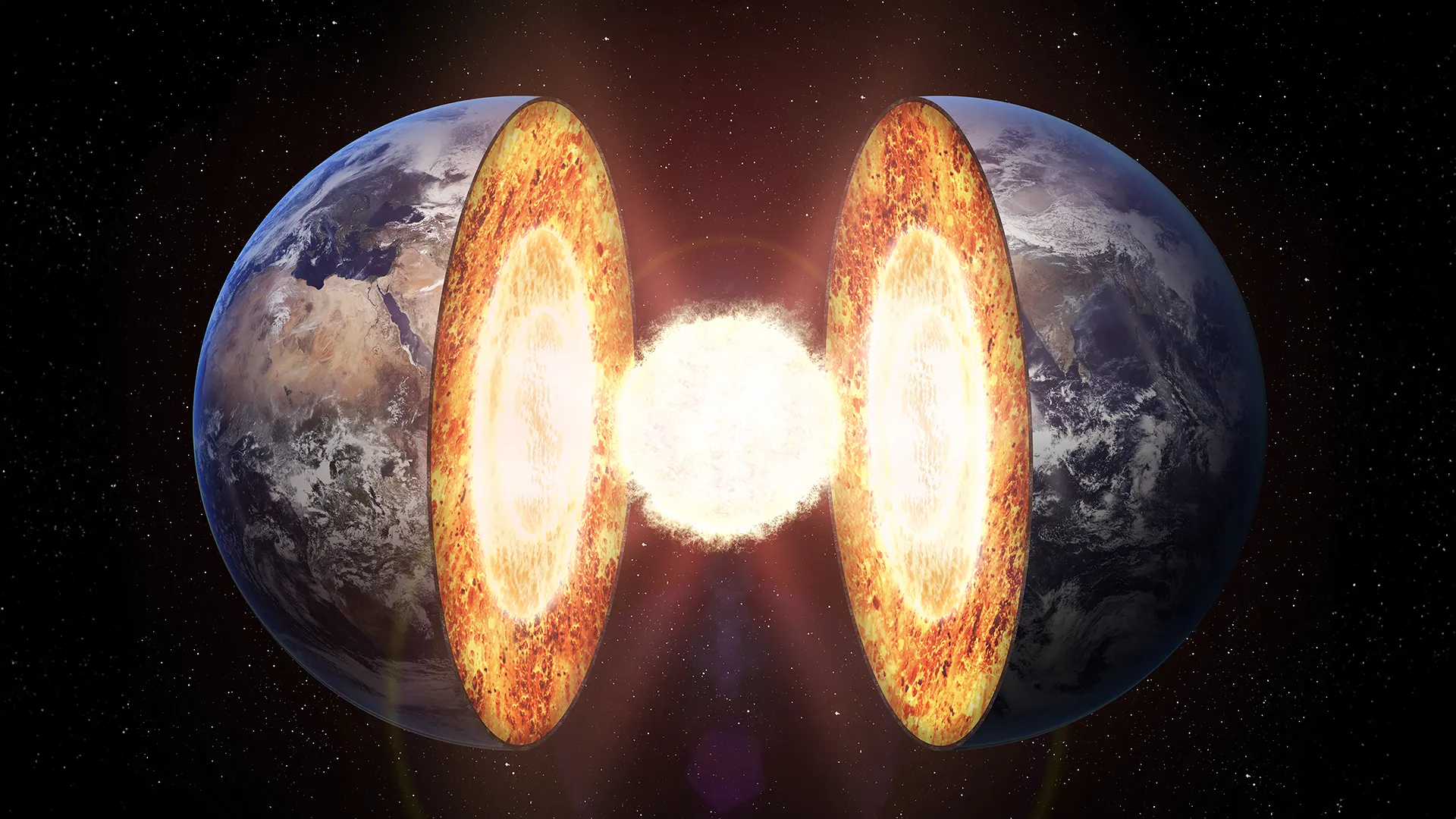
For over half a century, the region known as the D” layer, approximately 2700 kilometers below our feet, has puzzled geoscientists. Seismic waves exhibit unusual speed changes as they pass through this zone, hinting at a unique material composition. Now, research led by Motohiko Murakami, Professor of Experimental Mineral Physics at ETH Zurich, provides a crucial explanation.
In 2004, Murakami identified that perovskite, the dominant mineral in Earth’s lower mantle, transforms into post-perovskite under the extreme pressure and heat near the D” layer. Initial theories suggested this phase change accounted for the seismic wave acceleration, but further investigation proved it wasn’t the complete picture.
Utilizing advanced computer modeling, the team discovered that the orientation of post-perovskite crystals significantly impacts the mineral’s hardness. Seismic waves only accelerate when the crystals align in a uniform direction—precisely what is observed in the D” layer at that depth. Murakami subsequently validated this alignment through a unique laboratory experiment simulating the immense pressure and temperature conditions.
“We have finally found the last piece of the puzzle,”
—Motohiko Murakami, Professor of Experimental Mineral Physics at ETH Zurich
Convection Drives Crystal Alignment
The key to this alignment lies in the horizontal flow of solid mantle rock along the Earth’s core-mantle boundary. While scientists long suspected this convection current existed—similar to boiling water—direct proof remained elusive. This study provides experimental evidence confirming that solid rock indeed flows slowly but steadily at this immense depth.
This discovery isn’t just about solving a geological mystery; it fundamentally alters our understanding of Earth’s interior. According to the U.S. Geological Survey, approximately 1,350 volcanoes are potentially active worldwide, and understanding mantle dynamics is crucial for predicting volcanic eruptions and seismic activity. USGS Volcano Hazards
A New Era of Earth Research
Murakami and his team have demonstrated that mantle convection is a reality at the core-mantle boundary, solidifying the theory of flowing solid rock. This breakthrough opens new avenues for mapping currents within Earth’s deepest interior, potentially revealing the driving forces behind volcanoes, tectonic plates, and even the planet’s magnetic field.
“Our discovery shows that the Earth is not only active on the surface, but is also in motion deep inside,” explains the ETH professor. This knowledge marks a turning point, transforming assumptions into certainties and ushering in a new chapter in Earth research.
Researchers can now focus on visualizing the invisible engine powering our planet, gaining unprecedented insights into the complex processes shaping Earth’s surface and interior.
