
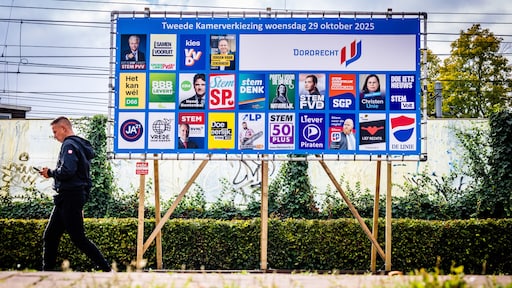
Navigating the Dutch Voting Aids: StemWijzer,Kieskompas,and CheckJeStem
As the Dutch elections approach,several online tools aim to help voters identify the party that best aligns with their views. These “voting aids” offer different approaches, and experts recommend using multiple to gain a thorough understanding. Here’s a breakdown of some popular options:
‘Check is stem’ and Focusing on Current Parliament
‘Check is stem‘ allows users to vote ‘for’ or ‘against’ specific motions. This provides insight into a party’s voting behavior. Similar to other aids, it primarily focuses on parties already represented in the House of Representatives, excluding newer parties not currently holding seats.
The Value of Multiple Tools
Political scientist Gijs Rademaker describes voting aids as “a nice tool” for those undecided between a few parties, helping to highlight key differences. Experts consistently advise consulting several aids, as their methodologies vary significantly.
StemWijzer vs. Kieskompas: Different Approaches to Nuance
Two of the most prominent tools are StemWijzer and Kieskompas. StemWijzer presents statements with three response options: ‘agree,’ ‘disagree,’ or ’neither.’ Kieskompas offers six options. Political scientist Simon Otjes notes that StemWijzer offers less room for nuance due to its limited response scale.
StemWijzer includes a broader range of parties – a total of 24 - including those not currently in the House of Representatives, making it suitable for voters interested in emerging political groups. kieskompas focuses on the fifteen parties currently represented in parliament, positioning users within a political landscape defined by two axes: left-right and conservative-progressive.
Understanding the Political Landscape with Kieskompas
Roderik Rekker, a political scientist, explains that kieskompas simplifies the political spectrum to these two dimensions – economic positioning and cultural values. He contrasts this with StemWijzer,which presents concrete,currently debated proposals. Rekker suggests kieskompas is most useful for those unsure of their general political leaning, while most voters likely already have a sense of their position on the left-right and progressive-conservative scales.
Jeroen van Lindert, project manager at Kieskompas, emphasizes that the tool doesn’t offer direct voting advice. Instead, it allows users to visualize their position within the political landscape and explore parties in proximity to their views.
Distinguishing Between Parties: The StemWijzer Advantage
Otjes highlights StemWijzer’s ability to differentiate between parties with similar platforms. He uses the example of JA21 and the VVD, noting that StemWijzer includes statements specifically designed to reveal subtle differences and help voters determine which party better reflects their views.
The Role of Nuance: Sliders and Subjectivity
Some voting aids utilize sliders instead of simple ‘agree’ or ‘disagree’ options, allowing voters to express the degree of their agreement. While Rademaker acknowledges the benefit of added nuance, Otjes questions its necessity, suggesting the difference between, for example, 55% and 63% agreement may be insignificant and subjective.
Critical Evaluation: Who is Responsible for the Details?
Before using any voting aid,it’s crucial to consider its origins and methodology. The Voting Guide relies on parties to provide their own answers, while Kieskompas’s team is responsible for positioning parties within the compass.Otjes points out that the latter approach is “less easy to manipulate.”
